Jodi Hays at Visual Questions has a chit chat with Hamlet who was a big, early influence on her.
#hamlettdobbins

Jodi Hays at Visual Questions has a chit chat with Hamlet who was a big, early influence on her.
#hamlettdobbins
Tara Escolin visits the Atlanta-based studio of Jackson Markovic to discuss his practice of analogue photography and documenting Atlanta’s dance scene. I certainly don’t think he would call himself an abstractionist, and some of this work is definitely nonfigurative. I’m guessing most readers are also familiar with Jeffrey Gibson, another queer artist whose work ties into dance music. Jackson also did a review himself recently of Ross Landberger, another photographer pushing materials. And yeah I do love some photography, with a bent that won’t be surprising.
More
#jacksonmarkovic

I’m sure you’ve read about the Cloud Dancer controversy (maybe you’ve seen it framed as a dog whistle to our current, white nationalist administration). As usual I’ll note that two things can both be true- Pantone can be not-ill intentioned and tone deaf. All I see is editors and marketing folks (on all sides) who want clicks and likes but maybe that’s just me. And…
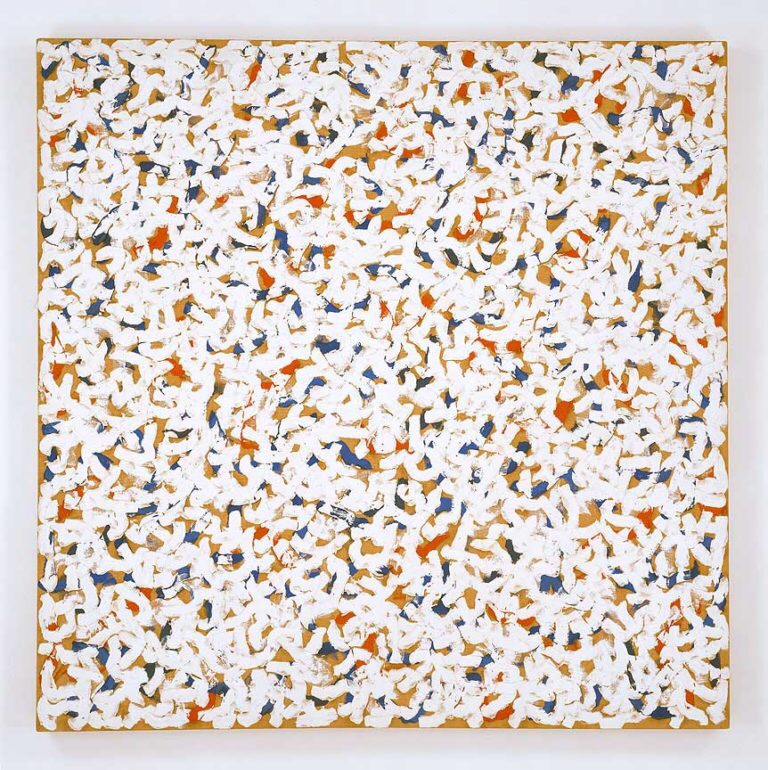
White and white-adjacent hues in the context of Art make me think of Robert. I initially blogged about him with the news that Ryman had passed, and took a little time to reflect on my reactions to his work over the years. This interview from 2007 is helpful. I also made a Pinterest gallery of some of his work.
Here’s an early work from right around the time he really found his voice (’62). Thanks for helping me learn to see Mr Ryman!
#robertryman
I have a full-time job in clean energy. In a prior manifestation of this career, I used to travel a lot, many times to Biloxi Mississippi to call on the local utility. I’ve vividly remember the “Hurricane Katrina high watermark” line painted on the wall in the lobby of the Holiday Inn on the waterfront, 400 yards from the ocean that previously had viciously swallowed this small City.
So when I saw that Merin McDivitt had reviewed Molly Sawyer: Through the Light, a material response to the aftermath of Tropical Storm Helene, at the Spartanburg Art Museum, I immediately read it, and so should you
#mollysawyer
Nnena is the 2025 winner of the Turner Prize. She is the first learning-disabled artist to win. Born in Glasgow in 1966 to Nigerian parents, Kalu is known for sculptures resembling cocoon-like forms that she strews with videotape, cellophane, and other unconventional materials.
#nnenakalu

I hope if you’re in the Bay Area you’ve seen Muzae’s newest at pt. 2 Gallery. Juxtapoz had words about his practice several times. The paintings are really something else (I’ve seen a couple irl- this post is a revisit also).
More (IG)
#muzaesesay

Artsy recently asked Jeffrey Gibson to list 10 Native American artists to watch. employs acrylic polymer, reindeer hair, acid-free Mylar, nylon thread, and steel pins to evoke animal skin and guts.
He also mentions Caroline and Teresa.
#sonyakellihercombs

Hello, readers. I wish that this year included some high notes for you. For me, there were several of them, which I’ll share a tad ’bout below. If you’ve been a reader for a minute (and thank you!) there are links to prior iterations of this now recurring, annual effort to give snaps to our wonderful, local Art scene.
A few notes before we begin- these are not in order of preference or ranked. Als0, in the prior three iterations I’ve written about ten exhibits but this year I’ve expanded to 12 so there’s one for each month, maybe? I mean, *I* make the rules around these parts so it doesn’t *really* matter. Anyway, last but not least I want to note that while I clearly consider my opinion valuable enough to document it, no critic ever writes or talks about anything other than what moves them. There were clearly lots of exhibits that happened this year that aren’t included in this article, that took effort by curators and artists alike, and let’s all just take a moment to appreciate how lucky we are. Amen. Shall we begin?
Although you can’t find Critter on the IG, I hope you found Mid Career at Lump . If you saw this one once you didn’t see its totality- it evolved multiple times over almost two months, taking up both sides of our favorite artist-run gallery. If you love word play and clever Art historical references wrapped up in nods to pop culture, this giant work of Art probably (like me) pulled you back several times. As with all great shows there were lots of tiny gifts, like Critter’s journals of observed/overhead comments that also found their way into several of the works. Although I said these are in no particular order, I am putting Lump first because they deserve a big shout out. What a particularly strong year of programming from them- it would have been easy to put more than one of their exhibits on this list. I really hope they keep hosting the UNC-CH MFA thesis shows in particular (I think we will be seeing more from all four of the recent grads from that program btw).

We are really lucky that Rigoberto Mena decided to relocate here from Florida. He had the limelight a couple of times this year, and Skin of the City at Raleigh’s Contemporary Art Museum was, I think, their best painting show. While this one was unfortunately only up for a few weeks before CAM unceremoniously shut down this summer, I went a couple of times to sit with them and found their “skin” belies their complexity. I find it to be a real gift to have someone from Rigoberto’s sensibility among us- the mode of painting on display was a visceral counterpoint to the heavily intellectual work that pours out of American grad schools. The paintings are vigorously, physically wrought, and sit in stillness waiting for the gift of our attention, like the skin of Mena’s beloved Havana. Sorry to not have a link to this show- it’s really too bad CAM can’t be bothered to archive their exhibitions, but I imagine most of us have criticism for the lack of vision or mission over there of late. A real tragedy as the venue, with its superb location, flexibility and variety of spaces as well as excellent programming will be missed if they cannot find a way through and out the other side of their challenges.

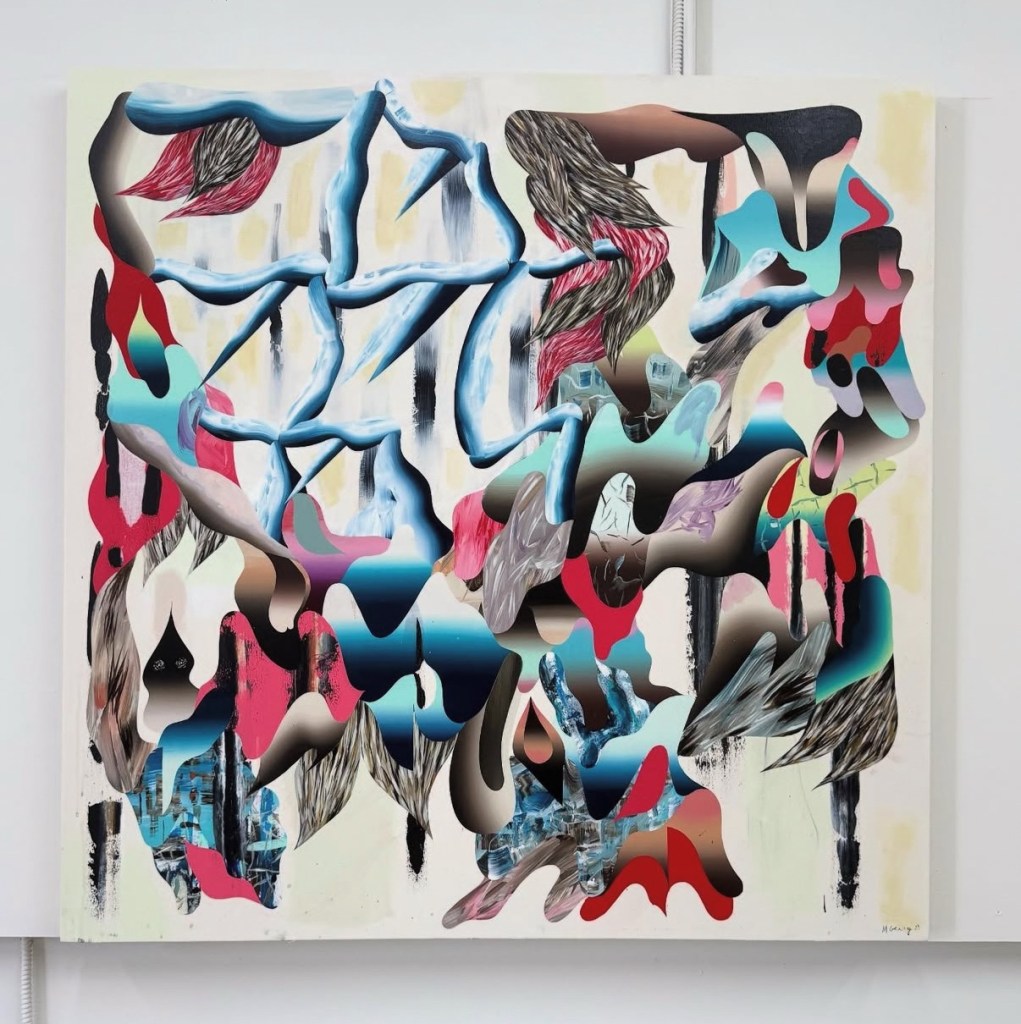
Martha Thorn and Mike Geary Strange Attractors at Birdland gave us the opportunity to get lost. The work was strange, in the best of ways, and I do love a clever word play, in this case one where the title is primarily a reference to complex fractals- who knows what structure if any underlies the work (frankly the author doesn’t care). With the typical layers and layers of masked and re-masked visual planes painted in the wild, acid trip colors both artists are prone to, I had to hit this one up a couple of times also. BTW, Birldand is definitely the best “new” space in the area, although I admit a bit of bias as I was able to be part of an exhibit there over the summer (village impulse). Glad to see VAE not only rebooting as an organization, but also taking over directing this venue, to make sure the programming stays top shelf.
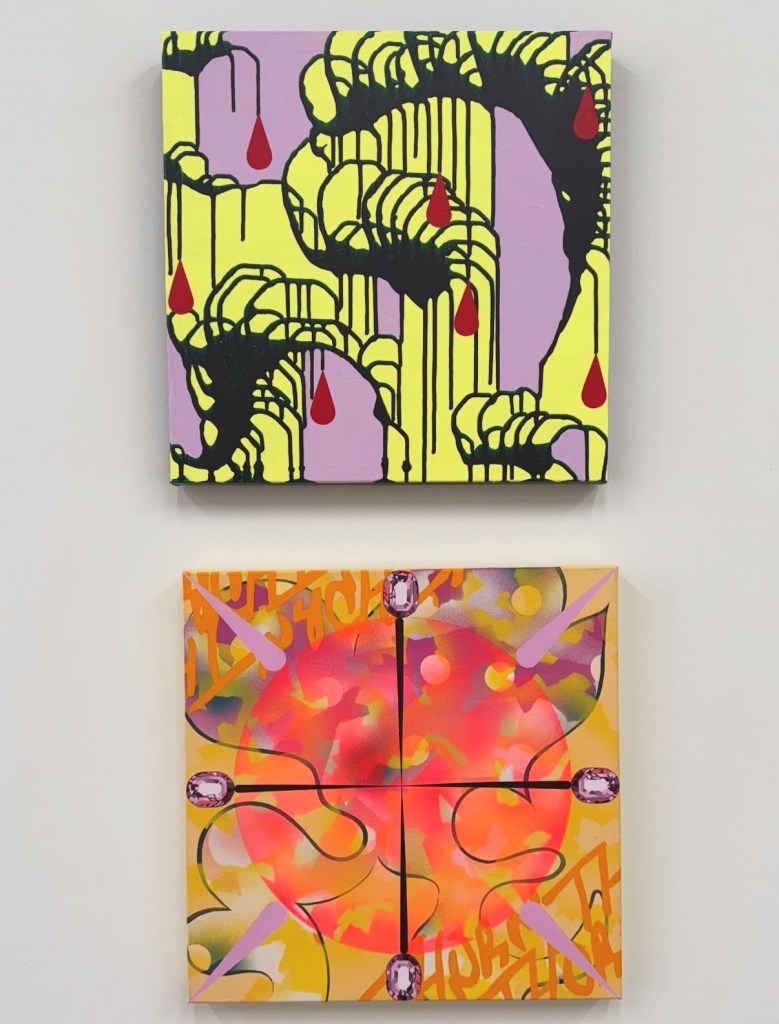
Humans Being at Satellite, which at the time was around the corner from Birdland but is now over on Poole Road, featured Christine Randolph, Bob Ray, Allen Lee and John Samosky, and matched scale to venue. Small works in a small space- not that the show or its contents felt small. Salon format doesn’t work for every show or in every space, but it did here; juxtaposing the works with no hierarchy made their surreal contents more surreal by context. The density also served, I thought, the function of making visitors “be.” There are a lot of things humans can be, among them imaginative and creative, in particular of new or at least other worlds. I hope we can all share and enjoy these types of journeys- envisioning is a gift that artists can give right now that the world sorely needs.

Movements by Maria Britton brought together both paper-based objects and wall-hanging ones made of found and painted materials. It’s not every artist that can or even will move between modalities, and while the pedestal and wall works had a nice dialogue it’s clear one is not a warmed-over rehash of the other- they stand on their own, literally in the case of the wacky paper objects. As comfortable and fun as it would be for me to focus on some art historical references I see in the work, it feels very much like Maria is making up and and using the forms that resonate for them outside of a concern for any echoes. Also, it was a lot of work. Well done, as always, Anchorlight.

Renzo Ortega WAR at Artspace (link is to a pdf) brought (back) together paintings from 2000-2003 and was another painting tour-de-force. Ortega is another Latin American expat that we are fortunate calls the Triangle home. This work… hit on another level for me. I remember the Gulf War era as something that, at the time, felt like a low point in terms of my alignment with a lot of my fellow Americans, who cheered our country’s blatantly imperialist adventurism which got turned up to 10 by the neocon crowd (and yeah, *that* feels like something I’d almost welcome today). It’s an era that feels forever ago in the age of instant news that was also just being born at the time- remember watching live action War? Fucked up, right? Expressionism is an oft overused term and fitting here, both as a description and a mode of making. Really, really powerful work.

Martha Clippinger at The Orenge (courtesy Art Suite) is my wink-wink betcha didn’t know entry for this year . Orenge is a “venue” I feel like is not on the map for a lot of folks and honestly can’t remember how I got the word about this one. Martha was, as usual, clearly working with “painterly” concerns, and the material reality of the work (fiber) changes what that means. Maybe we’re (finally) in a time where observations like aren’t necessary, and it feels material (haha) to nod that way. People familiar with Martha’s practice know that collaboration with other makers is a part of her strategy; and, fiber art in general, even as it lives as a fine art object, when located in a commercial space, repositions the possibility for how Art intersects life. Regular readers know I’m into many ideas we inherited from Modernism so you’re likely not surprised to see my shouting out someone living that in real time. Also, Art Suite should do more pop-ups, their “stable” has some real NC heavyweights and they should find ways to showcase like this more often.
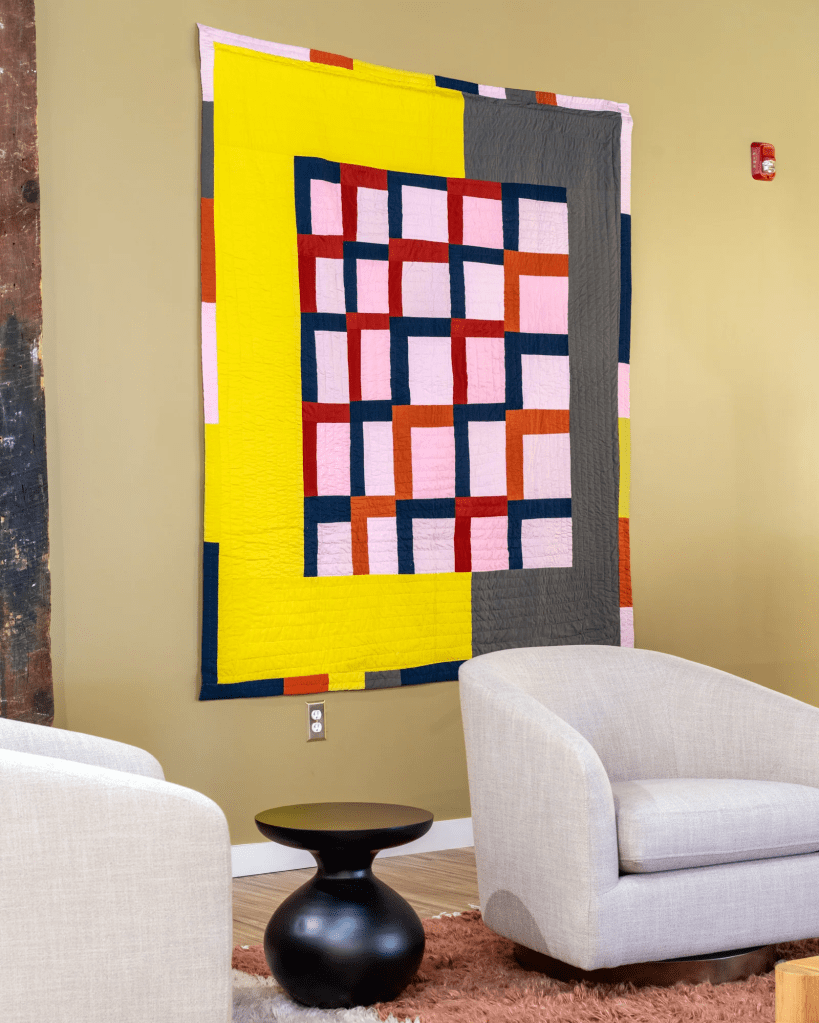
Staying with geometric/grid-oriented abstraction, I absolutely want to shout out Freddie Bell (we weren’t) built for this at DAG, in their good gallery (the one at Golden Belt; not sure why they didn’t archive this exhibition, so, no link…). Scale is super critical with non-figurative painting and the size of these works was very well thought out. The paintings were clearly about optics and not fussiness, and their small-ish scale emphasized the artist’s hand and the viewer’s eye- below is a detail to show you a little more about what I mean. There were also some wonderful assemblages in this show, painstakingly assembled out of painting that was made, destroyed, and reassembled on up-cycled, non-traditional support surfaces. Freddie’s practice in general is attentive to the relationship of our bodies to, well, everything… and they expand beyond objects into body movement among other things. Continue to keep an eye on what Freddie is up to (new works are dynamite)!

Jerstin Crosby PAUSE at Oneoneone is my personal, favorite work by this Artist to date- I’ll argue it’s definitively his most developed and relevant as well. I’m probably breaking some type of rule writing about another creative that has curated me into an exhibit and vice versa but like I said, I’m making the rules around here. There was definitely a (past) cultural moment where this show might have come off as cool hipsterism, but 2025 is not that moment, in fact the opposite. There is a sincerity at work here that the surface level of coolness belies for the casual observer. This isn’t just “yeah for the handmade in the age of AI” (although yeah I feel that). (As Jerstin said in the show statement) “I recall a time when society felt bound together by shared cultural underpinnings” and, clearly, the artist’s impulse to “pause” in this time of information acceleration really landed for me in the context of a longing for shared purpose and a sort of… if not contentment, at least belief that we shared the same reality. Super clever use of materials as well. Glad we have this space as part of our ecosystem in the Triangle, and its sister, Light Art + Design.

Skully Gustafson imagined Upon a Wand and we were all fortunate to get to see these paintings at Peel, another Chapel Hill stalwart around the corner from Oneoneone. A good blend of what we’ve come to expect from Gustafson compositionally (seriously flippant, with lots of “emotional mayhem”), the newer work, I felt, found a way to maintain the same spirit and embrace some luscious painterliness without giving up any of the “devil may care” vibe. Also glitter.

Karen Rose Border Paintings at Diamante is another show I didn’t hear enough of you talk about and you flat missed out if you did. I love the trick in the title. These scenes are not the border of the US at all, as one would expect in 2025, and in fact not even necessarily borders or even countries from which immigration by Latinos to the US is occurring. I felt it was more than clever to point in such an almost heavy handed but misdirected way to create (I hope…) pause for the audience. The strong horizontals which are clearly “of” landscape combined with non-mimetic color that is still representational (of emotional state) were so choice. No surprise that Peter Marin has a great eye for painting.
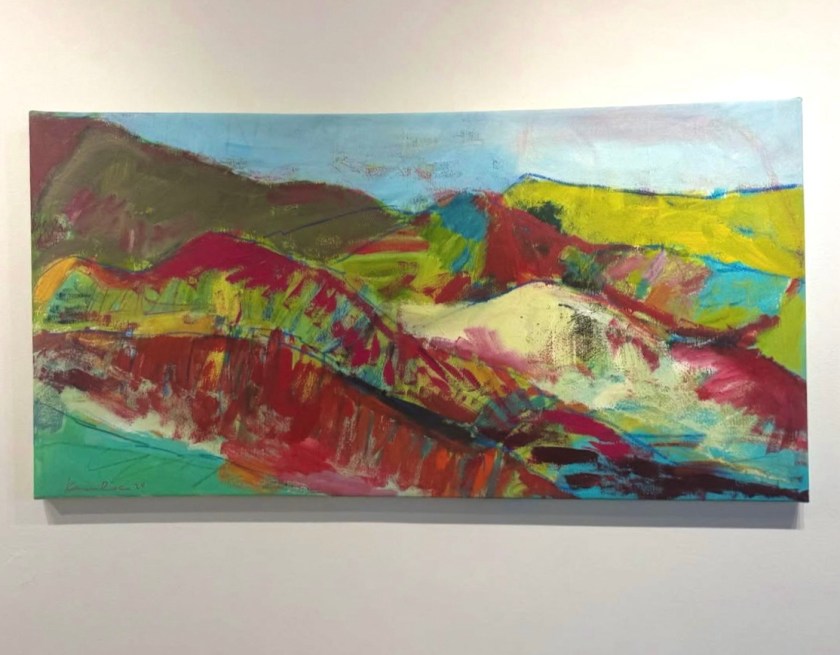
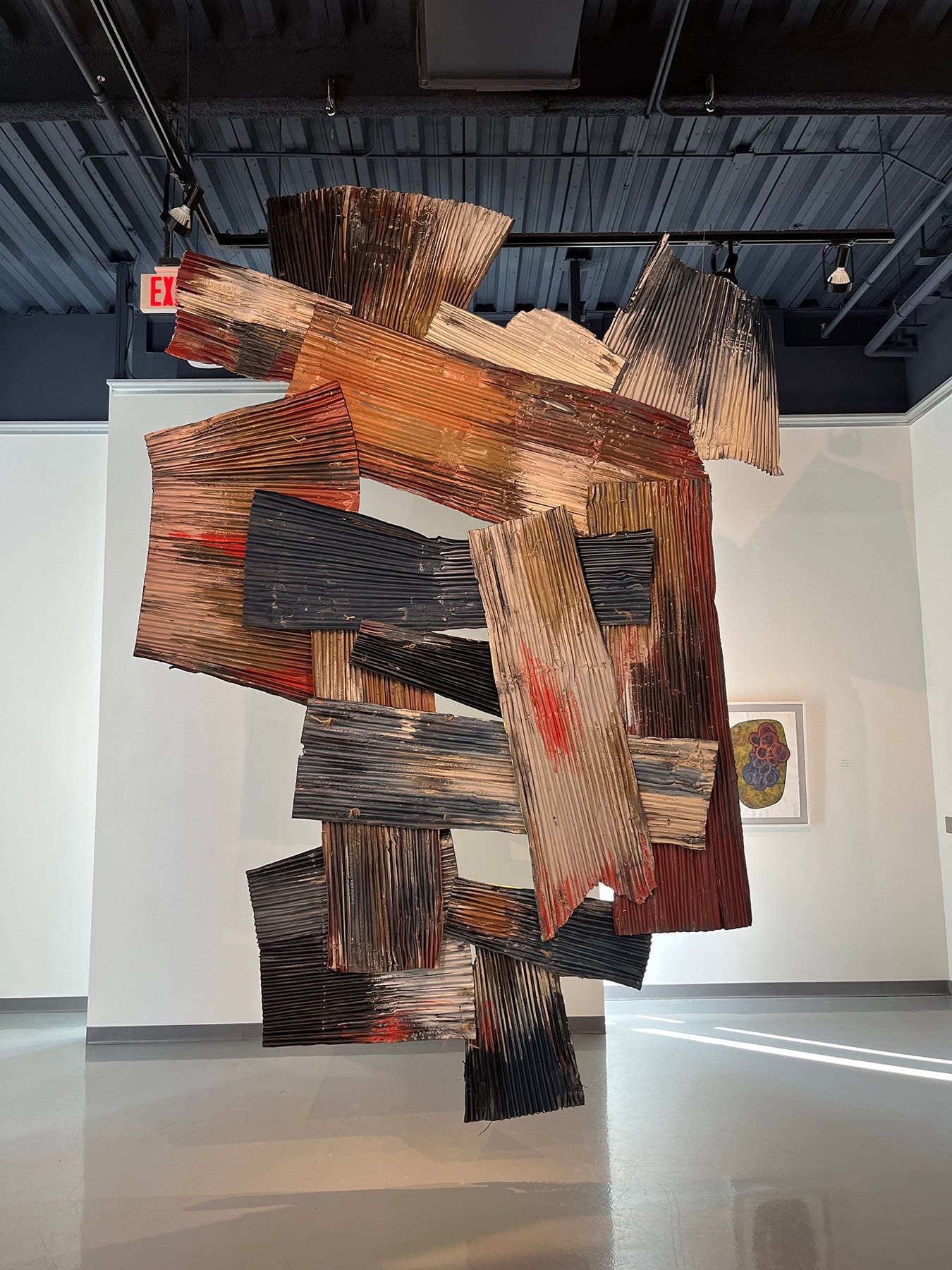
Julie Anne Greenberg Charting the Uncertain at Meredith College’s Frankie G. Weems Gallery was one of several solid performances they hosted (well done Todd Jones). If you think below is reminiscent of a hurricane you wouldn’t be far off, in a sense- the artist says “just as meteorologists attempt to predict the weather, humans hopelessly attempt to forecast their own lives.” Made of modular elements that give Greenberg almost infinite possibilities, the work exists in a space not between Art and “the natural” but of them both. The objects recall petals, or bark, and clearly Art- almost like brushstrokes. Fantastic and fantastical, and both somber and optimistic. More, please!

When I’ve put together these “year in review” previously, I’ve noted that (I think) one should consider museum exhibits in a separate category from exhibits by smaller, collection- and endowment-less (and often staff-less) institutions, so I’ll repeat that approach this year as well. My preference for abstraction noted, the museum exhibit that did “it” best for me was, hands down, Grace Hartigan: The Gift of Attention at NCMA. In addition to the importance for this exhibit that Hartigan, while canonized, is not widely and often celebrated, the show also introduced viewers to poets Daisy Aldan, Barbara Guest, James Merrill, Frank O’Hara, and James Schuyler. Their work deeply inspired Hartigan, in particular their rebellious spirit, including (and likely because) many of them were queer during a time when this was almost unthinkable, which is in itself, sort of unthinkable. Powerful work and words, organized by curator Jared Ladesma who NCMA should green light to do much more, within and outside of the collection as far as this writer is concerned.

Fuck you guys fucking rock. Let’s go 2026!!!
was a founding member of Supports/Surfaces, known for questioning pictorial illusionism with unmounted stretchers, flexible ladders, and assemblages of collected objects. He is represented by Ceysson & Bénétière.
#danieldezeuze

Karl at Whitehot has words about Georg’s chromatic logic (in the context of a recent, posthumous exhibit of the German artist’s work at Nino Mier Gallery.) Rising through the hard-edge movement after World War II, his work pivoted between Bauhaus experimentalism and New York’s emergent formalist abstraction.
More (estate IG)
#georgkarlpfahler
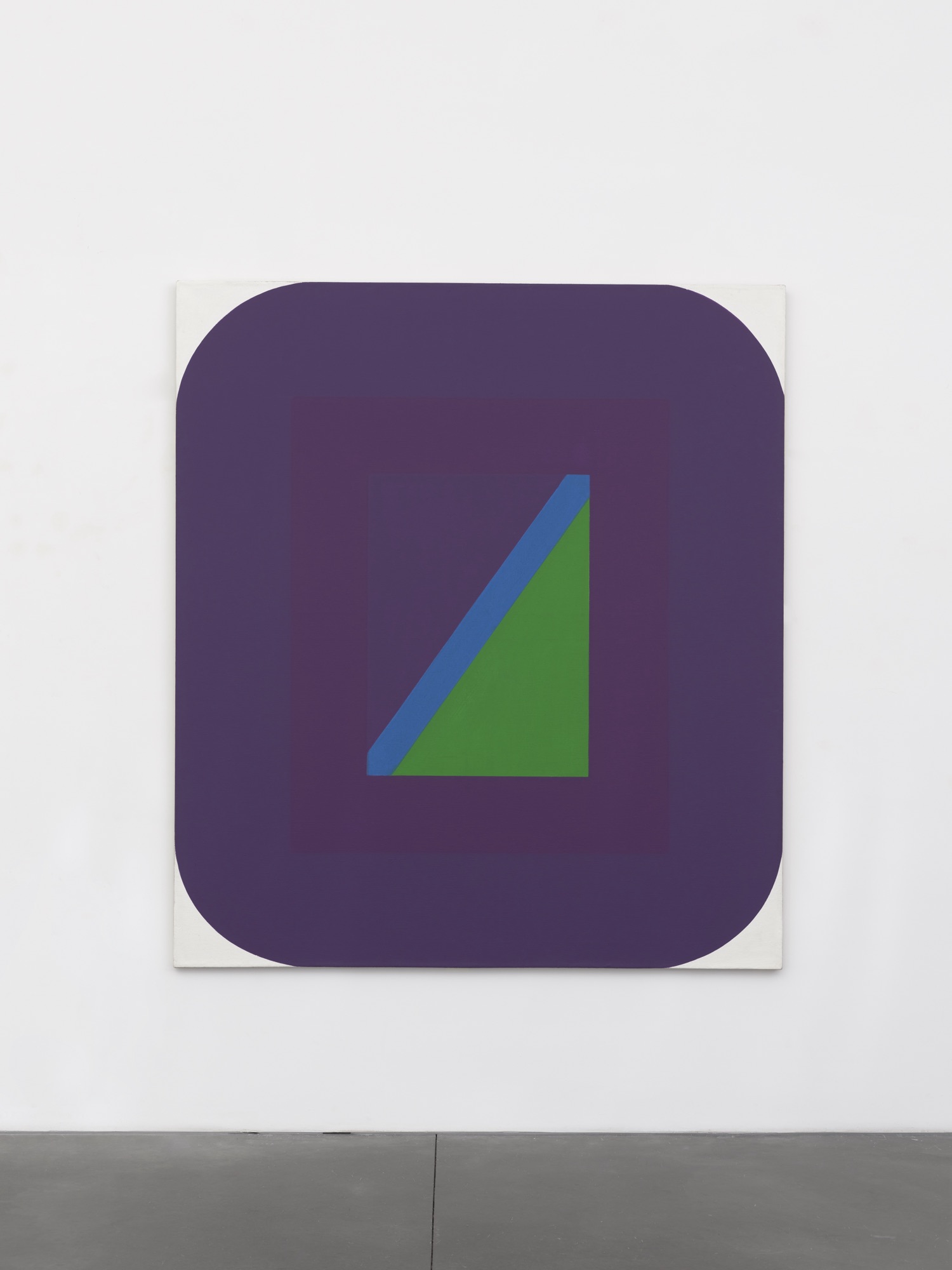
Jonathan Stevenson discusses Stephanie’s “coolly seductive” paintings on display at Kevin Kavanagh Gallery in Dublin. Below is one of many titled “Emotional Calculus” like the show itself. He notes that, in “due course, the paintings reveal deeper intent, which is to complicate and enrich your ultimate apprehension of the presumptively simple life.”
#stephaniedeady

I first wrote about Timothy when BmoreArt noted the “systematic rigor” in States of Mind in 2021.
Updating the blog as he recently passed. If you have a moment and need some sad but uplifting prose read Cara Ober’s homage to this artist and teacher.
#timothyapp
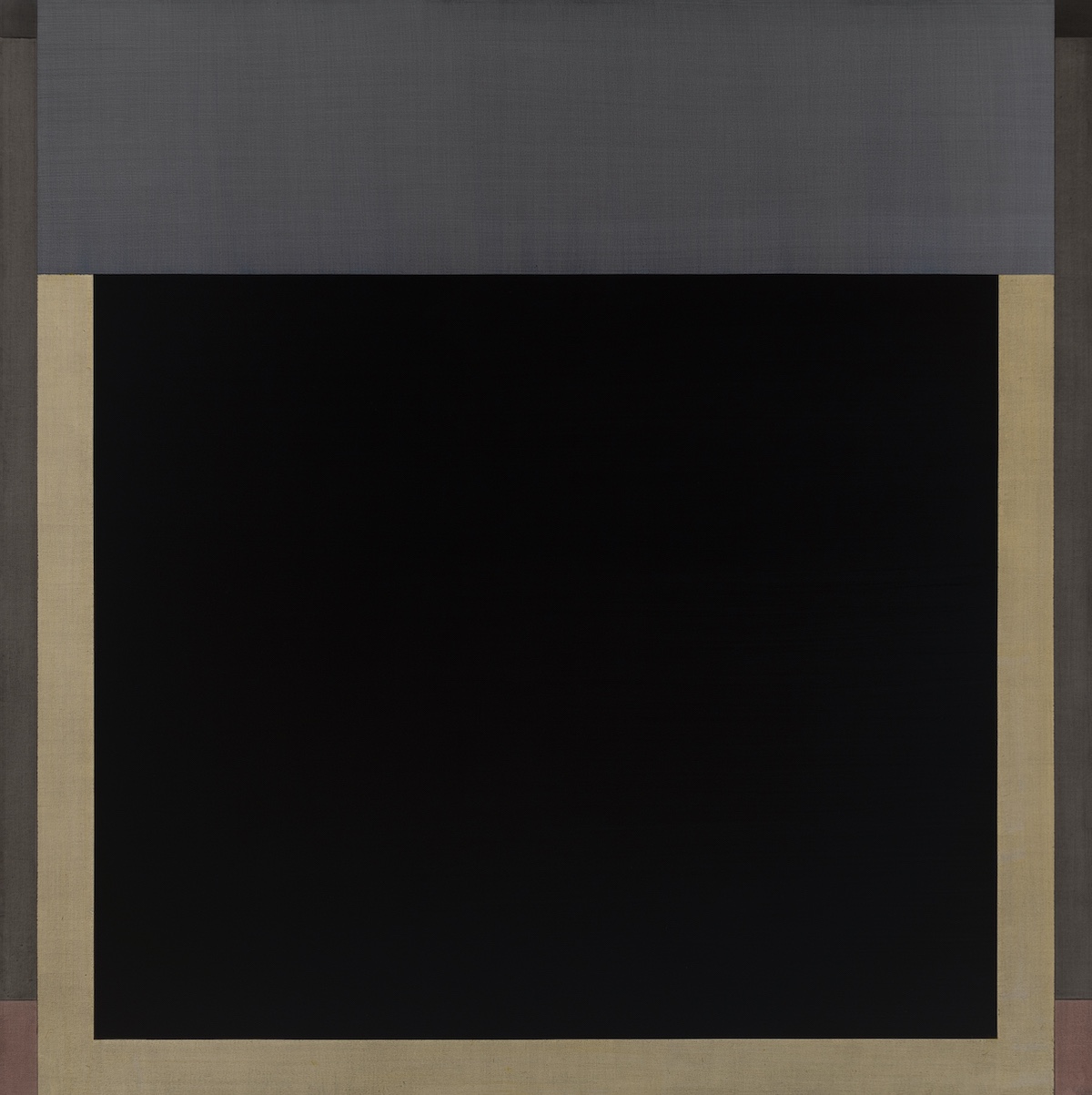
I wasn’t familiar with Allie until I saw below in an ArtNews article about updates to the Detroit Institute of Art’s collection*.
Allie McGhee has been a leading figure in the Detroit art scene since the 1960s. Initially a figurative painter, McGhee moved away from representation and toward the more universal abstract language he is best known for today. His mixed-media paintings, including sculptural works in which he folds, bends, and crumples the canvas, are notable for their signature arcing forms and brilliant washes of color.
*The DIA was among the first museums anywhere to build and exhibit a collection of African American art, which it began in 1943. In 2001 it became the first US museum to name a curator devoted to that field in Valerie J. Mercer, who still serves as the museum’s curator and head of African American art.
#alliemcghee


 Painting After Art is Dead