This is certainly a well worn topic of discussion among creatives. Definitely one of the main reasons my awareness of it is raised this week is the opening of the exhibit Open Source, an exhibit which I curated, at Wilma Daniels gallery in Wilmington, NC. Central to the show is the idea that not only the literal material of the work but also its content can have a multitude of sources. I would say my relationships with the artists are source material for me as well.
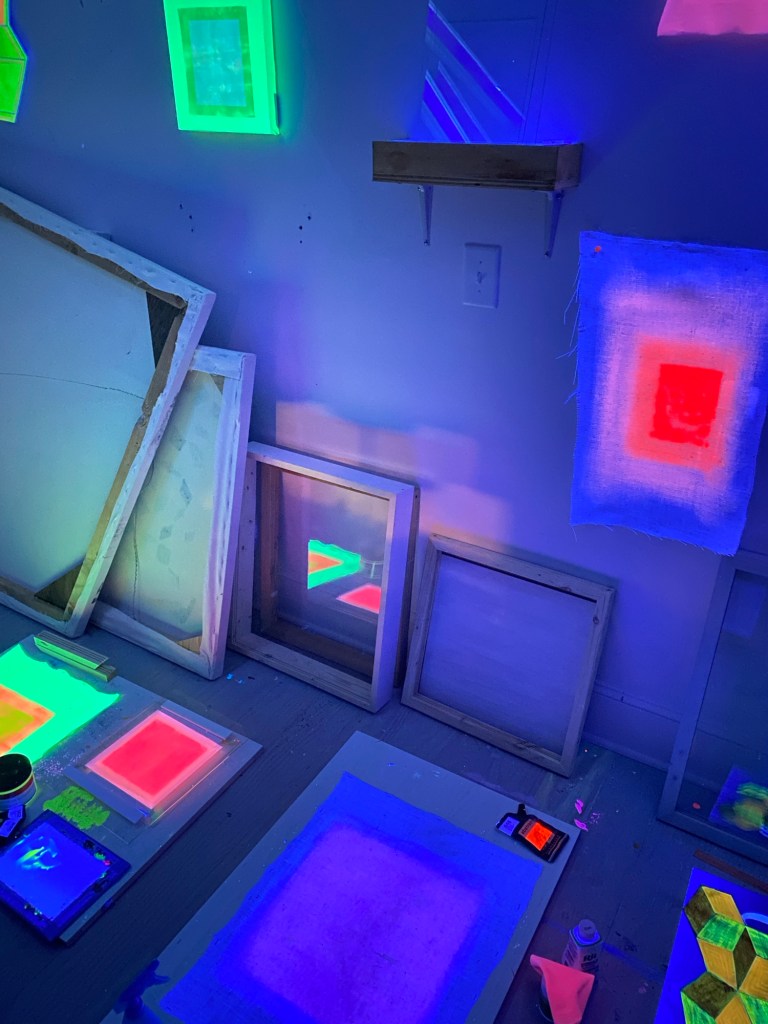
A number of you have asked about the object making part of my practice recently (we all do this- “watcha workin’ on?”) and my answer has been “material studies.” Which is to say there are new-ish sources at play (yeah I am using that noun on purpose). I feel a pull from the material itself to highlight their more physical qualities more (glass, wood, non-canvas surfaces, even paint is now more obviously dimensional and plastic) while composition becomes more optical (simplified compositions focused on color and in many cases leveraging light as a “material”). Which isn’t intellectual or even really an idea, it’s an impulse.
I noted this direction in an Instagram post this weekend where I pointed to a loose tie between a recent study, a book about Clyfford and a couple of photos.
An Instagram post by Nick Aguayo also really resonated for me. (I think) he notes the source of work can actually be a somewhat mysterious to (even) the artist, that its general direction can trusted- its “point” doesn’t have to be that all aspects are formed and understood:
“I am deeply interested in color and experimenting with it, but I think that the deeper concern of the work is a matter of structure and meditating on how the making of something in itself can carry a certain energy and attitude towards looking at the world.”
So for now I’ll continue to accept many inputs and trust my fascination with materials as one of the same.
Knot’s work center around the exploration of light and color, with a notable series being “Colliding Colors.” This ongoing project delves into the complex interplay between colors of light and their profound impact on human perception.
#sebastiaanknot
is currently included EQ in the 2024 II International Biennial of Contemporary Fibre Art at the Museum of Embroidery and Textiles in Valtopina, Perugia, Italy.
Hyperallergic notes that amid a rise in waste dumping, artist Ethan Primason gives discarded items new lives, working intuitively until he finds their new form. More
Jesús was a pioneer of the idea that a viewer could actually walk into an artwork and experience it from the inside, something we now take for granted, but which was revolutionary in its time. Born in Venezuela, it was in Paris in the 1950s that he immersed himself in the movements that were transforming Geometric Abstraction by using effects of motion and movement to bring artworks to life: literally, as in Kinetic Art, or metaphorically, as in Op Art, in which paintings or sculptures appear to be moving due to visual trickery. His works were realized on increasingly grand scales, so that eventually viewers could move within and throughout his vast sculptural forms. This made his work perfect for realization as grand public art, and so his legacy is visible across many cityscapes today.
Maria (who shows with David Castillo) has developed an index of color relations to determine specific emotions, memories and spirituality. The colors can be autonomous or have a new meaning altogether when encountering other colors and the forms they inhabit. The artist’s work is about the history of her body (a Cuban born body) in a permanent state of displacement and exile. Her paintings try to express the state in which this happens. They are about the inability to belong in any defined structure.
Howard is associated with Color Field painting and the Washington Color School (which included Sam and Alma among others) and the artists at Jefferson Place Gallery.
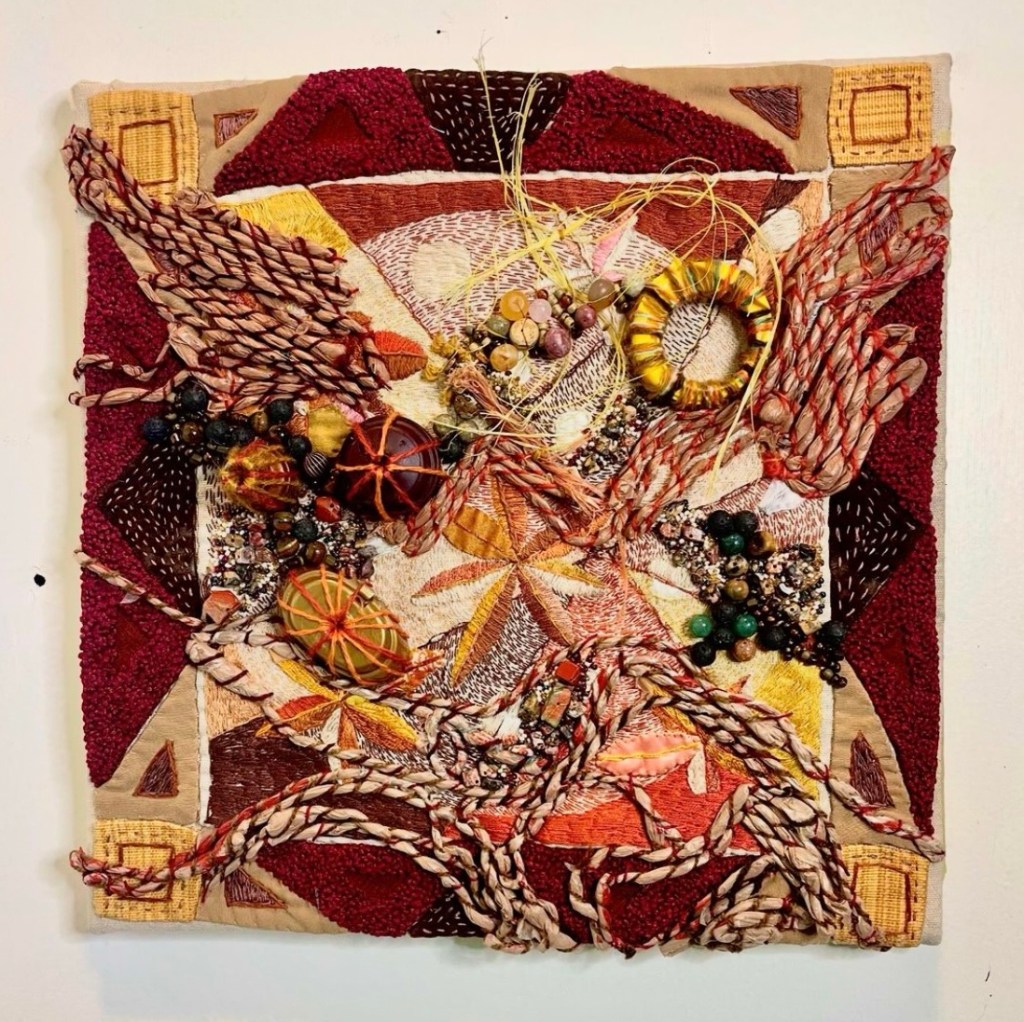
is currently showing Precarious Habitats at Meredith University’s Weems Gallery. Ferreira’s work incorporates thread, yarn, found, and heirloom fabrics, as well as a variety of repurposed materials, such as plastics, to create sculptural embroidered paintings.
are what’s on my mind as I sit down to write my bi-monthly update to you my regular readers, and btw, speaking of relationships, thank *you* for showing up to support my practice.
I’ve mentioned on this blog and probably to many of you in person that I have a whole, additional professional practice in clean energy. I’m proud of what I can literally point to (from consumers who now use efficient lighting to large, solar photovoltaic generators) that I’ve accomplished in that part of my life, which I attribute to my efforts to forge strong relationship (tldr; I’m in sales/BD). And, recent changes in the market have necessitated that I begin a search for my next role, which I sort of teased a while back. The search has given me the opportunity to reconnect with some great people that are doing important work to decarbonize our electric grid- it’s been edifying on a number of levels and has lead to some new friendships as well that I already cherish dearly. And, my relationship with my current team, in particular our shared value of honesty, has helped immeasurably as we have had to navigate a totally surreal and frustrating set of circumstances.
I’ve tried to foster openness and honesty in relationships in general. None more central and crucial to my wellbeing than my spouse. There have been some health challenges in our household in the last week that have strained my ability to manage my ADHD-fueled general anxiety disorder (that’s not an excuse, it’s normalizing mental health challenges), and without a robust set of language around mental health and a prioritization of boundaries a stressful week could have spiraled into a disaster (not that it was easy at all points, probably obviously since I’m pointing at the thing). Love you, babe.
The next, big thing happening in my art practice is all about relationships, too, specifically the 6 amazing creatives listed on the announcement below. That’s right- Open Source part II opens very soon. I’m beyond grateful to have these people in my orbit, in particular as several of them have made time to jump in and take over coordination or tasks that would normally fall to the curator, even though they obviously have lives as well. Conversely, timing for this show hasn’t been great for a few of us and, I think, it’s the trust from solid relationships that has enabled us to negotiate how to distribute work and help reach our collective finish line.
Also, the show foregrounds, for me, the relationship that curating has to my practice, and in general is an attempt to highlight several relationships: that of contemporary practitioners to both history and this moment in time; the relationship of object-making to culture generally; and the positioning of the viewers of this work as central to the “content” that non-figurative work creates and embodies…
Open source, in the world of software code (the hidden structure of much of the world as we view it) is source material that is made freely available for possible modification and redistribution. Open source is a decentralized software development model that encourages open collaboration. At our current point in the history of making Art, there is also a decentralized framework within which abstract artwork can be and is made. No single artist or group owns the source of meaning for this modality, and a wide range of collaborations with and utilizations of the elements developed out of the historical canon is possible, as well as incorporation of content and materials from outside that world. In the space needed for and occupied by abstraction, an openness is required, for creator and audience. The artist must be open to the ways in which the source materials of the work, including subjective content, inform decisions about everything from composition to titles. And the audience must be open as well since abstraction’s signifiers (color, shape, surface) are non-literal.
Saw below recently at the High Museum. His most recent works (which include below) have an all-over composition suggestive of biological growth and the patterning of nature.
John is one of many important creatives that John Yau helps us rediscover in Please Wait By the Coatroom. Spanning from the 1960s through the present, Pai’s active artistic practice could be viewed as a continuing process of evolution whereby the artist connects one fundamental unit to another, and another, facilitating an incremental ritual of accretion where a new whole emerges, one that has been informed by the artist’s exploration of his subconscious, memories, and myriad interdisciplinary interests traversing music, science, Eastern philosophy, and literature.







 Painting After Art is Dead