is represented by Carrie Haddad. Her work “has always been anchored in drawing.”
#jennynelson

is represented by D’Arcy Simpson. His process is to make small color paintings on panels and then combine them to create life-sized compositions.
#michaellarrysimpson
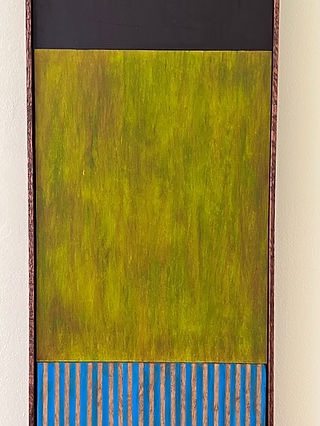
D’Arcy Simpson Art Works says of Joseph “The dense and textured canvases of Joseph Stabilito’s new body of work swirl with elements of anatomy, astronomy, technology and biology. He has created a vocabulary of marks and motifs that create expansive universes, depicting the conscious and unconscious states of human experience. “
more
#josephstabilito
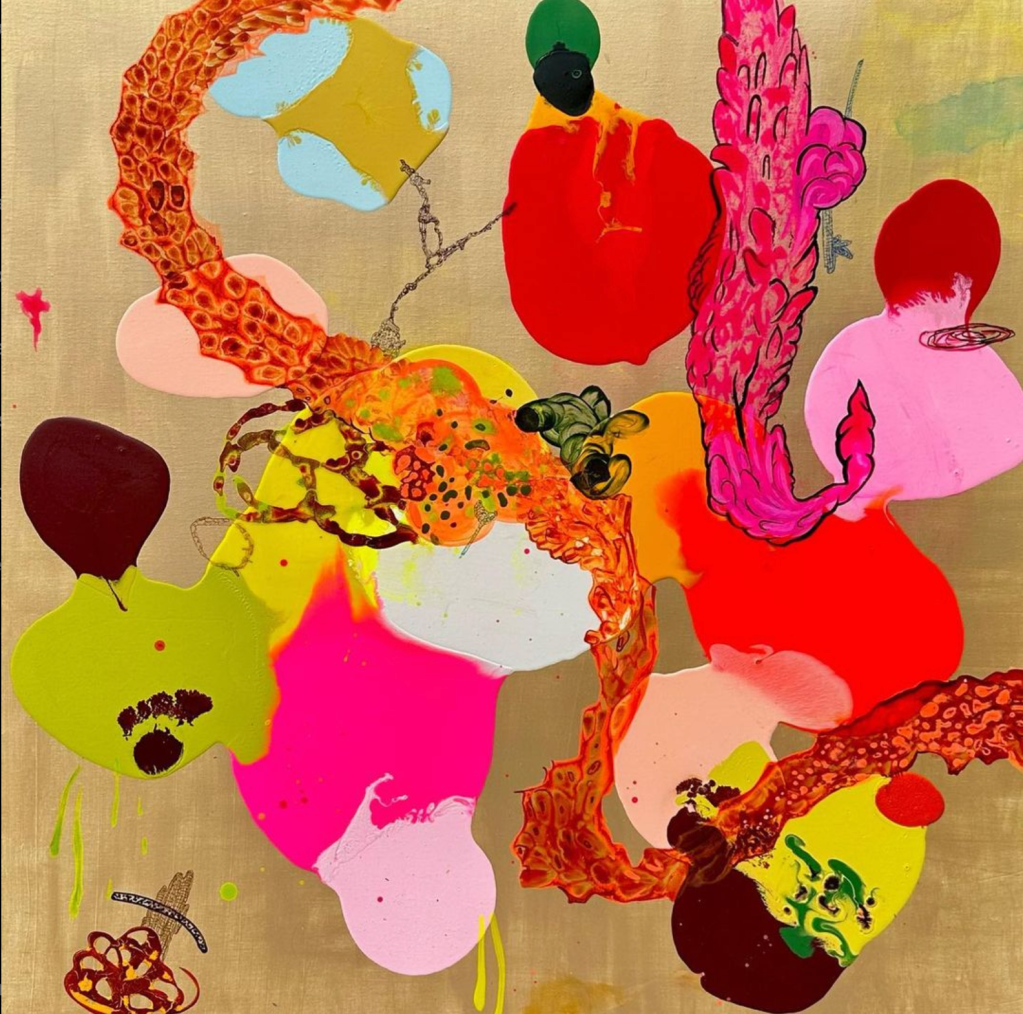
In his most recent exhibition, Federico Herrero once again suggested open questions about what landscape could mean, but also formulated an evolving proposal of what already exists.
#federicoherrero
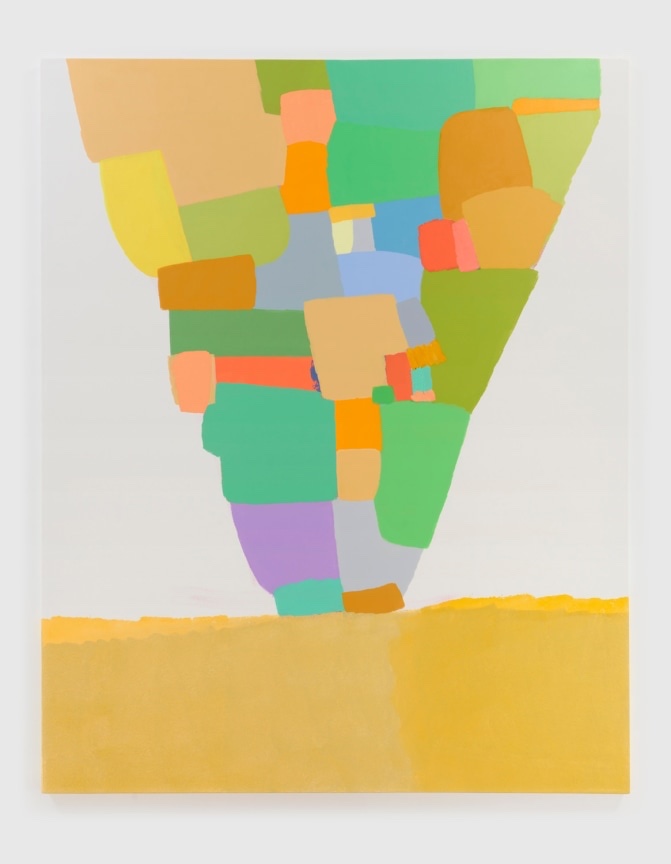
had new work up recently at Cathouse Proper (a space run by art). One of the links is to an interview with Tom.
#ethanryman
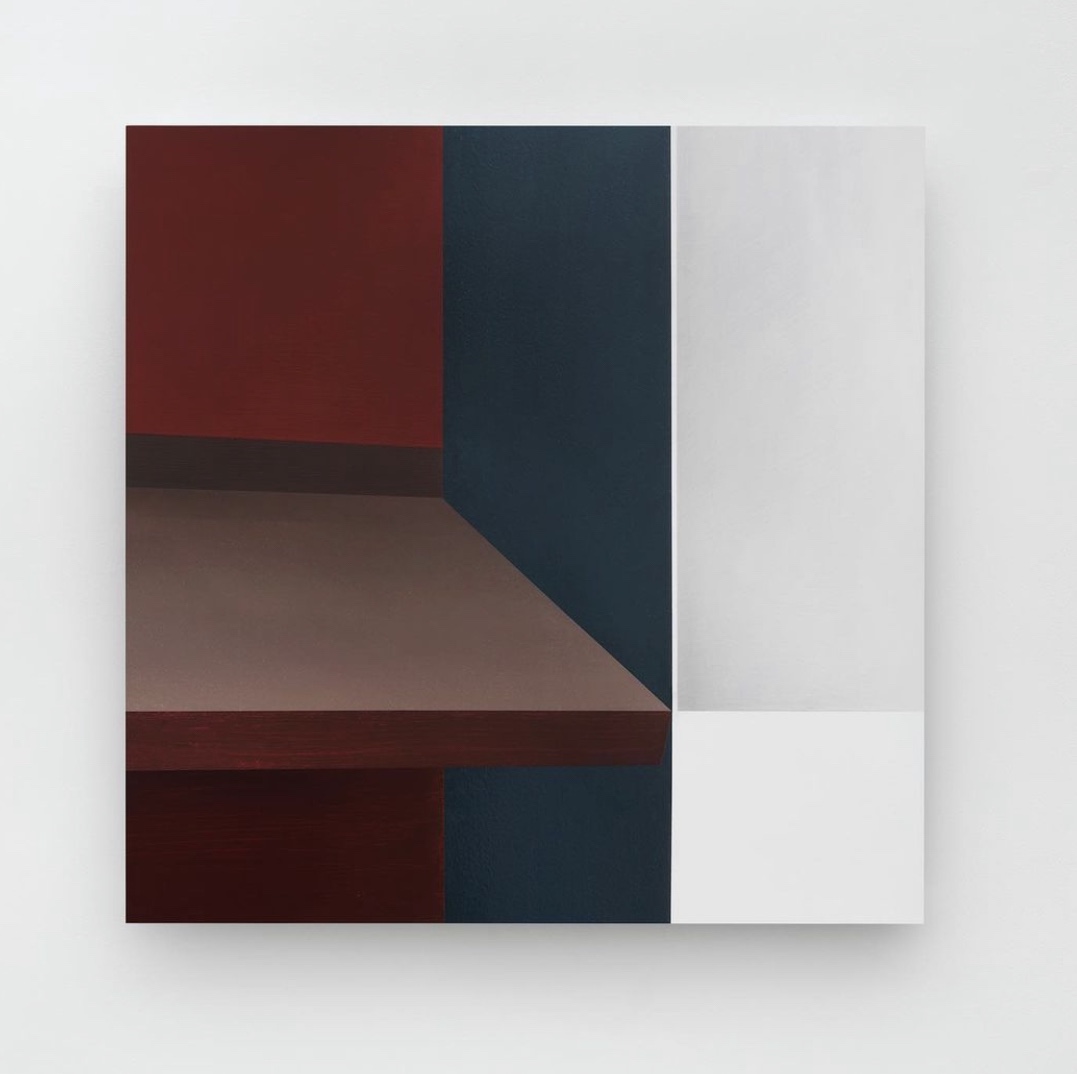
“Nonobjective” when referring to artwork has a particular meaning in the visual Arts. Objective means “expressing or dealing with facts or conditions as perceived without distortion by personal feelings, prejudices, or interpretations.” It seems impossible, to this creative, for an artist to approach such a state- I don’t think I’d be able to make work free of personal feelings, nor would any audience be capable of perceiving without the same. And, while the objects that result from my practice could be called non-objective in the sense that they do not represent or point to objects outside of themselves, I also like the description nonobjective as a way to refer to activities that do not have a destination. Interestingly, the definition in the Merriam Webster link above has very abstract and open terms- an objective can simply be a “goal.” Maybe it is impossible to be either objective or not-objective?
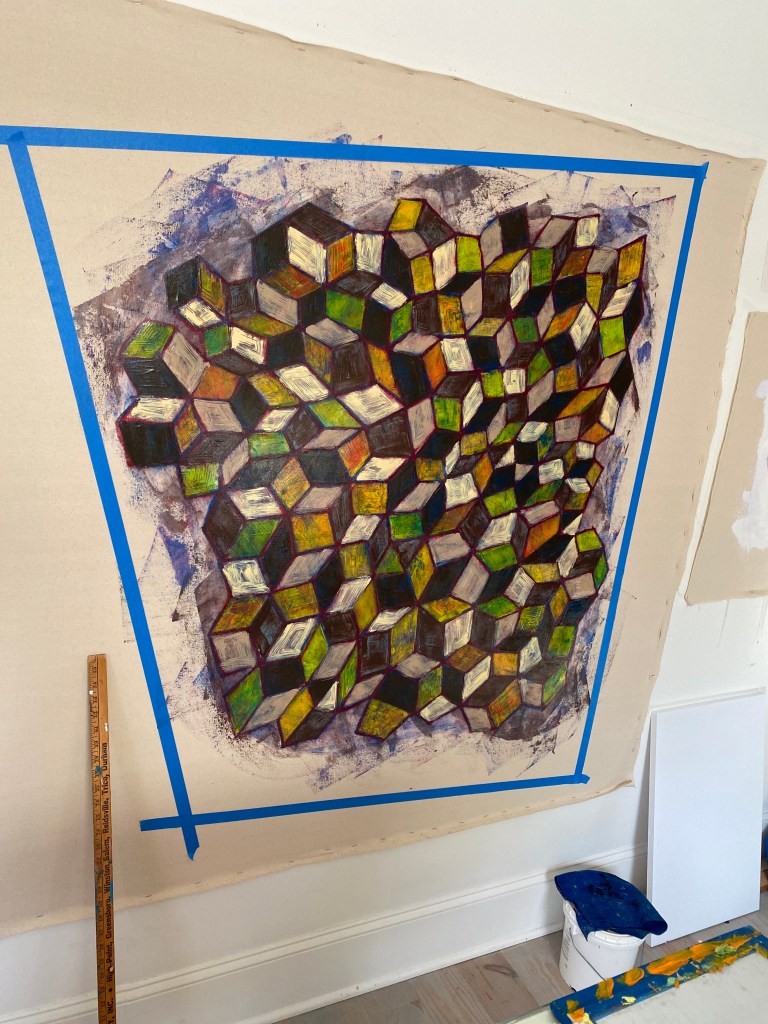
The context for the thought exercise above is the recent resolution of an object. I finished up a piece (first image in the gallery below), which was the last of several iterations of a composition. The object- or perhaps the idea?*- first came to be as part of my work with Oblique Strategies. The first instance resulted from the card I drew on 1/6 which asked “what would your best friend tell you do;” I wrote in my journal that “Michael would tell me to do what feels right” (and what felt “right” was using my cube system to iterate a composition). The result seemed very much… right. Not a thing, not a place, not a surface, not really space; not of this moment or the past. A few days later on 1/14 I drew a card that granted me permission to retrace my steps; seeing the opportunity to revisit something I really wanted to anyway, I responded that “yes, I literally repeated a composition.” I also tried scaling it up on 2/12 because of my attraction to this collection of shapes. At the time I was asked “do we need more holes” (my response was “yes, use color and texture of paper” referring to the absence of media for some trapezoids).
*Sol Lewitt famously said that the idea is a machine that makes the work- work here can be an object. Which is why notions of “object” and “objective” have been on my mind- there is an idea here that is driving the making of the object. BTW the 2 albums featured below are both worth a listen if you haven’t, in particular The Oh Sees joint.


I also used Chat GPT to name this one. There are many reasons to engage AI; for myself I see this “collaboration” as a way to create a reflection of us back to ourselves (if one thinks of this iteration of AI as an amalgamation of all humans have thought and written about abstraction).
A few more images of new things going on in the studio below to round out this update; a couple of drawings that are a revisiting of compositions created during my daily drawing practice (which will impact future paintings), and some images of the largest painting I’ve made in a minute nearing completion.


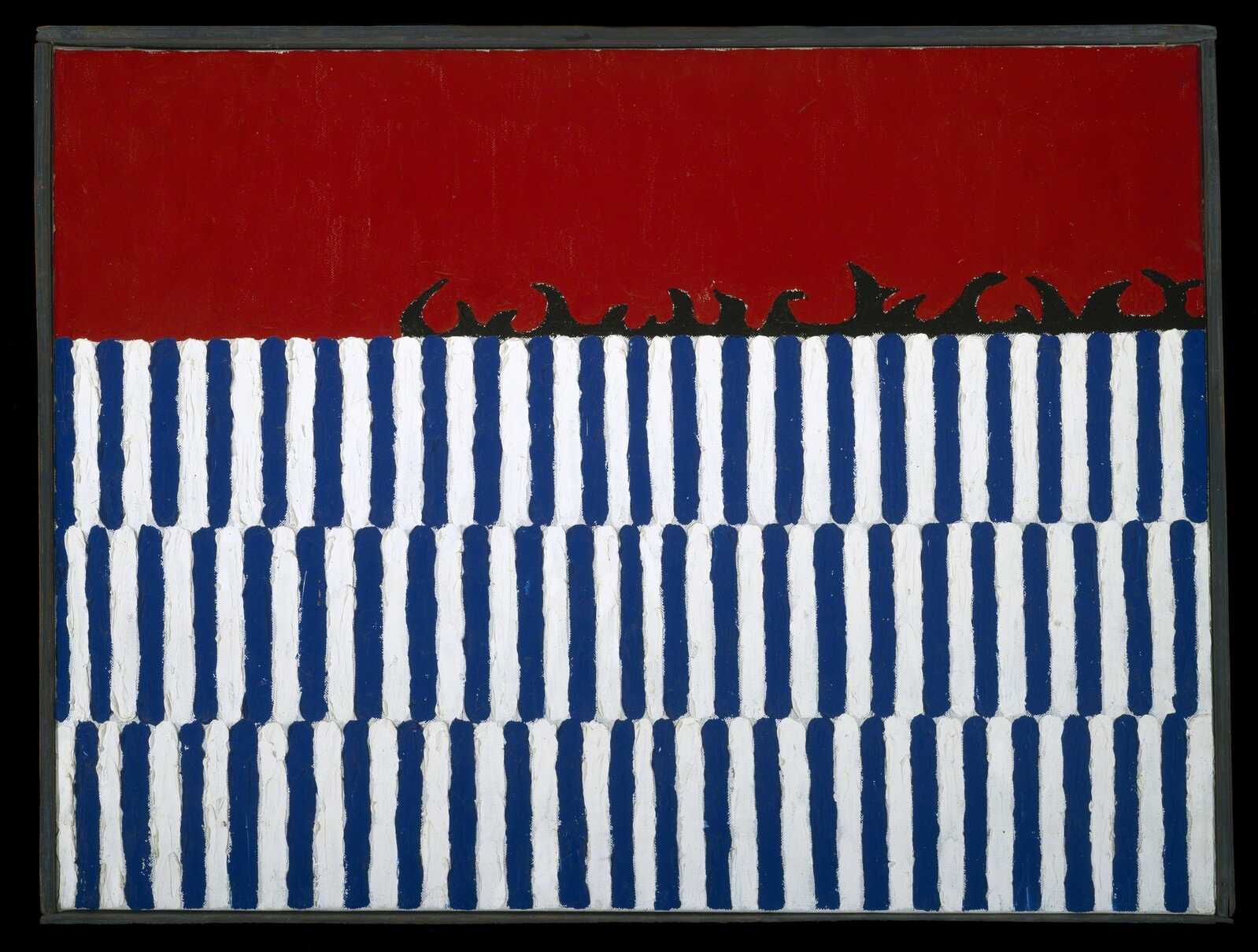
is one of several LGBTQ+ artists discussed in Evan Moffit’s recent Artsy article How LGBTQ+ Artists Use Abstraction to Move Past Labels. In it he asks what “is “queer abstraction”? The term is slippery. Abstraction, like queerness, derives its force from a lack of fixity. Unlike the standard markers we use to categorize identity, it refuses to coherently represent anyone or anything. LGBTQ+ artists, or artists whose sexualities are non-normative, have been making abstract art as long as abstract art has existed. Calling their work “queer” is much more difficult when that work doesn’t involve representation at all.” Amy and Carrie also get mentions.
More
#forrestbess
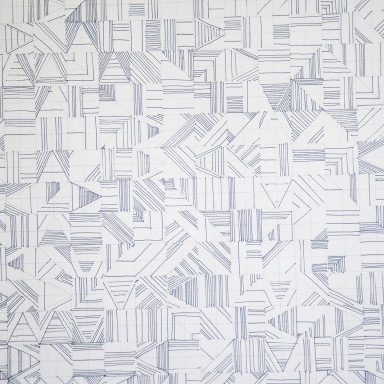
A 1927 painting by Paul Klee inspired this series by Vera Molar for which she programmed a computer to “place parallel lines within a square grid and vary the alignment (horizontal, vertical, diagonal) and the weight of lines as well as their closeness.” Numerous variations could be produced, which allowed her to “bring to light and to realize images…which only pre-existed in a vague, uncertain way in my imagination.”
#veramolnar
Saw below recently at LACMA along with work by Craig and Peter.
Roland Reiss began working with plastics in the early 1960s in order, in his words, “to move away from the brushstrokes, paint, and canvas of the Abstract Expressionists… The technical elements of painting could be replaced with new surfaces, colors, textures, reflectivities, and physical strength.” Red Edge is one of a series of works he created by making latex molds of ceiling panels used to diffuse fluorescent lights, then spraying the molds with polyester resin in candy-colored hues and backing them with fiberglass. The resulting honeycomb-textured surface reflects light, generating an optical effect that causes it to appear to vibrate. As Reiss described it,
“You have the surface of [the] painting itself moving in space.”
#rolandreiss

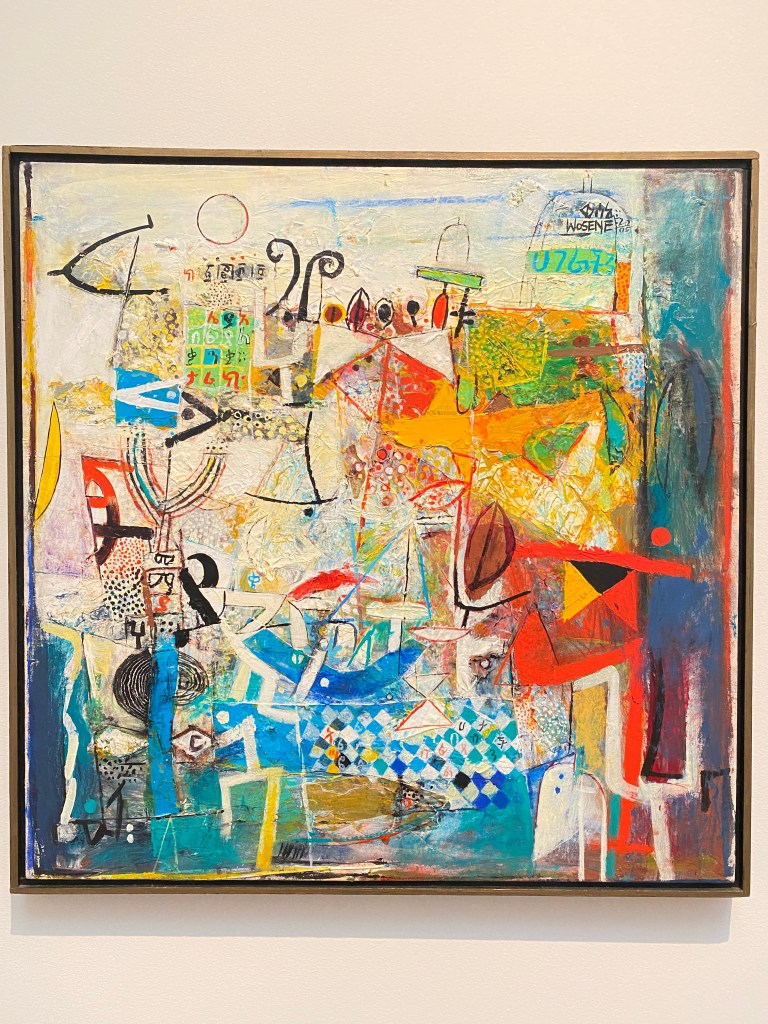
Wosene, who is Ethiopian born, nods to a multitudinous African experience of the Caribbean with this work (which is at the NCMA) and employs Ethiopian graphic systems, liturgical symbols, architectural forms, and Pan-African motifs. In drawing from such a rich vocabulary of written sources, Kosrof cleverly links past with present and Africa with diaspora, pushing the boundaries of visual literacy to new levels of hybridity.
#woseneworkekosrof
Below is part of the permanent collection at NCMA. Helen was an American early Modernist painter nicknamed “Reds” for her hair color. Torr worked alongside her artist husband Arthur Dove and friend Georgia O’Keeffe to develop a characteristically American style of Modernism in the 1920s. Like Alexander and Norman, abstraction was a part and not the entirety of her practice.
#helentorr

Saw below at the NCMA recently. As a young painter in Paris, Macdonald-Wright helped found a short-lived but influential art movement called synchromism, which proposed an abstract art based upon a musical/mystical interpretation of color. Returning from Europe, he eventually settled in Southern California, where he became an impassioned advocate for modern art. As exemplified by this painting, Macdonald-Wright’s late style is far more lyrical than the bolder paintings of his youth. One can attribute this gentleness at least in part to the artist’s devotion to Taoism, Buddhism, and Japanese art.
Even the title alludes to a Zen-like concern for the beauty of the ephemeral.
#stantonmacdonaldwright

 Painting After Art is Dead