Sherin’s new works are an expansion of A’aru // Field of Reeds which the Egyptian-American artist exhibited during her 2023 residency at Shangri La Museum of Islamic Art, Culture & Design in Honolulu, Hawaii. Continuing her dialogue with contemporary and historical antecedents, Guirguis posits cultural identity and intersectional feminisms through an integration of oral histories, abstracted motifs and a consideration of minimalism and ornamentation in Egyptian aesthetics.
Hyperallergic says Dyani’s newest at Various Small Fires is one of 10 Art shows to see in Los Angeles in December (2023). Her mixed media works incorporate beadwork and painting, referencing both Native American traditional art forms alongside European and American modernisms. In doing so, she highlights the influence that Indigenous aesthetics have had on Western art, specifically geometric abstraction.
Hyperallergic had a good article recently on the celebrated and unsung histories of French abstraction. Christophe gets a nod along with Georges and Pierre (my personal favorite Parisian abstractionist is Bernard).
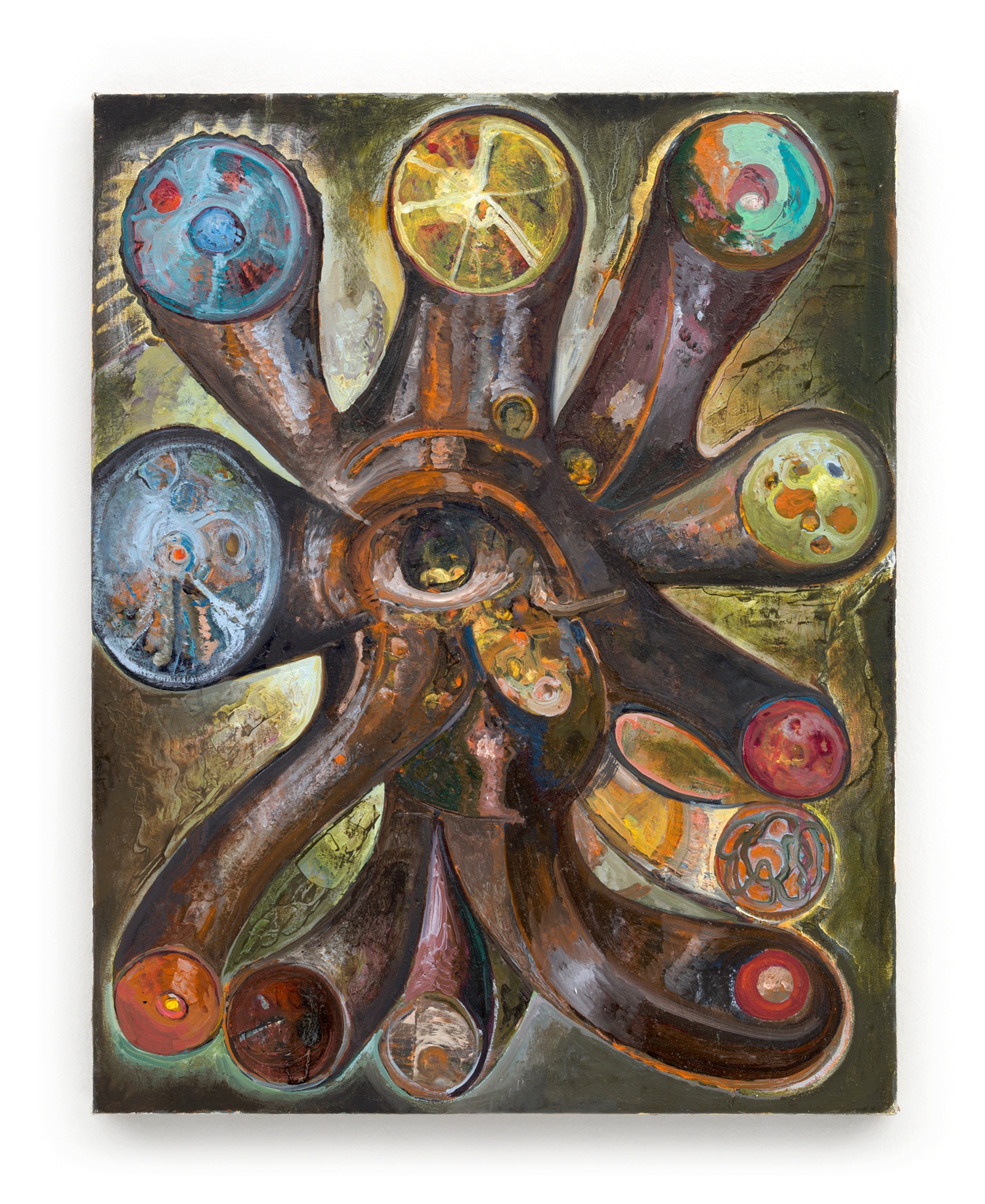
David Nolan Gallery recently presented Uncertainty Takes a Holiday, Steve’s fourth solo show with the gallery, Possessed by a desire to “maximize” a painting, DiBenedetto continues to find new ways to exploit the possibilities of oil paint through crusty, built-up surfaces and bright, jewel-toned shapes that gleam in the midst of gritty, impastoed muck. Though he can apply paint so thickly it might qualify as bas-relief, the forms themselves are flattened into the background in a way that often feels like massive amounts of time and space have been compressed into a single plane.
YI GALLERY is pleased to present Denouement, a solo show of recent paintings by Elizabeth Gilfilen. This is the Brooklyn-based artist’s first exhibition with the gallery.
Juxtapoz says Antwan’s newest is “another leap in this world of the Parisian artist Antwan Horfee, an abstracted, mind-blowing series of paintings, drawings and video work that, when you squint your eyes, has the remnants of graffiti and urban density but feels entirely new.”
In their always great Hudson Valley Selected Gallery Guide: (December 2023 edition), Two Coats of Paint gives props to Greta’s newest at Headstone (where she is in Rumor Mill with Christine Stiver).
David Carrier at Two Coats of Paint published an interesting read recently about Emilio role as Venice’s Abstract Expressionist in the context of “Rivoluzione Vedova,” at Museum of the 20th Century near Venezia.
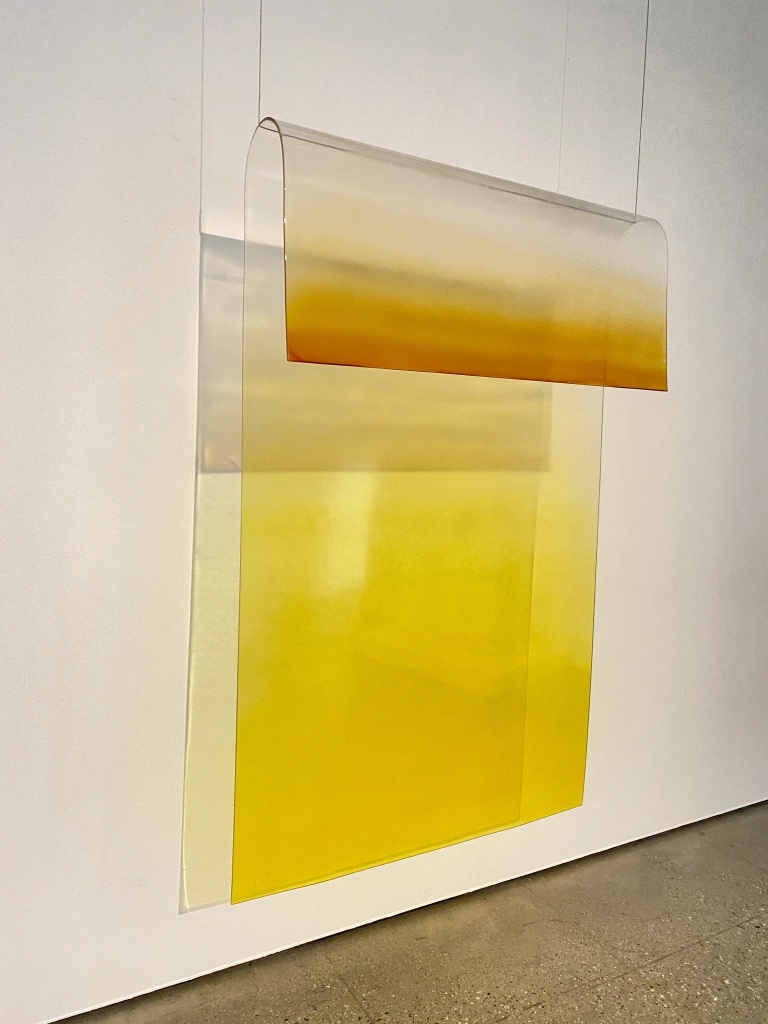
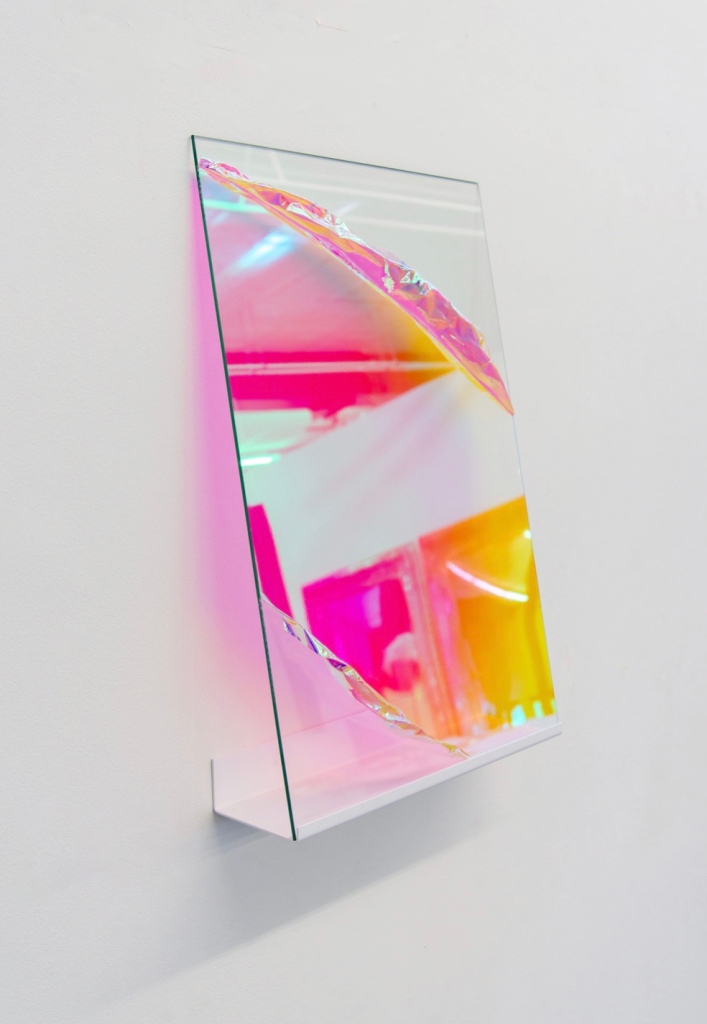
who is a also a painter, has installation work on display with Sinéad Ludwig-Burgess at Okotoks Art Gallery through March 31. Of the work, Payne says she was influenced by “those subtle-but-vivid spectrums of colour in the cloudless sky at dawn or dusk, or the way that hot pink light in November hits the buildings in the city. What I guess I wanted to do is synthesize, artificially, this sort of feeling of witnessing an ephemeral light phenomenon in nature – I want to bottle it, put it in something.” More
Imbued with an indelible vibrancy and depth, Harminder Judge makes transportive sculptural works that simultaneously reference Indian neo-tantric painting, as well as the abstract expressionist and color field movements of the 20th century.
Saw below at the Nasher recently. Born in Jacksonville, NC, Reginald merges unconventional art materials with simplified forms to create symbols of protest and resilience. Offering IV comes from a series of eight paintings on stretched industrial rubber. The artist’s use of rubber stems from his investigations into the exploitative history of its commercial manufacturing in central Africa.
I deploy this word as a tag on my blog for artists using materials in ways that one would have said, when I was in Art school, “that wasn’t how we were taught to use those in Art school.” Paint on canvas, pencil on paper, etc. Maybe I’ll switch to multimedia eventually…
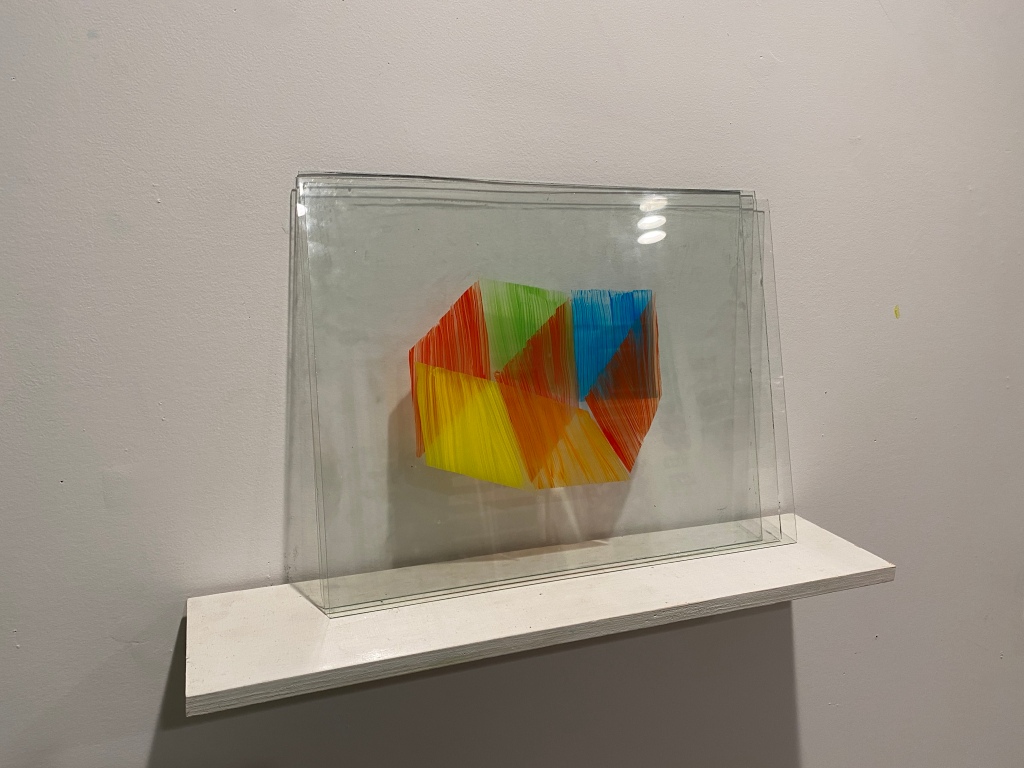
The context for this observation is that I am in the early stages of working on glass- see below. Glass is definitely a nontraditional support for painting, for a couple of reasons that are obvious to me now- it’s the worst combination of heavy and fragile, and it’s definitely not a permanent substrate for water-based paints like acrylic (all you have to do is spritz it with water and the paint, even if dry, will rub right off). Regular readers will know that impermanence is just fine with me.
While landfill waste diversion isn’t a subject for this work, it is something that matters to me- all of my other installation work, whether the cubes or my recent interactive pieces, employ material reuse. In the later case not only are the cubes reused studies, the supports, including the foam core on which the cubes are mounted, are all upcycled– only the magnets and some “virgin” paint or media are first-use.
There are still themes/ideas of contradiction to work with- the contradiction of paint that appears to be free of a support; the layering of “sides” of the cubes which is undone by them being flat shapes rather than the edges of a solid viewed in perspective. Given my recent re-writing of my artist statement, I like adding another modality (another “and”) to my practice as well. I think eventually the sheets of glass will get stacked in a way that requires the viewer to move so that the cubes “edges” align- I’m intrigued, as a means to center contemplation, by strategies that highlight any requirement for the viewer to be present and engaged.





 Painting After Art is Dead