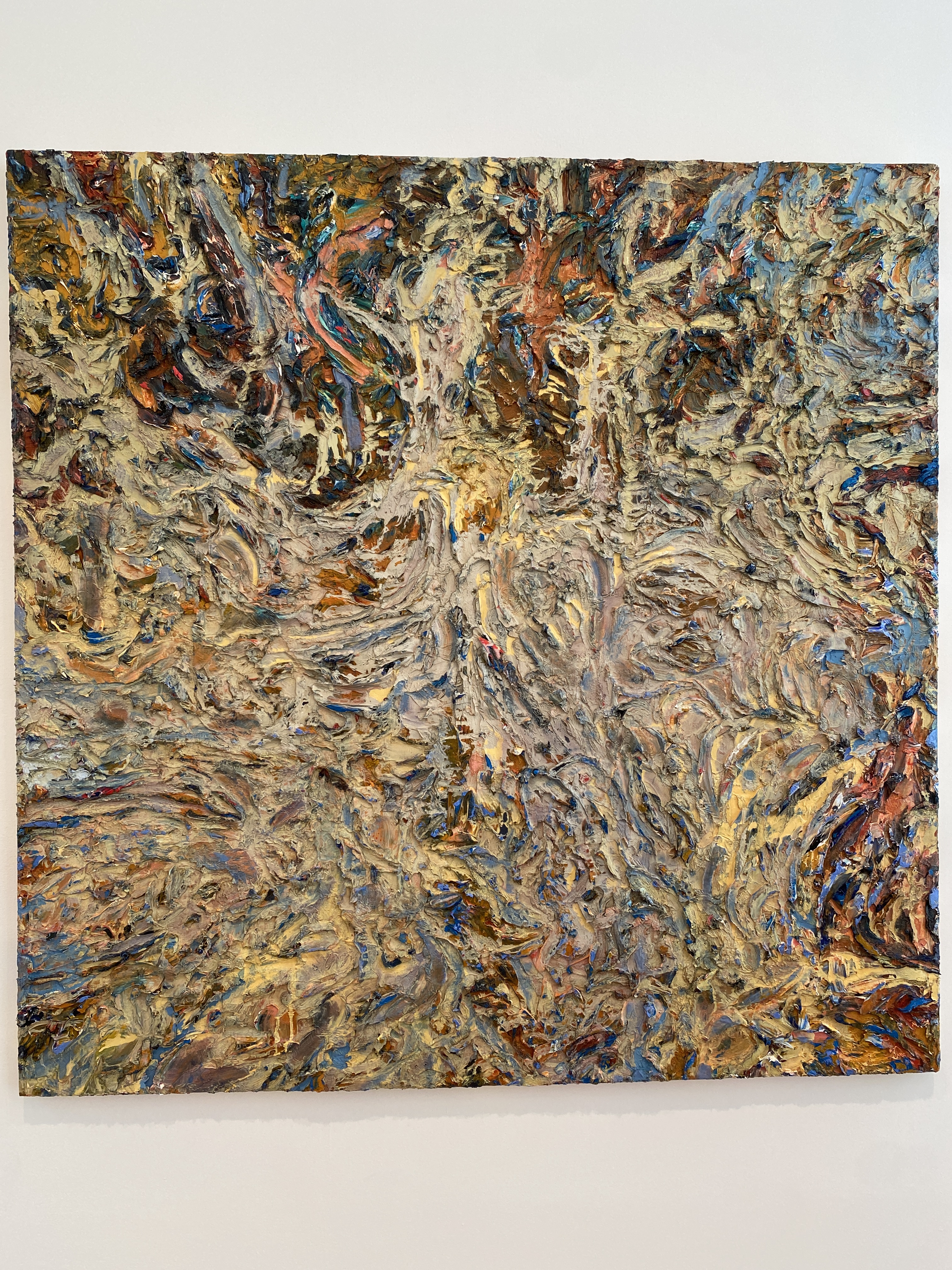
Saw below during a recent trip to the High Museum in Atlanta. Gabriel is interested in abstraction as a mode of painting that offers an open-ended forum for posing questions about the nature of his everyday experience as a Black artist. For Mills, abstraction represents a rebellious way of approaching marginalized and countercultural political ideologies through unencumbered expressivity.
Caio is well known for his lyrical, abstract works of art. A talented musician, he is fascinated by the relationship between tone and form, which he explores in his paintings and works on paper.
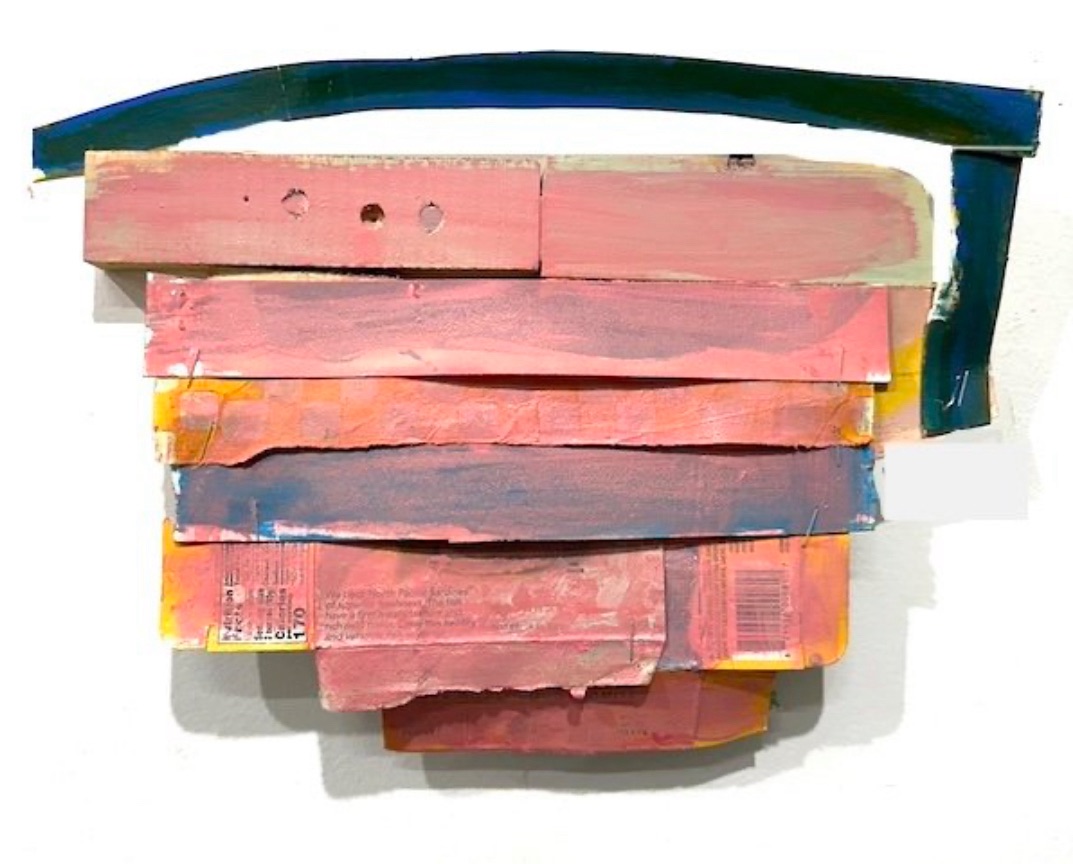
Working primarily in hand-painted and hand-cut paper to create hard-edge abstract art, Crissy‘s pieced watercolour paintings and low-relief paper sculptures explore attention and contemplation, time and place, and our relationship to the natural environment.
was recently featured on Conversations with Artists where she spoke about her desire to bring together disparate strands so they may, for an instance, exist in the same circumscribed moment (formal and emotive; painting and constructing; illusion and physical object).
What a triggering title, I’m sure, for many readers, especially those that went to Art school (or, like myself, Architecture school, where in my first critique a professor literally asked “whose Mongolian cluster fuck is this” about a model that had taken me 20+ hours over a couple of days). So I thought we’d start with a little haha- literally. everyone. who went to art school has been in a situation like the one Terry Zwigoff brings us in the vignette above (based on Daniel Clowe’s comic and screenplay) .
The topic is on my mind for several reasons. One is recent feedback I’ve gotten on some exhibition proposals. First and foremost I find* myself grateful to actually get feedback- those of you reading who submit a lot of proposals know how rare it is to find out why your submission wasn’t at the top of the stack. And while I could, but won’t, lie that reading “this aspect was thin” or “explain better how it actually does that” *raised defensive hackles at first (any abstractionist reading this knows about critique that is actually leveled at the modality and not your work in any specific way), once I noticed myself having those thoughts, I was able to realize I could have *much* better answers. This was an opportunity to grow and improve- how wonderful, and, again, lucky for me to be given the prompt to do so.
I have to give a shout-out to Adam Grant. My boss at the old day job gave us all a copy of Hidden Potential for a holiday gift and I just got around to picking it up recently. Don’t let the source or the endorsements scare you off- the ;tldr is that we can all learn to be better learners. You don’t have to pick it up because you want to be a CEO or the next MVP of the WNBA yourself.
One of the other reasons I have “critique” centered in my consciousness this week is the recent passing of Jeremy Gilbert Rolfe, a painter that I’ve always admired who also had an amazing facility with words. Whenever I think of him I’m reminded of his visit to the University of Houston when I was in grad school there- it was easily the best critique I had in terms of the attention he paid to what I was doing as an abstractionist. Perhaps not surprising? Again, those with Art school PTSD know that too many established artists (and under-appreciated profs…) love emotionally abusing 18-24 year olds. As far of the value of the feedback goes, I believe that while it’s valuable to get (and give) feedback from sources that lean in different directions from your practice, a kindred spirit will just see things that others don’t. Facts. So, find your tribe and nurture those relationships! Seriously- the best feedback I got about the proposal *and* the response to the same came from one such relationship that has become one of the most important to me and to my practice (you know who you are, I love you my friend).
FWIW I try to make critique a part of my practice, both by having a regularly scheduled meet-up with a consistent group (the thread of years of seeing each other’s work change over time and having visibility into the genesis of the same is a *powerful* tool for critique) and also by teaching.
BTW, for those of you that are local to the Triangle, you might be aware that I’ve been making a point this year of giving and asking for studio visits, or just meet-ups for a beverage. If we haven’t connected yet, let’s make it happen. And if I’ve promised you we would and haven’t followed through, thanks for your patience!
I bought a back issue of Art Papers recently that featured an image of Paul’s work to highlight Geane Moreno’s essay about erotic abstraction “Pushing into Darkness” (which I can’t find a link for anywhere in the internet) that also gives Ernesto a nod. More
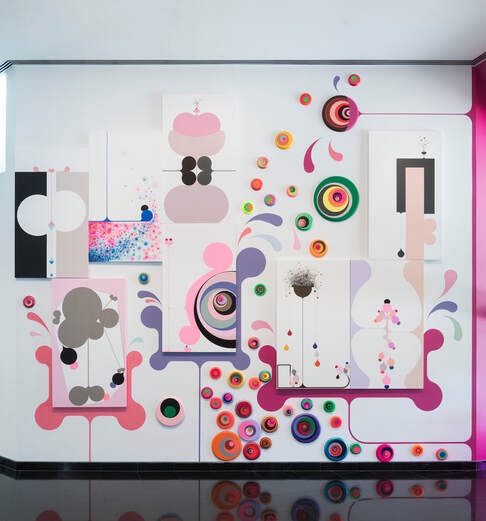
Udomsak’s practice has long been characterised by his specific use of collage, creating obsessive pattern made from newspaper, noodles, cellophane and paint. Over the past two decades Krisanamis’ work has maintained a distinct formal and conceptual clarity, offering a unique experimentation with the well-worn territories of grid.
#udomsakkrisanamis
With 40 years of exhibition history, Anthony (Tony) Daley is a highly decorated abstract artist holding works in Tate Collections, Saatchi &
National Portrait Gallery.
#tonydaley
Tim was born in England in 1966. He moved to the United States in 1984 to pursue his career in art. He is best known for his adaptations of musical scales to abstract painting. In the last decade, his work expanded into public sculpture.
I was part of an artist talk this weekend where I reflected on and took questions about one of the pieces from my new homage series. I don’t mind talking, it’s part of my day job actually. And it also got me thinking about the role of “the discourse” and spoken and written forays into the same by creatives (that’s a good link fwiw).
The moment I decided to decide on some words about words was upon reading a social media post after the talk by a friend who questioned what the Art world would look like in the absence of the artist statement phenomena which according to Wikipedia is relatively recent. Statements and talks are not the same thing and also yes they are, intertwined at the least (the chicken in the egg).
Seems like to answer the question posed (what would change about the Art world if International Art English disappeared- link is a pdf btw), one should unpack what purpose artist statements serve. I argued, prior to reading the wiki actually, they derive from the relationship of Art to academia*, that their purpose is to point the viewer towards the artists’ intended relationship to Art history. Specifically I argued (to no one in particular and also literally) that the challenge is postmodernism is not actually an “ism.” Said differently, we don’t have the type of shorthand in the visual arts that, say, musicians have, where one might declare “it’s not boom bap, it’s trap music” that would be the best candidate for a stand in.
I’d also suggest nothing perpetuates this part of the experience of taking in Art more than artists ourselves who. Are. Always. asking each other what our work is about.
*The very existence of the arts in the academic Ivory tower is, of course and not surprisingly, the reason the majority of opines on said post’s resulting thread were approximately “everyone is entitled to an opinion with or without academic credentials” (a very American, individualist viewpoint). I’m not sure I agree all opinions are informed with equal rigor and substance even if “we all have our opinions” is the dumbest hill to die on ever. Even with my quip about music categories considered one should probably recognize that people still have words about music they love (thank you Pitchfork, Okayplaya, Stereogum at el), because good Art inspires the same.
Do I think the visual Arts are better with or without statements? I’d say they are here to stay and if that isn’t what motivates you to view Art thanks for showing up for whatever reason motivates you, especially to Artist talks.
Rigoberto is known as one of Cuba’s most famous art visionaries. His style has been described as an intellectual process in which he explores space and depth while grounding his vision in architectural elements. He has recently moved to the Triangle so heads up folks.




 Painting After Art is Dead