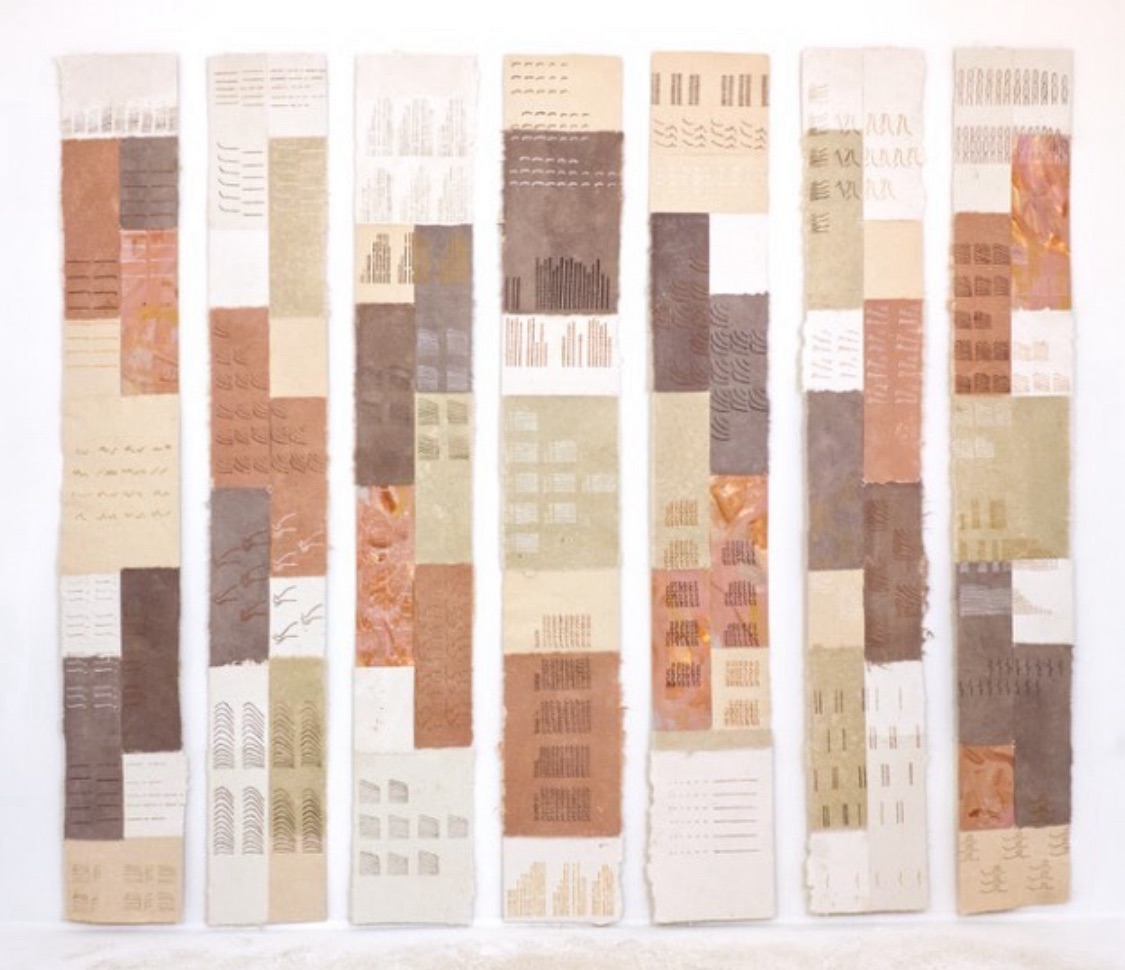
Elizabeth Frazzare at Artsy says abstract weaving is having a moment (and explains why she thinks so). She gives a nod to Liz (and covers Melissa and the women of Bauhaus obviously).
#lizcollins

Elizabeth Frazzare at Artsy says abstract weaving is having a moment (and explains why she thinks so). She gives a nod to Liz (and covers Melissa and the women of Bauhaus obviously).
#lizcollins

first solo show, Foregrounds and Horizon Lines, with Turley Gallery, features new works on paper in which he used a map-making quill and ink to weave together elements from 1970’s geology textbooks, American West survey photography, graphic design, and minimalism.
More
#joeyparlett

Michael at Two Coats has words about Caroline’s “compelling in-betweenness” – a commentary on her very unique process that involves found materials.
#carolineburton

I’m often surprised, though I shouldn’t be given how broad and deep the canon is, that pieces of that story are missing from a blog that covers 1,500 plus artists (this btw for those who are new). Leon Polk Smith was an American painter. His geometrically oriented abstractpaintings were influenced by Piet Mondrian and he is a follower of the Hard-edge school. His best-known paintings constitute maximally reduced forms, characterized by just two colors on a canvas meeting in a sharply delineated edge.
More (Leon Polk Smith Foundation)
#leonpolksmith

Thanks to my friendship with Jenny Eggleston I was asked to be included in In The Pink at the Halle Cultural Arts Center where the pieces on the left below are installed from now until April 1 (no fooling). I posted on Instagram yesterday how the juxtaposition of a painting with some of the cubes made me reminisce on some of the earlier strategies that I used with both physical and implied cubes (middle pic). The easel implies still-life and the cube assemblage is definitely a collection of objects like those many of us who went to Art school probably drew and painted.


The picture on the left feels a little goofy- for me, the painting becomes a cubist portrait of… cubes. I’m including a Roy Lichtenstein for reference to the idea of being cartoonish*. The full context for my sincere if unnecessarily self-conscious emotions about any use of the word Cubism in relation to my work is the regularity with which non-Art-world types use this word incorrectly to describe it. It’s a dumb thing for me to be bothered by, especially when it is always in the context of expressing interest in the objects that result from my practice.
What I reflected on after I walked away from the exhibition install was how the work shown in the middle image above had helped me see that contradiction was showing up in my work, in this case the contradiction of the subject (cube) being present literally and representationally, and highlighting this duality through juxtaposition.
I’ve realized that goofiness in the context of a practice that takes itself pretty seriously is a useful contradiction; said differently, if I was truly goofy none of these words would have been necessary. If one digs IE googles a little deeper you quickly see that “goofy” while meaning everything from harmlessly eccentric to silly, doesn’t ever imply not being serious. *BTW, cartoonish is another interesting word choice if I do say so, meaning “not like real life, because of being too simple or exaggerated” which sounds right in the strike zone.
And… I’m not the first artist to work through this stuff. Chuck Jones, whose aesthetic is so deep in my subconscious, was clearly influenced by Modernism, including Cubism (hot take- Le Courbusier is the best Cubist painter) and Nicholas Krushenik cleverly and deftly took the equation in the opposite direction. BTW “yes” the spatial “snap” the one gets from cellular animation is hugely influential on how my mind’s eye thinks about putting images together, even if the paintings I make aren’t even really representations of a specific thing or space (then again, are the subjects of cartoons ever real?).


was a Swiss painter and graphic artist and one of the main representatives of the concrete and constructive art movements along with Max and others.
#richardpaullohse

like Hiba and Hanane is included in Contemporary Muslim At of North Carolina. Pictured below is “The Invitation” (2023). With over 750 in person and online participants from the Triangle Muslim community, Ummah’s first community interactive art project asked for participants to make the intention to be “Invited” to perform the Holy pilgrimages, Hajj and Umrah. This traveling canvas visited several mosques and Muslim spaces, where participants inserted pins around the Ka’bah which represented themselves and their loved ones. While pinning their dot, they did Du’a for Allah to call them on this spiritually intense and challenging journey, the goal of which is cleansing of the heart and purification of the soul. The end result was a canvas symbolic of a community’s collective anticipation, yearning, and hope to be Invited.
#artistumah

is one of many artists included (posthumously in his case) in Woven Histories: Textiles and Modern Abstraction at National Gallery of Art.
#edrossbach

Hyperallergic says (among other, relevant things) Jackson’s “anti-canvases” in the Whitney Biennial is their “most thrilling discovery.”
#suzzanejackson

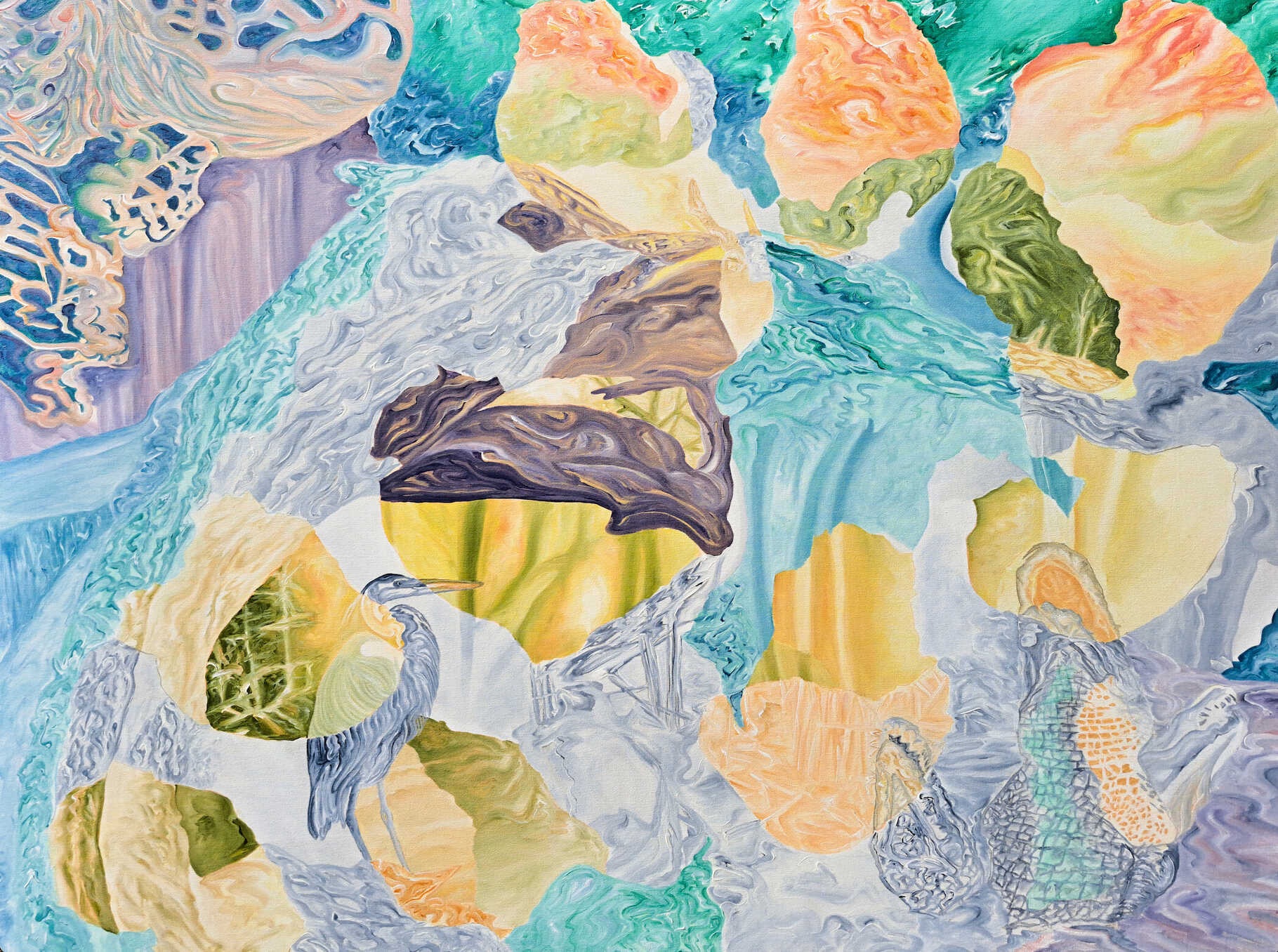
In Angela Heisch’s abstract paintings, deep blues and warm taupes swirl together in bold spirals of light and dark, hard edges and soft gradations. Her enigmatic forms resemble slices of plants, flowers, living beings, and even the cosmos; they vibrate with energy that’s both familiar and otherworldly.
#angelaheisch

Eddie Martinez’s frenetic, bold, kaleidoscopic paintings draw from art historical traditions such as action painting, Neo-Expressionism, and the CoBrA movement. Martinez filters tenets from his aesthetic predecessors through coarse brushwork, a wide variety of media, and abstract forms and rhythms
#eddiemartinez

One of only a handful of women to be included within the first generation of Abstract Expressionists, Yvonne Thomas combined the intuitive mark-making of the movement with a keen eye for the expressive possibilities of color.
#yvonnethomas

is a native of Raleigh, NC, is a painter and instructor with a distinctive style that blends abstract art with Arabic calligraphy, and- like Hiba– is one of the creatives included in Contemporary Muslim Art of North Carolina.
About the piece below Hanane says “this painting captures the unwavering resistance of the beautiful people of Palestine. Their courage inspires the ordinary person to overcome hardships through ‘tawakul’ which is the God consciousness, and trust in God’s plan.”
Through her work, Hanane has raised over $15,000 to various charities and local organizations. Her complete collections can be found at artsybyhanane.com.
#hananejamili

is currently in Contemporary Muslim Art of North Carolina at VAE (which all Triangle locals should see if you haven’t). About her work, Hiba says “I stitch as an expressive art form so much of my embroidery is inspired by my identity, my faith, and my beliefs. Many of my pieces are centered around incorporating various traditional stitching techniques into contemporary designs. This piece, which I’ve titled ‘peace in all things big and small’, is the word ‘salaam’ (meaning ‘peace’) represented in Kufic style Arabic calligraphy and cross-stitched in a repetitive pattern in various sizes to illustrate a prayer for peace in all things, both big and small.”
#hibachohan