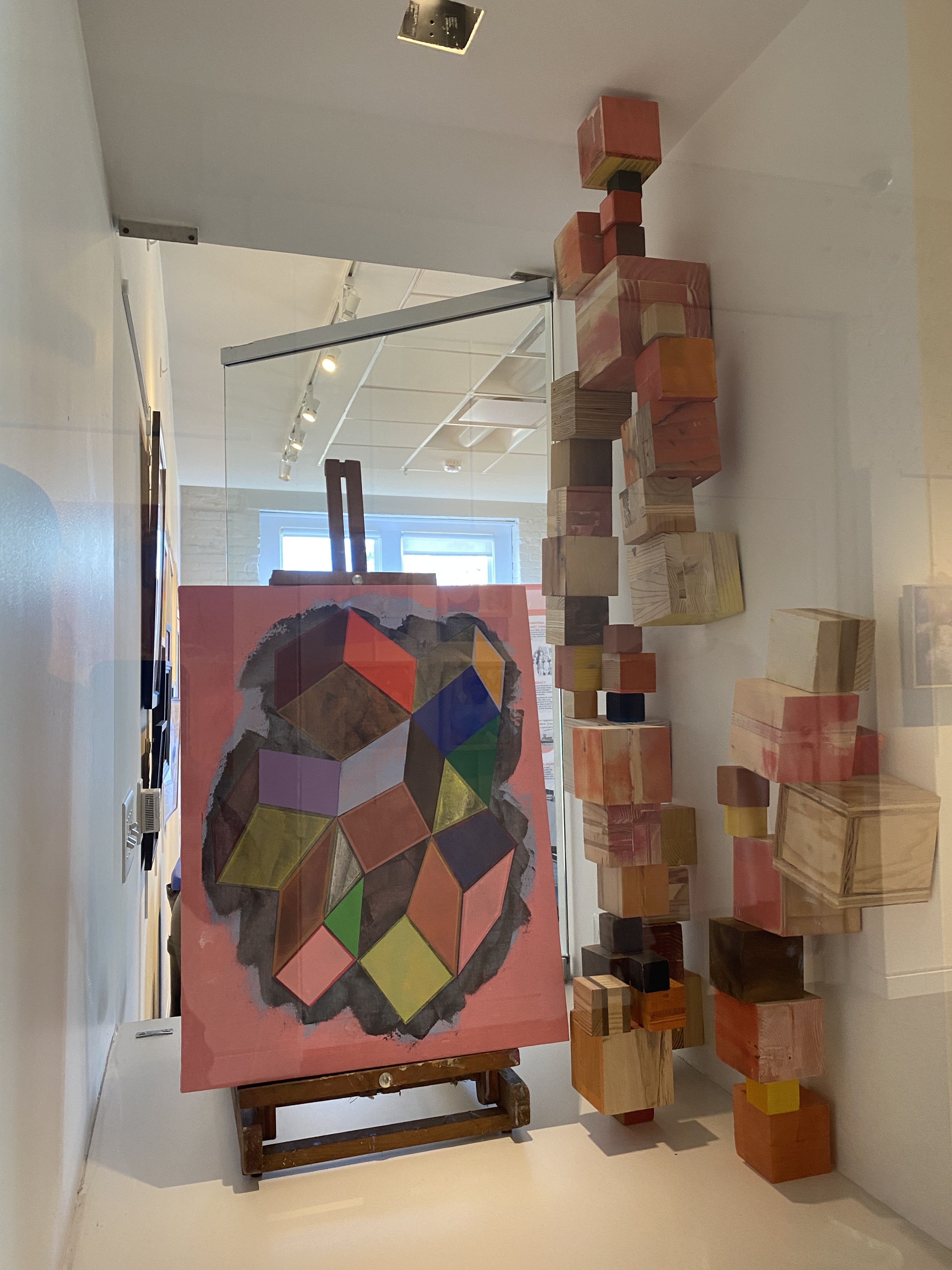
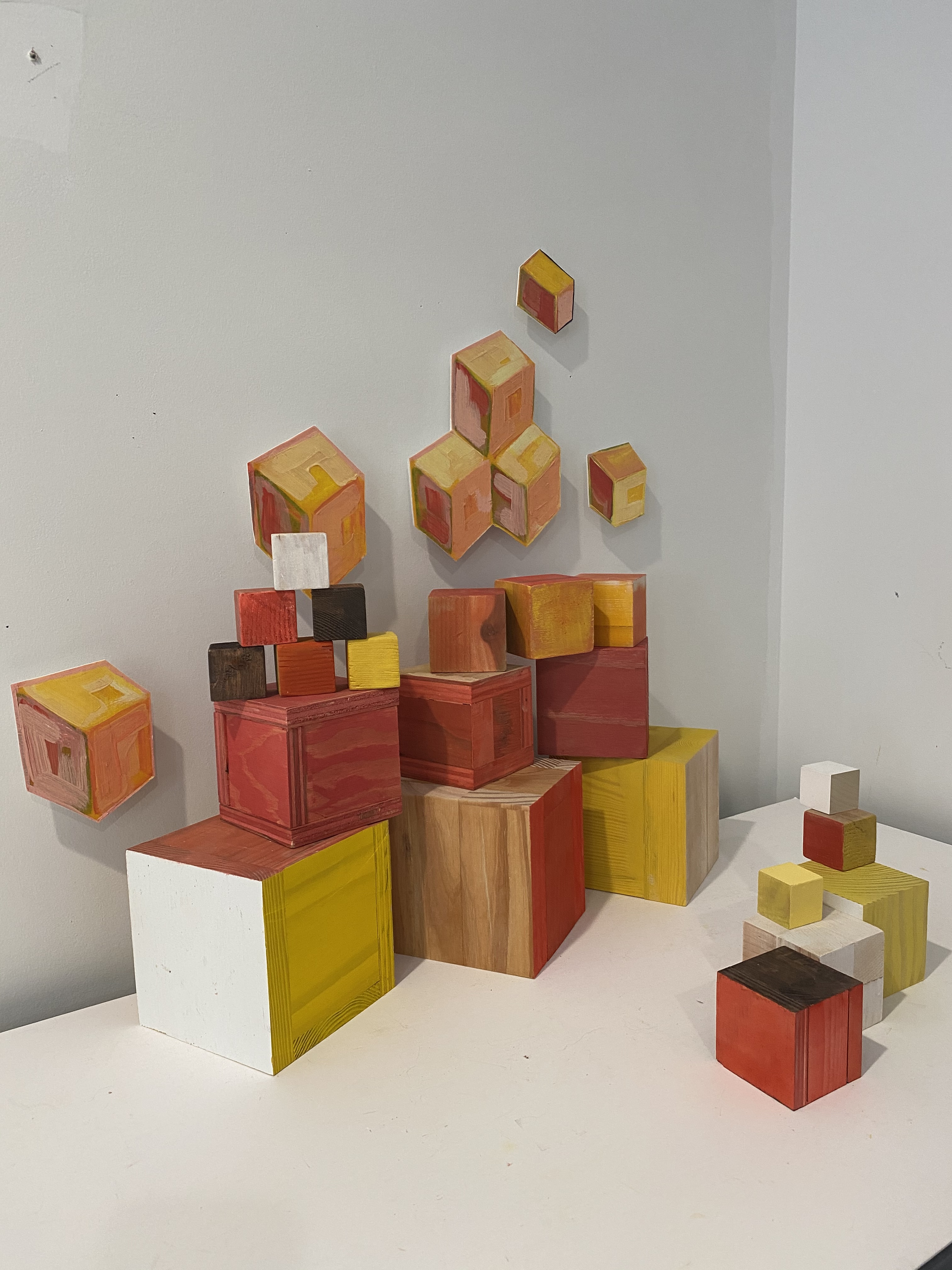
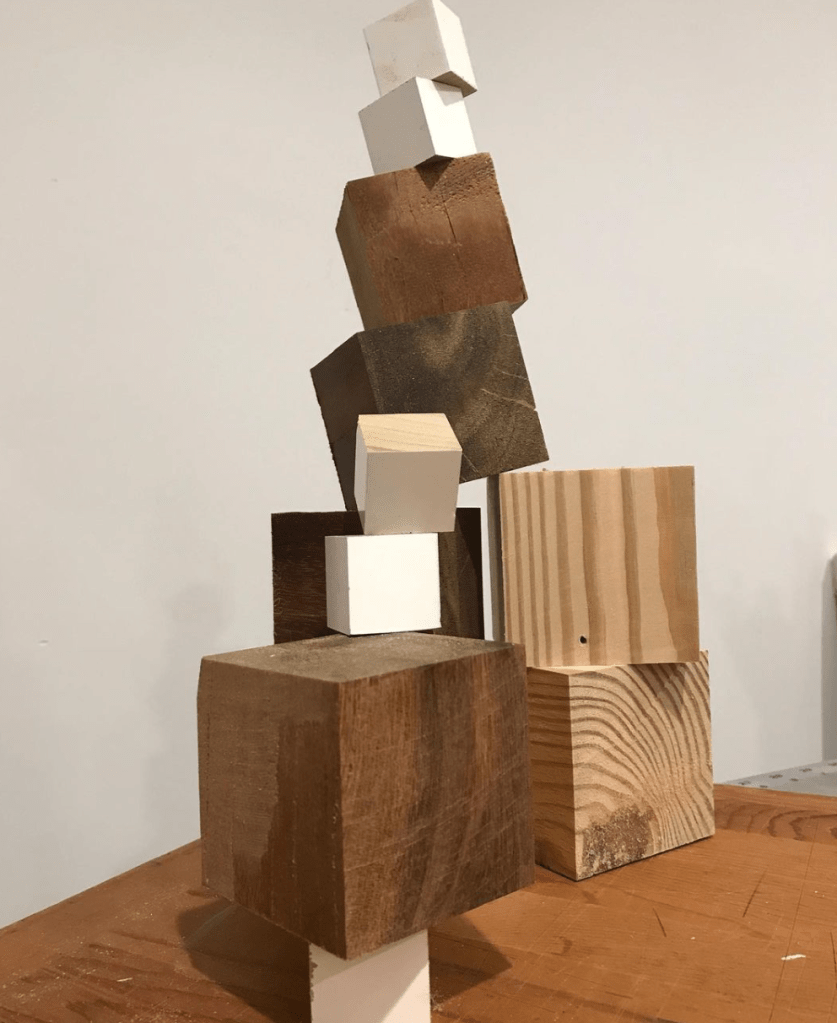
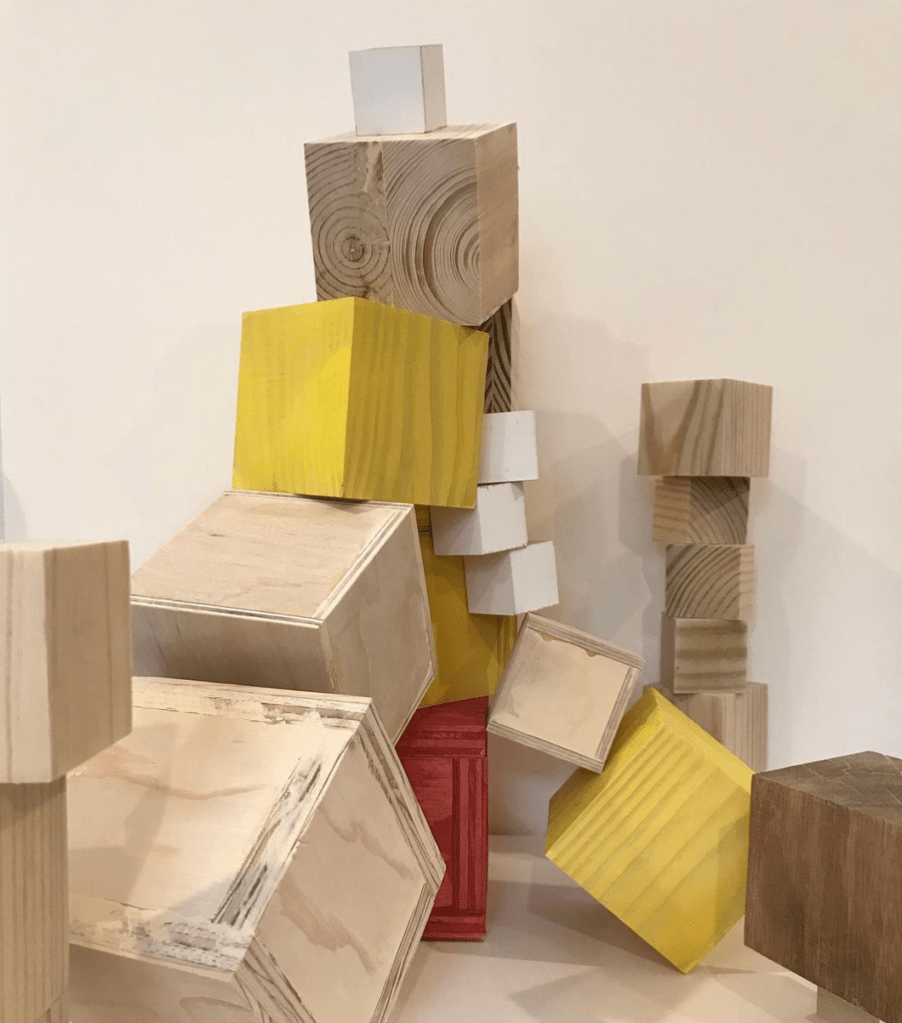
Thanks to my friendship with Jenny Eggleston I was asked to be included in In The Pink at the Halle Cultural Arts Center where the pieces on the left below are installed from now until April 1 (no fooling). I posted on Instagram yesterday how the juxtaposition of a painting with some of the cubes made me reminisce on some of the earlier strategies that I used with both physical and implied cubes (middle pic). The easel implies still-life and the cube assemblage is definitely a collection of objects like those many of us who went to Art school probably drew and painted.
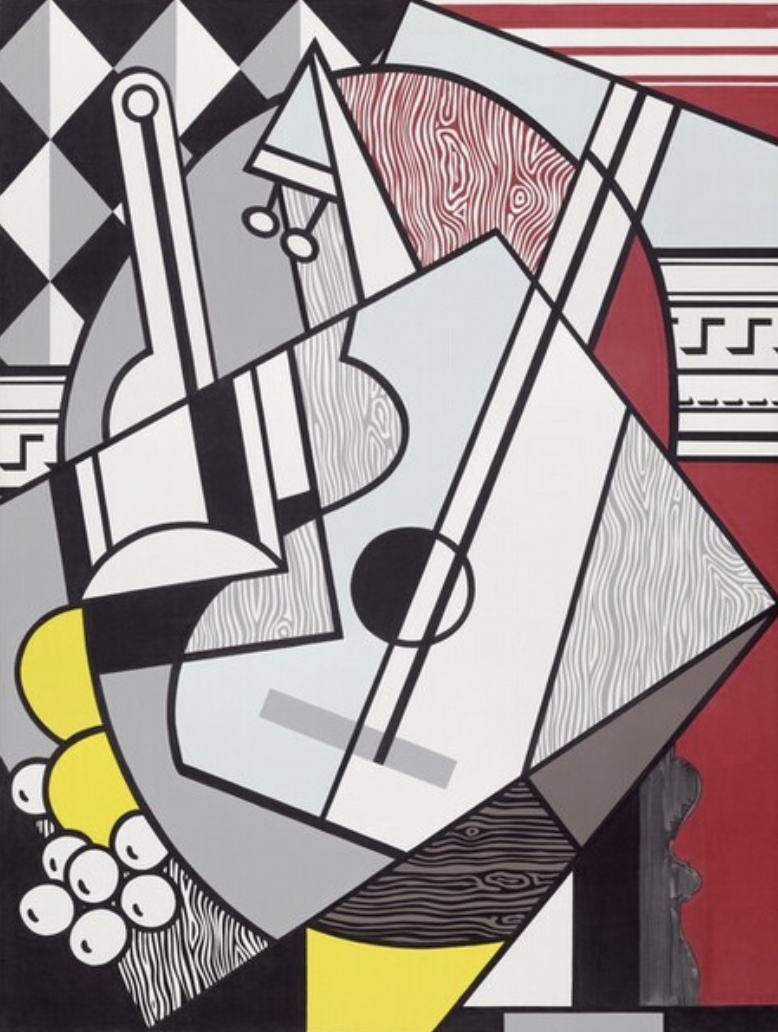
The picture on the left feels a little goofy- for me, the painting becomes a cubist portrait of… cubes. I’m including a Roy Lichtenstein for reference to the idea of being cartoonish*. The full context for my sincere if unnecessarily self-conscious emotions about any use of the word Cubism in relation to my work is the regularity with which non-Art-world types use this word incorrectly to describe it. It’s a dumb thing for me to be bothered by, especially when it is always in the context of expressing interest in the objects that result from my practice.
What I reflected on after I walked away from the exhibition install was how the work shown in the middle image above had helped me see that contradiction was showing up in my work, in this case the contradiction of the subject (cube) being present literally and representationally, and highlighting this duality through juxtaposition.
I’ve realized that goofiness in the context of a practice that takes itself pretty seriously is a useful contradiction; said differently, if I was truly goofy none of these words would have been necessary. If one digs IE googles a little deeper you quickly see that “goofy” while meaning everything from harmlessly eccentric to silly, doesn’t ever imply not being serious. *BTW, cartoonish is another interesting word choice if I do say so, meaning “not like real life, because of being too simple or exaggerated” which sounds right in the strike zone.
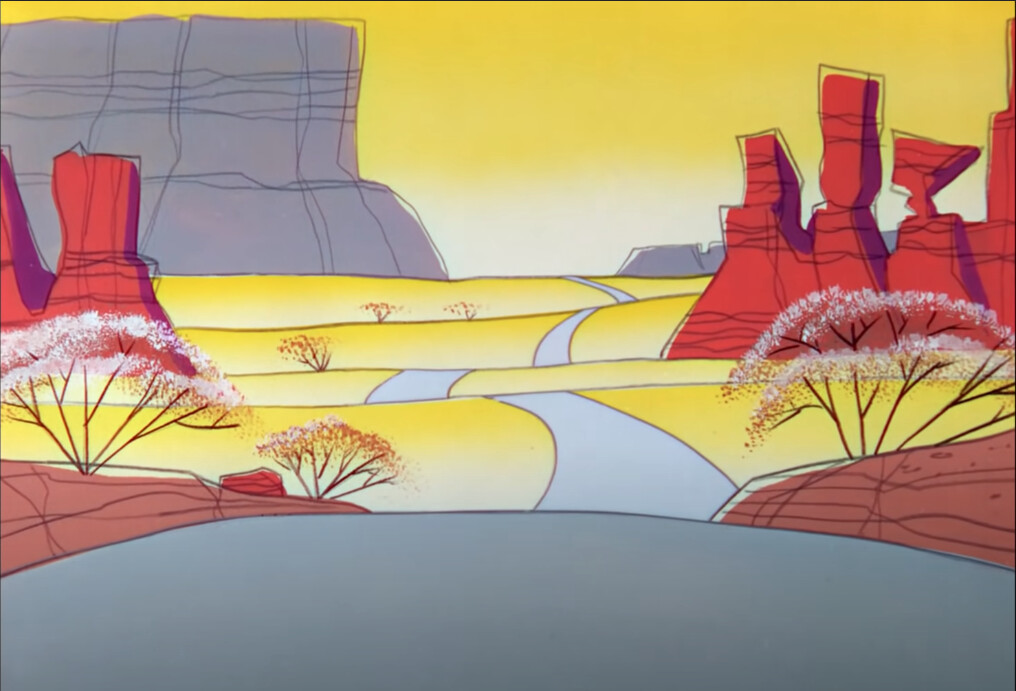
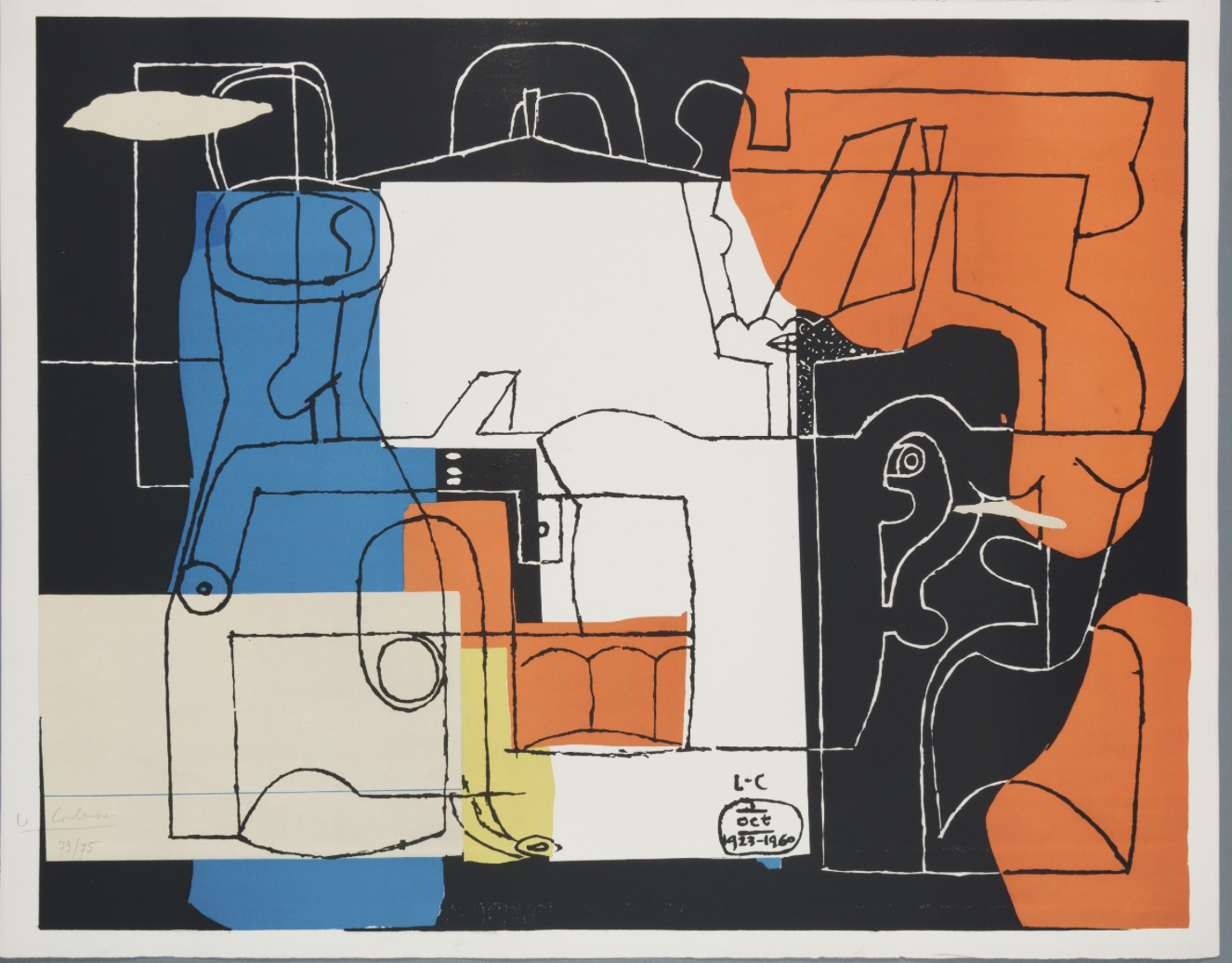
And… I’m not the first artist to work through this stuff. Chuck Jones, whose aesthetic is so deep in my subconscious, was clearly influenced by Modernism, including Cubism (hot take- Le Courbusier is the best Cubist painter) and Nicholas Krushenik cleverly and deftly took the equation in the opposite direction. BTW “yes” the spatial “snap” the one gets from cellular animation is hugely influential on how my mind’s eye thinks about putting images together, even if the paintings I make aren’t even really representations of a specific thing or space (then again, are the subjects of cartoons ever real?).
A friend mentioned to me recently that they were impressed with the volume of content about other artists on this blog. Everyone loves an attaboy of course, and I do, in fact, put dedicated time daily into learning about what’s up and who’s doin’ the dang thang. I also leverage this practice into a library I can use to look up each of the artists later, by dropping the image from each blog into thumbnail galleries. I also use hashtags for each blog so I can search for the artists later if needed (so between the two, it’s sort of like this blog is really my diary). Current count is 1,517 as of this post. Kind of surreal to even write that number.
I sort of got into blogging by accident. When I rebooted my practice in 2018, I decided I needed a site. I had owned sterlingbowen.com for years so I could have the email address sterling@… (I only recently bought paintingafterartisdead.com after my old IG account got locked up by a f&$%ing hacker and I had to rebrand). I built this site with WordPress because a friend of mine who has been a developer for a couple decades now suggested it was very well supported and sort of ideal for non-programmers who were willing to spend some time learning. I like learning. I was also reading a lot about the state of the art world and at one point decided the try out the blog functions of a platform built to do the same, and I published a post about Julie Mehretu. At first I would blog every week or so, then eventually I found there’s plenty enough content, once you start digging back through history, to publish a post about an abstractionist daily, which I hope keeps all of you reading, learning and sharing.
I also began using some of the features of the platform and specifically the template I picked to create mini-diaries on work (paintings mostly) in progress, which eventually become “recently completed” pages. Beginning in 2021 once I was showing more regularly and gaining more followers, I reorganized the site and also switched up the format and began writing a post about the site’s namesake every other week (these posts can be an update, a hot take or random, theoretical ideation in long form).
I’ve gotten pretty efficient at creating posts, mostly because WordPress has a great feature that allows it to play nice in an IOS environment (don’t ask me to explain how) which lets me create a draft post from most apps that serve me content via a hyperlink. However, “yes” I do have to read a good bit. Not the same as reading books, kids, btw. The internet is often the worst place ever, and, holy cow does it allow me to cover a lot of ground. One can keep up with most of the good, new painting in NYC (which is where most of it is) just reading Two Coats of Paint. BTW, please don’t (just) subscribe to their email list- if you love painting, throw them a few shekels. I read (and support) several other zines/blogs- at one point I created a page with links to most of them, probably for a class I was teaching. I also use an RSS reader (Feedly) to catch most of these, which allows me to bulk create future posts from one app if, say, I’ve got an hour to kill waiting in an airport or something.
If for some reason this is the first post you’re reading here, welcome, poke around then navigate back to this page and subscribe.
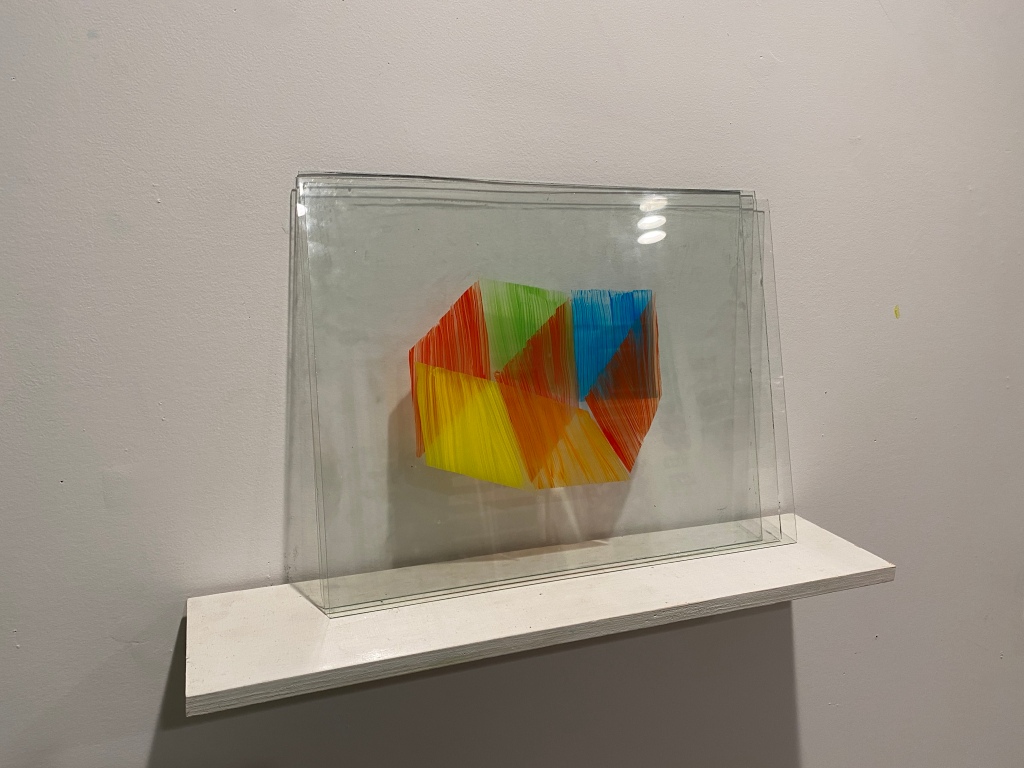
As I recently blogged I have started to shift some of the focus of my practice to material reuse, with the addition to content being, I think, landfill waste diversion and more specifically, avoidance of methane emissions. Since the work pictured in the link above, I’ve created the work below, which has three layers of glass inside a frame of dumpster-rescued framing lumber. While at first I felt compelled to try to pound the square that is cube into the circle that is oh never mind… anyway, contradiction of materiality is still present I believe, as well as choice and chance (any time one cuts through a piece of wood you reveal something that isn’t known in advance).
I’ll freely admit the composition makes it hard to not think of Josef Albers famous Homage to the Square series. Alber’s teaching has a lot of influence on me- I use many of the exercises out of Interaction of Color when I teach. There’s already a lot of links in this blog so if the reader isn’t familiar with any of this maybe just stop and Google for the next six hours. Seriously. Have fun!
There is of course an Albers entry on the Guggenheim’s site- their/his page has this quote “The optical effects Albers created—shimmering color contrasts and the illusion of receding and advancing planes—were meant not so much to deceive the eye as to challenge the viewer’s faculties of visual reception. This shift in emphasis from perception willed by the artist to reception engineered by the viewer is the philosophical root of the Homage to the Square series.” Albers was also apparently very spiritual, having at one point said “Good to know that rubies have depth. But more to see that pebbles are miraculous.”
I’ve written about the value of contemplation and awe on this blog, so all this feels right in the strike zone. And since I came through art school during the postmodernist wars of the ’90s I’m all good on quotation/appropriation blah blah blah moving on. However, this last week I really felt myself getting hung up on the word “homage,” given the definition- while Albers no doubt meant “expression of high regard : respect” the word drives from an older practice, “a feudal ceremony by which a man expresses allegiance as the vassal of a lord.” Respect I can do, no prob- I think there’s even a nice tie-in between homage and reverence, in the context of Albers spirituality and (this artist’s perceived need to) hold humanity and our continued struggle through and towards valuable enough to have… faith and maybe practice something like devotion? However, as a child that grew up in the doctrinaire environment of an Evangelical household, allegiance is a bridge too far (my afore-mentioned post-structuralist indoctrination education notwithstanding).
The issues I am (was?) having with positioning really came to the fore for me this week with a recent post by Laurie at Two Coats about an exhibit of Noland, Stella and Olitski that was cancelled at the last minute. tldr; I demurred and my (hot) take is/was that the museum in question missed an opportunity by passing on a planned exhibit to hold both truths- that the mores of many late Modernists were exclusionary and they themselves were not diverse or valuing of the same and that their work can and does hold relevance to history and contemporary audiences. To close the loop here, I’m thinking and writing about this topic because I know Albers was not an ally, forgiving him for the time in which he was raised aside. He apparently sexually assaulted Audrey Flack at Yale (I first learned about his misdeed through this Hyperallergic podcast which, like Ms Flack, is amazing for a lot of reasons, her revelations about his abuse and my own struggles to continue to use his text for teaching afterward notwithstanding).
So where am I- swimming in contradiction, where else? But seriously, I did have the opportunity to submit the work to a group show this week and so all of the above is the backstory to the following first draft of a statement for the work, which I simply titled “through” and is, I’m hoping, the first of several (many?) works in a new series…
The materials used for this work are recycled, specifically, they are scavenged from construction dumpsters which means they represent waste diverted from landfills. Landfill gas (LFG) is a natural byproduct of the decomposition of organic material such as wood waste in landfills. LFG is composed of roughly 50 percent methane (the primary component of natural gas), 50 percent carbon dioxide (CO2) and a small amount of non-methane organic compounds. Methane is a potent greenhouse gas at least 28 times more effective than CO2 at trapping heat in the atmosphere over a 100-year period, per the latest Intergovernmental Panel on Climate Change (IPCC) assessment report (AR5).
The work also directly references the Homage to the Square series of prints and drawings made in the last century by Bauhaus artist and teacher Josef Albers (1888–1976). Considered an ascetic by some academics, his spiritual disposition is evidenced in the following quote: “Good to know that rubies have depth. But more to see that pebbles are miraculous.”
Modernism, and artists we categorize as Modernists, while not monolithic, generally shared a belief in the possibility and the importance of progress as a goal, which may seem naive today and can also be seen as aspirational. Many espoused “universal” principles- a belief in the value of all life (even as in practice they often fell short of their own ideals)- and believed science should and could be used to understand human reality.
The word “through” has many different meanings for Westerners, including “moving from one side to another,” as is the case for viewers looking “through” the layers of translucent paint and glass in the work. For this artist, the definition of “through” that is perhaps most relevant to my intent of pointing at the state of passing “through” this time of (climate) crisis is “continuing in time toward completion of a process or period.”
Over at Two Coats of Paint, Saul Ostrow and Adam Simon are slinging words, and I’m picking sides. Well, I have picked sides*.
Saul penned Painting simulacra: Brice Marden, David Reed, and Gerhard Richter a couple of weeks ago at this point. If you think any of my writing is dense I’d steer clear; I’ve read it twice and am still not sure I get all his points. Suffice to say, it’s apparently still important for Art-with-a-big-A to have some kind of mission and we’re all supposed to be working that post-structuralist saw, never mind that post-structuralism for all its value is almost only a critique of structuralism. Or maybe I just don’t truck with the idea that painting is only good/correct if it is propped up by conceptual finger-wagging, which in my mind reduces it to a sign or symbol for an idea.
Also, put a pen in Ostrow’s preoccupation with a disdain for authenticity, given our current ethos, supported and propped up by most critics, like Ostrow, that regularly centers identity within Art. One to chew on and write about later (I don’t think he owns that critical bent btw, not even close) …
Simon’s response has this beaut in the first paragraph- “Ostrow’s critique is dense, and appears to implicate most contemporary gestural abstract painters as well as contemporary criticism that dismisses the possibility of radical formalism” -and he finishes with “Art is one of the primary areas of human experience in which something can be itself and its opposite simultaneously.” I think the tldr, and probably the easy button, would be that Simon has, for lack of a better word, a love of and therefore graciousness towards object makers that Ostrow doesn’t. The ungenerous tldr of Ostrow’s article is that he’s resentful of Art that doesn’t illustrate his current critical interests (again- painting exists to point at ideas, not to just, you know, exist), which admittedly sounds like resentment all on its own. Also, he is, in fact, a critic.
I’m aware that a phenomenological viewpoint (IE the bracketing I reference above) is generally considered a late Modernist and pre-structuralist stance, so it may seem odd or at least off that I would critique Ostrow’s preoccupation with Art-with-a-big-A. I’ll note that in a truly post-historical world no one cares what the grown ups think and we can point at ideas from history as a way of pointing to a generally understood meaning, rather than pledging allegiance. I’m also 100% certain I’ve written past iterations of artist statements that included the phrase “we should all just make what we want and let history figure out what is Art and what isn’t.” If I was asked to comment on any of those versions today I think it’s clear I’ve moved on from anything after that “and.”
BTW, I’ll make a few additional notes; as one can see for themselves in the comments on Simon’s piece, a) Ostrow responded that he appreciated the thoughtful response and that the critical discourse could use more of this species of dialogue (here here for people expressing disagreement and being willing to have a beer after) and b) the gender divide over who just said “thanks” and who felt the need to pontificate was uh, noticed (says he who just wrote all the stuff above). Also and, “yes” there are blogs on this site about Marden, Richter, Reed, and many of the other artists Ostrow mentions as well as many, many others (search below).
Inspired by reading the unabridged story of how Jane Cheekbecame an installation artist and having the special privilege of hanging out in her studio for a couple hours one afternoon recently, I’ve decided to practice sincere flattery.
Like many of you reading this, I was one of those creative kids (I’ve hinted at what I see as the psychological benefits of my particular childhood before over on my IG feed). Although I grew up taking art lessons and enjoying drawing, the first time I fell in love with painting- I should clarify, “abstract painting”- was senior year of high school. Up in the attic of my parents house I found one of Pop’s old stretchers from his undergraduate days (art minor), around which I wrapped a bed sheet I think. I went at it with a bunch of old house paint and something about the challenge of making an image without relying on naturalism captured me almost instantly.
I continued to try my hand with no outside direction into my first year of undergrad at the University of Charlotte. Probably not surprisingly- given my affinity for implying space using isometric cubes- I started down my college path in architecture school. I soon tired because I felt I didn’t want clients telling me what to do (yeah, it sounds pretty childish to me now, too) and switched to fine art. I signed up for an intermediate level class on abstract painting second semester Sophomore year and quickly found out that our library had hundreds of monographs on artists who also worked in this vein (let’s be honest- many of us grew up knowing abstract painting was a “thing” but couldn’t name a single practitioner). I was drawn to the Abstract Expressionists first and sort of worked my way forward to what was happening while I was in undergrad (for me, it was mostly about the likes of Lydia Dona, Fabian Marcaccio, David Reed and Jonathan Lasker– the biggest survey of the era in which I was schooled was/is Conceptual Abstraction).
This was the time in my life when the young, idealistic me became an Artist- a love of making was cemented as well as my predisposition to making what at the time I would have called serious work. I quickly went from small scale studies in my dorm room to 4’x8′ and sometimes larger, much to the chagrin of my professors (undergrad studio space was limited).
The 90s weren’t a bad or great time to be making abstract painting- painters still got their fair share of Artforum covers– and I felt like being an outsider inside the little Art world which was outside the real world was just fine. Rebelling against the rebels and all that. I was still recovering from being raised MAGA so I’m sure that played into it. All the above is to say that a) I am and mostly have always been drawn to paintings that would be called non-objective, abstract, or formalist and b) I recognize, due to academic training, that the idiom I wield is part of a tradition that grew out of Western painting.
Like all serious undergrads, I elected to try grad school too, of course, and started at the University of Houston in the Fall of 1998. In the middle of second year (of a three year program) I began to notice my lack of concern for the academic art world, and at that moment, fighting thousands of other MFAs for a limited number of opportunities to hang around a caste of characters who I almost entirely found boorish. I immediately took time off from grad school and began working odd jobs and making small op-art pieces based on my love of color field/op art practitioners and a Hannah Barbara pallet. I had some success with a couple of new galleries in the Houston market.
Life happened quickly after that, in the form of a first child in 2001, followed by officially exiting the grad program prior to receiving an MFA. I had been staying home to raise our first kid, an experience that changed who I am as a human, and found when attempting to reenter the program that grad schools expect full time commitments, which doesn’t allow for working parents with kids- ooops for diversity… A reevaluation of our life goals lead to a move back home to North Carolina in 2003, which was a starting over for us in almost every way.
After the move, I painted some- at first. My energy and focus was centered on trying to find work in clean energy, thanks to the influence of the book Natural Capitalism, which did eventually become my profession. My desire to make art began to dim to the point that, sometime in 2009, after not painting any if at all for several years, I gave all my paint and brushes/knives to a colleague (insert a chunk of years where I spend zero time trying to be or even describing myself as an artist).
Fast forward to 2016 (I generally tell people at this point I had been not-an-artist for about a decade). A couple of things happened that created a situation and elicited a reaction from me that my parent’s generation would have called a mid life crisis (I was 41 at the time). Within about a six month period, our eldest’s depression reached a point where he needed a massive ramp-up in resources including a couple of stints in short-term, resident psychiatric care, and I was let go by my employer on the same day our general contractor started a six-figure renovation of our home that would require us moving out for six months. I do want the reader to know how grateful I am for the people I had around me at the time (and still do, especially Jessica Bowen, my amazing and talented spouse of 27 years, who also blogs) which enabled me to be there for our son, who survived depression because of music. And, this was a challenging time emotionally that made me rethink my priorities and objectives for life (like I said, midlife “crisis”).
Around this time I started taking photos of clouds- we were having a really wet June in North Carolina, and a side benefit of all the thunderstorms was that some of the cloud formations were pretty amazing. The primary reason was the brief but material calm it gave me to focus on a moment of wonder- to contemplate (and also the take advantage of the chance I had to make a choice- words/ideas/themes that are still within my practice today). This activity morphed into a regular (wait for it) practice. I thought of these snaps as sketches, compositions of shapes and lines, often with color as an important element. I fired up an Instagram account and began to share them with my social circle (which, again, didn’t include Artists since I wasn’t one). With my final #abstractionallaroundus post on my old IG feed, I wrote what can only be described as an artist statement that hinted at my interest in automatism (yes, we’re getting to installation art, I promise).
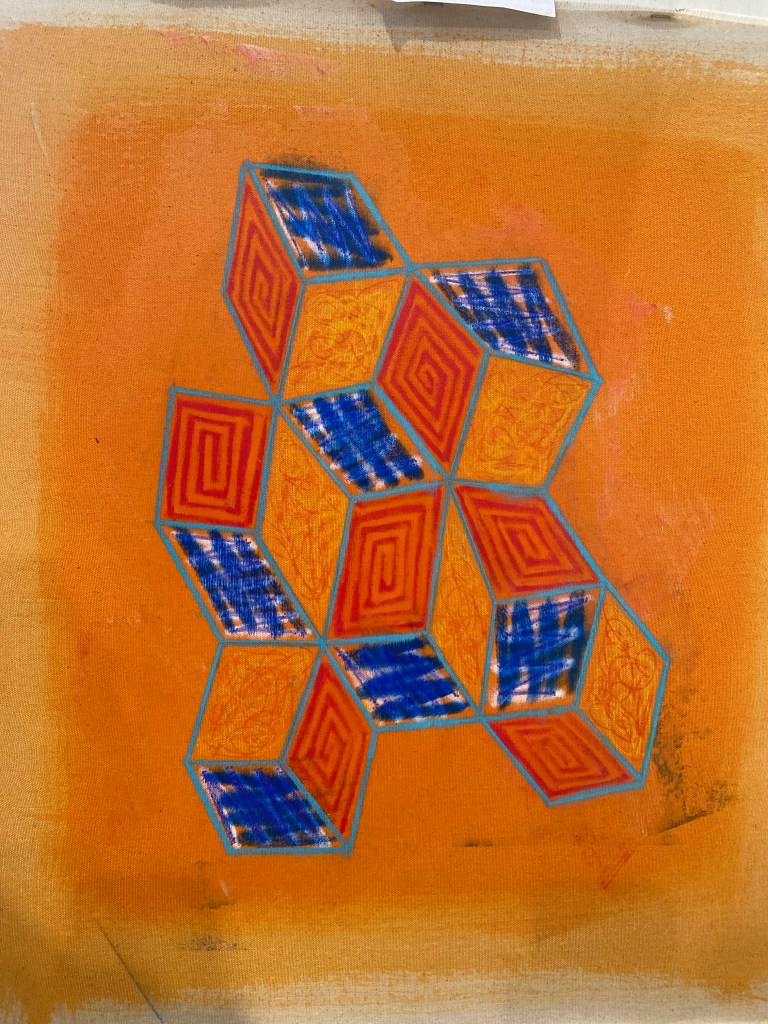
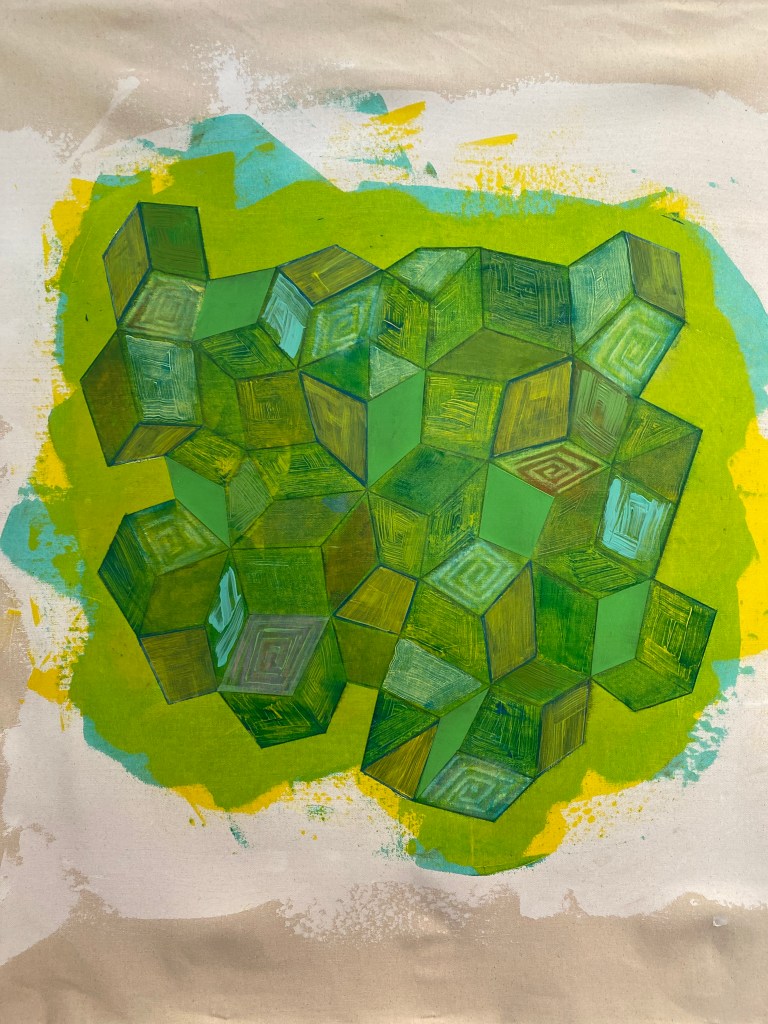
By 2017 my re-blossoming creativity had morphed into making drawings and paintings, too, first on scrap cardboard and eventually on canvas, and which were based on a system of automatic drawing utilizing interconnected cubes, which readers will recognize, and which had actually surfaced towards the end of my time at the University of Houston. Rebooting was the easiest place to start and in retrospect given how it has sustained me, a good decision. As I made more, I sought out the input of other creatives, and ended up joining an Artist affinity/crit group through an art venue cum artist incubator that at the time was Visual Art Exchange in Raleigh (now known at VAE and which has a different and improved mission). I still f&ck with the cats I met through VAE today; community is one of the best parts of being an artist. Also and, regular crits are important (to give and receive), try to fit it into your practice.
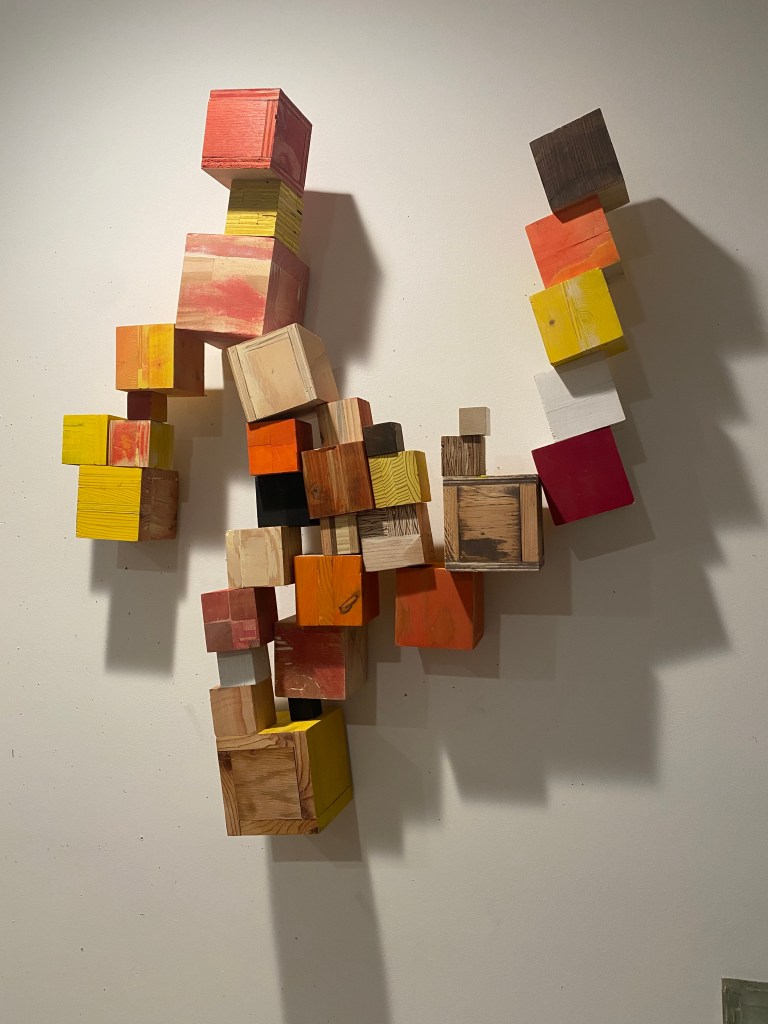
How does this relate to being an installation artist (and yes I still do and will always paint)? In one of these crits in very early 2020*, someone made an observation that the paintings I was making at the time didn’t have any clear source of light or relation to gravity. It’s sort of amazing what comments you hear- both as an artist and also in life in general- that will really hit home for you. This one did, and I spent the next couple of days thinking about light and gravity and wondering if it the best way to incorporate those concepts wouldn’t be to just make physical cubes. We all see what the answer was/is.
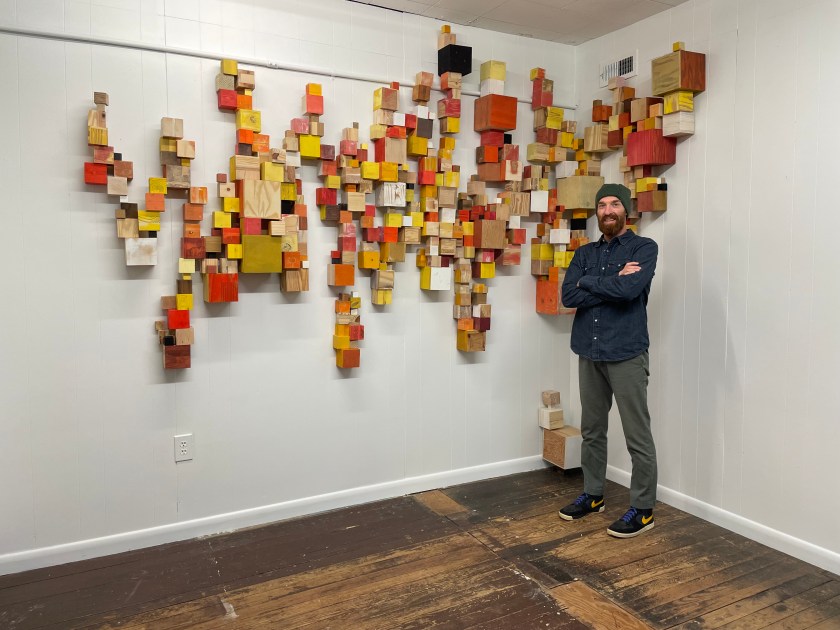
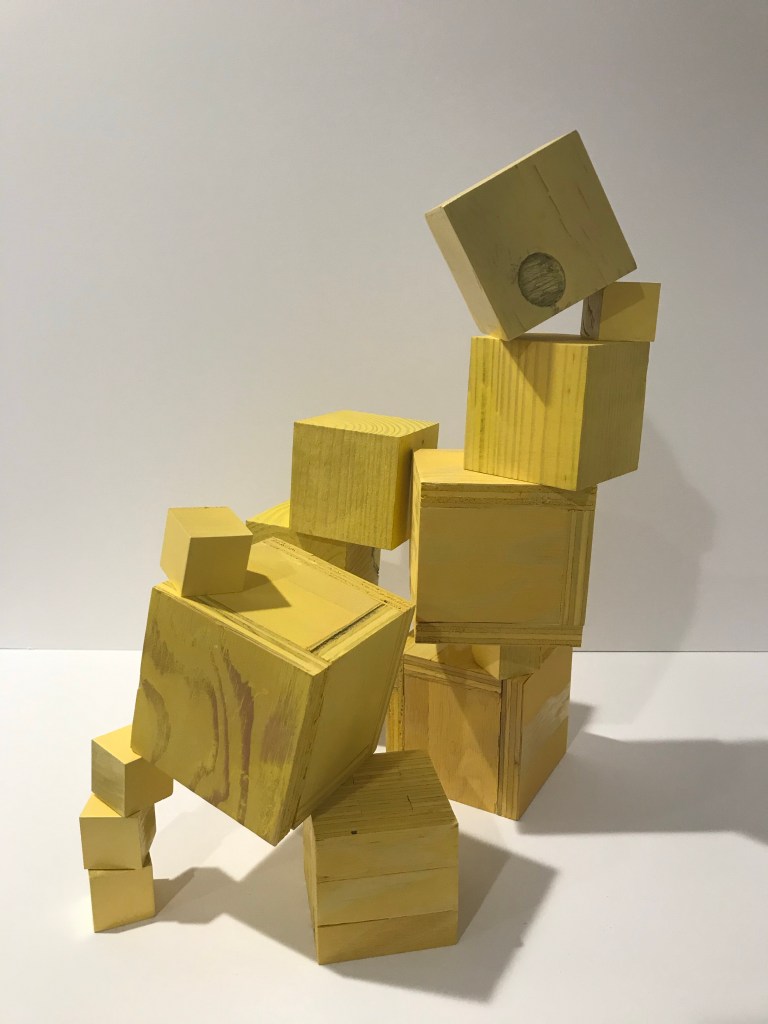
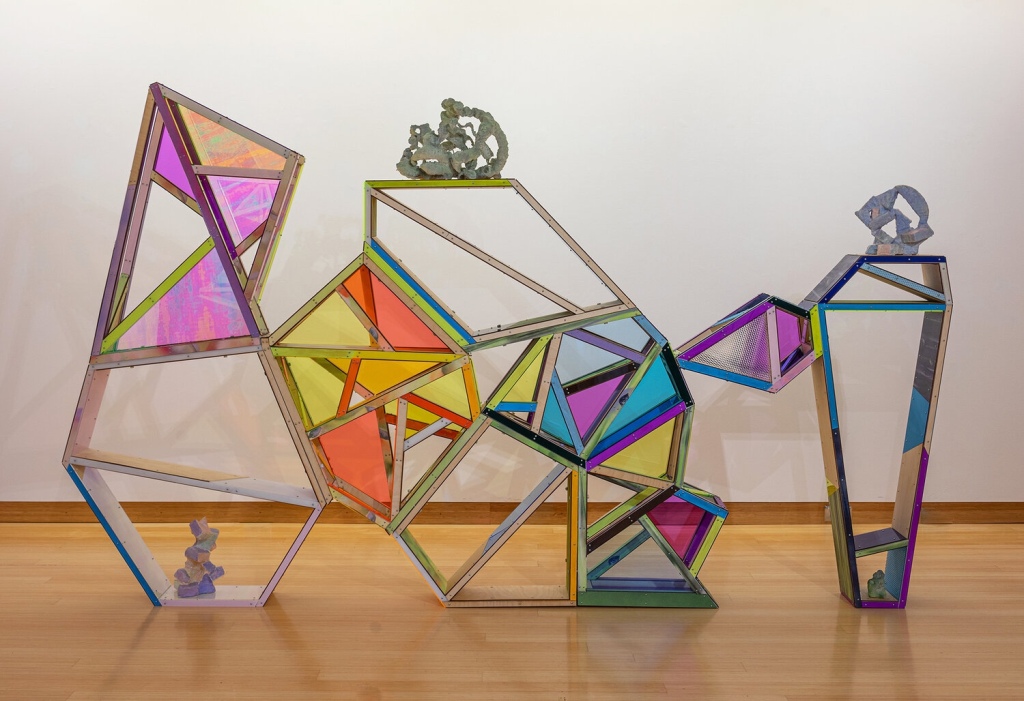
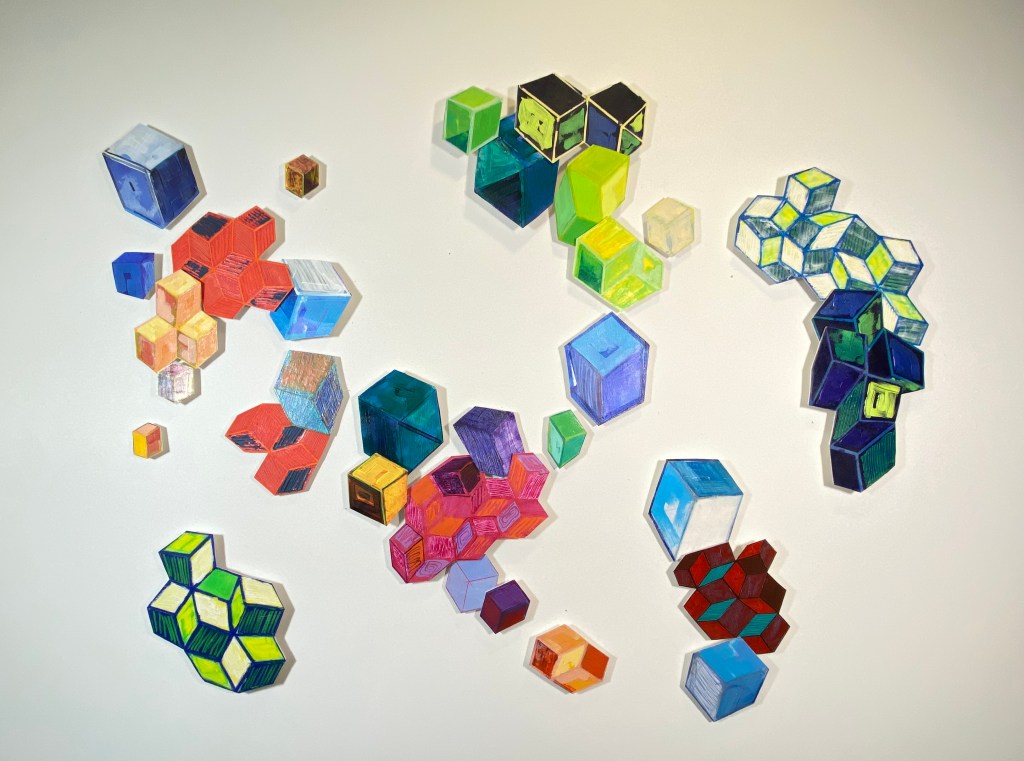
Early iterations are above. *I’m sure the reader will also note the context of the year in reference, so for me, the pandemic all of sudden became a time to make objects- eventually, a lot of them. This project has become a work in and of itself, that I’ve now shown in a number of iterations and look forward to installing this April at Art Fields art fair in South Carolina. I’ve written about the integration of this physical and always temporary manifestation of automatism into my practice often, and am grateful for the addition of this modality to my practice. It is a way for me to more clearly incorporate the theme of contemplation (for the audience) by centering a time element- no composition or presentation is ever repeated exactly the same, and their creation is very chance-dependent (they are never planned other than location). The nod to early Modernism via the cube is still present and perhaps even stronger since, even though the surfaces stand in for impasto and, given color, each cube can be thought of as a brush stroke, they are more clearly cubes than the painted compositions. I appreciate everyone in the local community who has supported this project!
I thought that, since today (Monday, January 15, 2024) is set aside to remember the legacy of Dr Martin Luther King, I would look on the interwebs to see if any of his many quotes addressed Art or creativity. While I wasn’t rewarded by discovering he was openly or even secretly an Art lover, I like many people I’m sure was impressed with the clarity of values that he demonstrated on so many occasions. I think the following probably resonated with me strongest (in the context of thinking about Art specifically:
“All labor that uplifts humanity has dignity and importance and should be undertaken with painstaking excellence”
MLK Jr
If any of you, readers, are interested in spending some of your time away from laboring for the man today trying to rebalance your own knowledge of Artists inside and outside the canon to be more comprehensive, I hope you’ll take a look through this list of black artists (I use hashtags to put broad and admittedly not nuanced categories around my posts, mostly as a tool to help me find the artists again later on this site). As an abstractionist I hope, if you are here to learn about new artists, you will look into some of my personal favorites; Stanley Whitney (literally my favorite painter), William T. Williams, Leonardo Drew, and Julie Mehretu (the first artist I ever blogged about on this site). I also can’t say enough about Sanford Biggers who isn’t an abstractionist and has made non-figurative work. I’m also very much looking forward to what Jeffrey Gibson will produce for the next Venice Bienniale.
Some of you may have caught one of my IG posts in the last month where I have soft unveiled a new work, which used to be called remixes (locals may have seen prior iterations at Golden Belt Arts in Durham or at Hartwell in Raleigh via Charlotte Russell Contemporary). While the piece still has the element of up cycling, the primary impetus and hope for the piece is that viewers will interact with it in the way I can be seen interacting in the stop motion video below. Not 100% certain what I’ll title this one yet*.
I’ve also previously done collab work with the audience using a web form, early on in development of the wooden cube system I’ve developed, which resulted in works like below. My collaborators were other friends who would give me instructions (an inverse Sol Lewit) via web form- they would indicate quantity, size and color of cubes that I could use to create a temporary work. Each participant was emailed an image of the configuration of cubes I made based on their instructions.
So I am still interested in Sol, sort of. I think the idea of an… idea that becomes a machine is interesting in 2023 across some dimensions that didn’t even exist in the ’60s. Also, as an artist interested in contradiction, I like the idea of inverting Sol’s positioning of his idea as the impetus for an audience-collaborator’s use of materials and giving the same materials but no prompt.
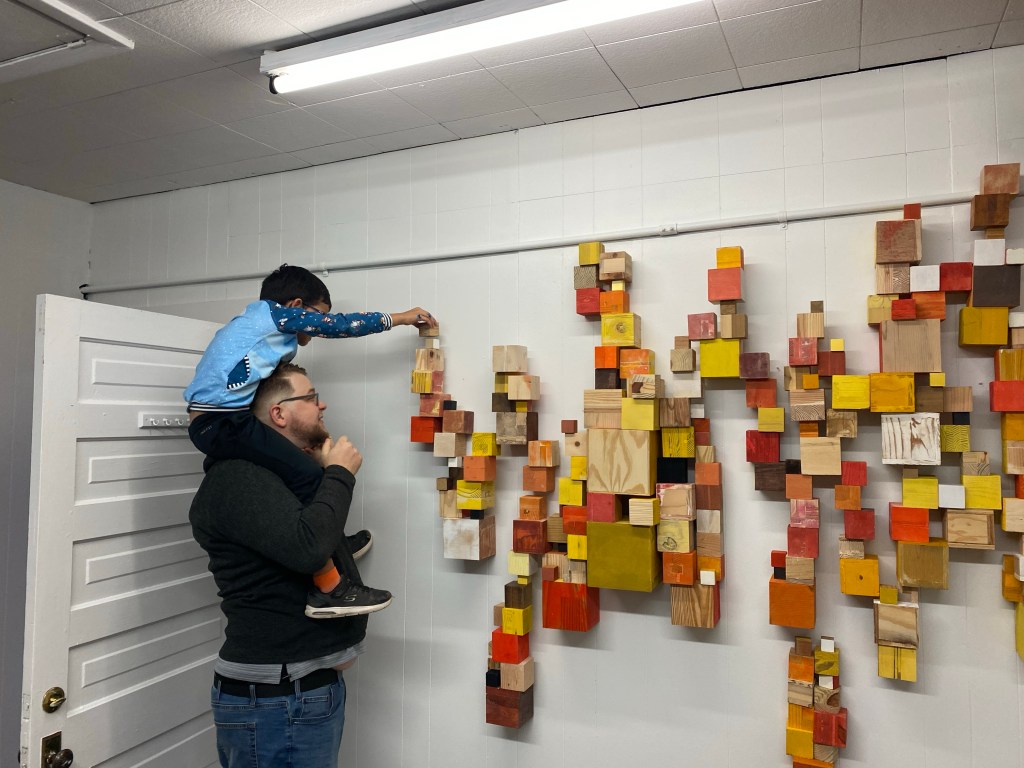
I have also integrated this thinking as part of my ongoing activation at/in my friend, Tom‘s, studio space at the Carter building on South Glenwood in Raleigh. I’ve made the open invitation to folks who pop through the space during the First Friday art crawl to participate in assembling the piece, and their reactions have been not surprising (they show surprise, and almost always uncertainty, too) and instructive. People also call them blocks btw (not “cubes”) because, well…
At first when I started all of these projects I felt like their guiding theme was a hypothesis of mine regarding the role of the audience in creating the content of the (non-figurative) work. Now, maybe, I think… the thematic entree for ideas into this work relates to another part of my practice, my afore-mentioned interest in contradiction, in particular the contradiction of the desire for control and chance to both exist in the work. These two concepts seem really material (haha) in the context of (American, middle class) life in 2023, no, oops- 2024 (Happy New Year, readers!). What I mean is that I have a sense, in my gut, that giving control of something you own to others, and letting chance- real abdication- steer outcomes in your work brings up all the feelings. Further, this set of actions seems to have a level of associated risk, in the context of this moment, that feels specific and intense. Said differently, I feel weird just trusting other people not to use power over me, or something I made, for ill intent. I am only beginning with this blog to attach words to these feelings and impulses and I look forward to talking about these ideas with many of you over the coming weeks!
*The working title I have for the piece, which will be shown publicly at Wilma Daniel’s gallery at Cape Fear Community College, is “Go Ahead Make Sense Of It All.” Part instructions, part acceding, part admonishment.
I’ll begin my run-down for the exhibits I enjoyed the most this year by using the same phrase I began last year’s wrap-up post– I am not even sure how to write a sentence that expresses how lucky I feel to live in the Triangle. In terms of what it means to me to have a community within which a satisfying practice can be established, I can’t think of a better area to settle (this year was number 20 living here btw).
I’ll also append above to note that the Triangle is home to a (really big) handful of the venues that the Carolinas have to offer, and there were certainly exhibits in other cities that I enjoyed immensely- a worthy aspiration to think about having the time to visit every city in the Carolinas regularly. While I don’t repeat local venues below, I’ll also note that all of them had more than one worthwhile exhibit this year, and there are other locations that are not included that I hope you will also continue to give your attention in 2024 (I will). Regular readers will also not be surprised by my preference for non-figurative work- I also hope that the presence, even predominance, of narrative work in this “review” is evidence that the Art world remains a place to surprise each of us if we are open.
Just like last year, this year I also had a favorite show. The CAM‘s Neo-Psychedlia, co-curated by Dr Kathryn Desplanque and Raj Bunnag (two outstanding and quickly rising stars in their own right) features Kathryn’s work as well as that of Charlie Dupree, Chieko Murasugi, Jerstin Crosby, Tonya Solley-Thornton and Zach Storm. The strength of the painting (and love of materials in general) in this show aside, I can’t hide the fact that the premise of the show resonated strongly with me because of themes that influence my own practice. I’ve written recently myself about the idea of revisiting former epochs, so I relate to Desplanque’s jumping off point which she conveys in the show statement (IE noting the what/when/where of Psychedelias’ original iterations). She then points to the context of our current moment and the relationship of the impulse to create alternative realities to a broader cultural and social agenda. Plus, the CAM is such an amazing venue.
BTW, despite this truly being my favorite exhibit, I was hard to keep to my rule of not repeating venues, given how important From Warehouse To Our House: The Monumental Work Of Vernon Pratt was to me, as an abstract painter. So, we’ll give that one an honorable mention. Go team abstraction!
Anchorlight brought us Maxito: A Memorial Exhibition by Lope Max Díaz mid year. Anyone who ever thought hard-edge abstraction was cold and impersonal should consider this work. Wonderful to see Lope’s production and the arc of his career here in the Triangle recognized, and this particular group of objects were/are a solid synthesis of high Modernism’s calls to contemplation with a context (Lope’s loss of his son unexpectedly) that merges the personal with the universality of loss.
Lump was home this year to the largest group show they’ve hosted in a minute, with the fantastic name Slump (I hope in the future they’ll program Plump and Clump, Bill that’s a note for you if you’re reading). With 19 artists in all, the exhibit schlizerped its way around the entire building- floors and all areas on the walls- snatching your eye and mind in what felt like 1,900 directions. Fantastic curatorial effort by Jerstin Crosby.
Diamante Arts and Cultural Center really blew me away with Ambiorix Santos Huellas. It is/was a tour de force of gestural abstraction which I visited a couple of times. I was inspired to see another painter who is not afraid at all to reach and strive, who is confidentially making marks and dealing with the results as they happen, keeping what matters and obliterating what doesn’t. Kudos to Peter Marin for programming this one (and for having an outstanding show there himself earlier in 2023).
Meredith College Weems Gallery was the site of Nathan GrimesHome | Body. It’s really hard to convey just how monumental this show was in terms of breadth and scale and diversity of strategies for shaping and informing physical space. There were elements of sound and touch at work as well. I truly hope you all got a chance to spend some time with it and I also hope very much to see it programmed in other venues in our region soon- it is mature work that needs to be seen. I am sure part of the connection I felt to Nathan’s work was the shared adult experience of reflecting on and moving past damage done to us during childhood. I look forward to seeing what Todd Jones programs for this venue in 2024.
Adrift by Oami Powers takes the every day, or at least things we would say we know, and, somehow, makes it strange (or perhaps reminds us of the strangeness that all we can ever say about a thing is to attempt to recount our own memories with which it is associated). Powers notes in her show statement that elements “shift in and out of focus, a dreamlike, fragmented realism that blurs into abstraction.” For me, this exhibit was a very direct way to point at things we can never quite put our finger on. Well done, as always, Annah Lee and Artspace, which continues to be host and home to so much creative energy.
The Rubenstein Arts Center at Duke was the site of Marie-Louise Bennett‘s thesis show Returning to the Point of Entanglement which also leveraged multi-media to deal with the theme of memories as well as societal expectations and one’s place of origin, among others. Like Powers, Bennett uses things with which many of us have experiences- church pews or a “fort” made of household furniture and blankets- as jumping off points that lead to questions (like Powers she also tied the exhibit together through use of materials and color). I thought about the “doll” with an old, analog camera instead of eyes, and reflected on how we store memories in our mushy, very human brains, without meta-data or a cataloging system or anything approaching objectivity, for many days after viewing it.
Popbox project brought us what was easily the most meta exhibit of the year in Jim Lee‘s upstART Gallery project which pointed at the world by pointing at how the art world points at the world. The fact that Jim’s practice was new to me was a welcome reminder of just how rich our scene is- the number of co-collaborators that provided work for this project speaks to how much this practice is respected locally as well. Similar to Nathan’s show, it’s pretty hard to capture the breadth and scope of what Jim accomplished with this project, both in terms of the magnitude of work inverted and emphasized by its scale, and in terms of it galvanizing a community (I found this show in my social media feed continuously for several weeks as we all celebrated it). I very much hope to see what the duo of Mavis Gregg and Laurie Ritchie bring us in 2024.
Those of us who have wanted to see what’s next for Basement were rewarded with a near perfect merging of setting and objects in Martiń Wannam‘s La Eterna Injustica. Having seen the call for the Radicle residency, it’s clear the team at Basement were looking for a creative that would make work for the space. Sure, I share a love of maximalism, and there is also an element of contradiction at work here as well. Then again, maybe what I loved most was the unfinished setting for the unfinished project of building an inclusive future. The team at Basement did us all a service by bringing a vision of life from outside American culture to the Triangle.
And last but definitely not least I want to give big propers to our (NC) Museum of Art for their reorganization of The People’s Collection (and yes, I am totally blissed out that they’ve used the opportunity to pull some amazing abstraction out of storage). The job of museums (this writer thinks) is to educate, and this re-contextualization of our permanent collection was a welcome and necessary move towards celebrating the diversity of human experience and ensuring that future generations have a comprehensive understanding of what they are seeing. And also, abstraction.
I’ll also note that I am very satisfied (and immensely grateful) for having the first two attempts at curating myself this year. In April I got to organize ExtraSpectral in partnership with Durham Art Guild, which featured Jerstin, Tonya and Zach as well as Leif Zikade and Jane Cheek. And in July I was honored to be among some amazing peers in Peter as well as Carson Whitmore, Cindy Morefield, Freddie Bell, Jason Lord, Jean Gray Mohs and Natalia Torres del Valle as a part of Open Source which was shown at Lump and Sertoma Art Center, and which is an exhibit that already has planned future iterations. I’d clearly be biased to include either in my favorites list, and I’m confident that the artists I got to work with have and will get the recognition they so deserve through our involvement together in these projects. Here’s to even more amazing things in 2024! Thanks for reading whoever you are and please share this blog with your circle. Cheers, Sterling.
Earlier this week I was reading this Adam Simon piece on David’s newest in which Adam notes at one point his impression that Diao is “working out his complicated relationship to modernism.” I also think a good bit about that epoch, both as a creative whose forms reference it and whose studio practice could fairly be described as Modernist (in the sense that my visual vocabulary is intentionally stripped down). I’d say to follow that up that I relate to Simon’s description of one particular aspect of Diao’s practice- the recognition that the artist is clearly rejecting some of the ethos (in the terms that motivate me- it is true that both Modernism offered us new, relevant ways of seeing *and* had problematic aspects that contemporary artists should address).
One of the general tenants of at least late Modernists was a general belief or at least a sense of some universality of humanity. I won’t spend time unpacking the ways that’s problematic (it’s class 2) as I’d rather use the references of my work to the Modern epoch as a sort of key that contemporary art viewers should think about those ideas (as they might be applied today). Naive notions about universality aside, I think it is valuable to explore ideas about the desires we share- to be as free as possible (I’m not a Libertarian) and if possible loved, and certainly, *certainly*, to belong. I’m not sure how human society exists without some tie that binds us.
It is (was) the prominence of this concern among many Modernists that led to many, probably most if not truly all, of them espousing various forms opposition to war. I think have written (though I can’t point to a specific post) about similarities between the epoch of Modernism and our current moment. To be specific, I think many people share a general belief that our past institutions and values are not likely to serve as if we desire to move into the future. War, as state-sanctioned and enacted violence, has no place in a prosperous, meaningful future. We must end it if we wish to preserve human life on our planet, and we must relinquish it as a means to resolve human conflict.
I deploy this word as a tag on my blog for artists using materials in ways that one would have said, when I was in Art school, “that wasn’t how we were taught to use those in Art school.” Paint on canvas, pencil on paper, etc. Maybe I’ll switch to multimedia eventually…
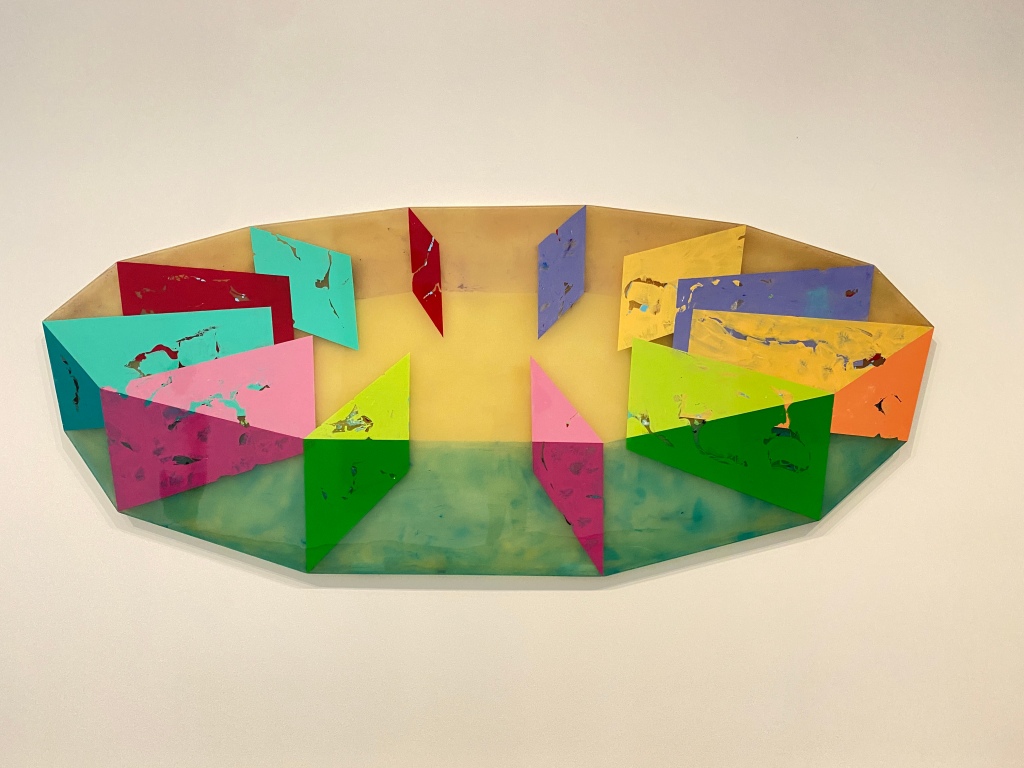
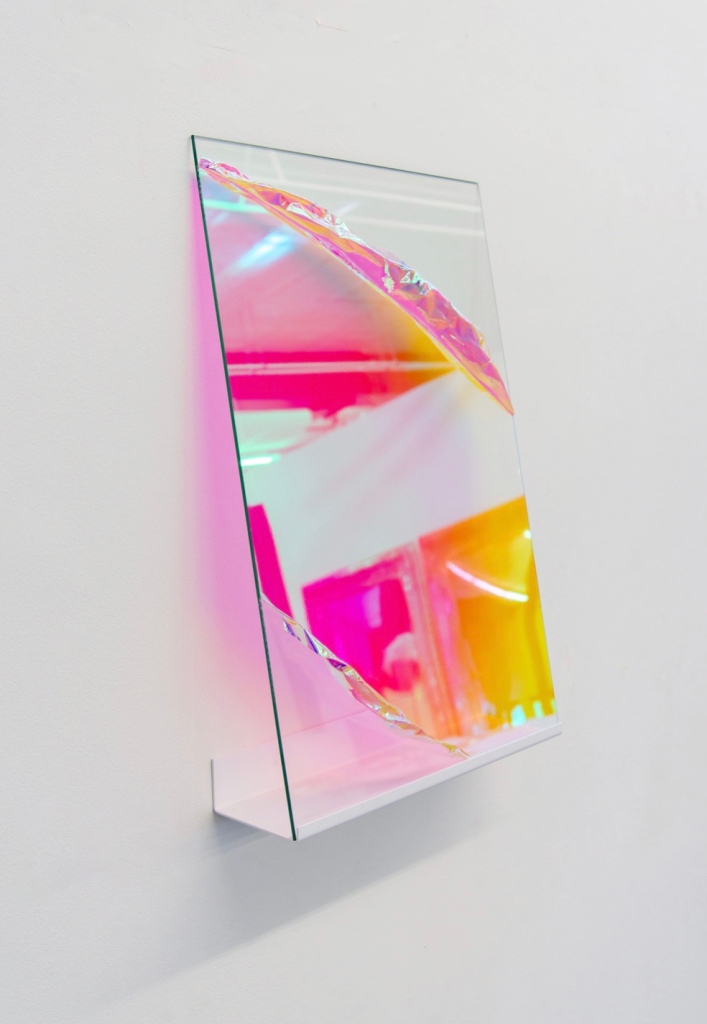
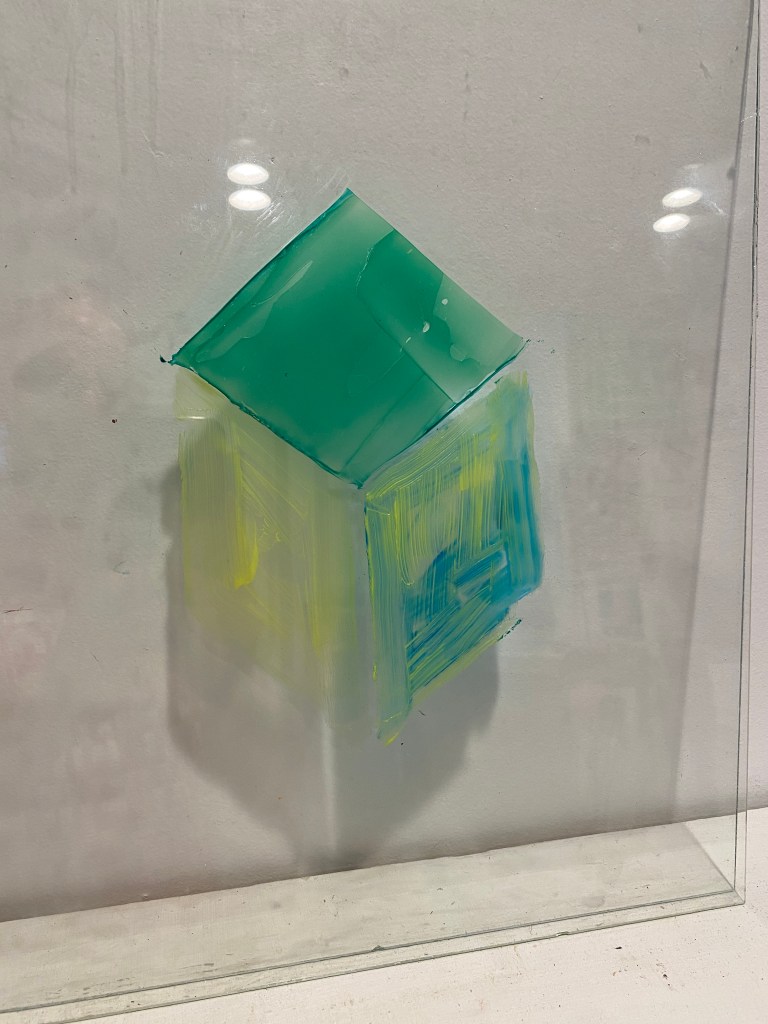
The context for this observation is that I am in the early stages of working on glass- see below. Glass is definitely a nontraditional support for painting, for a couple of reasons that are obvious to me now- it’s the worst combination of heavy and fragile, and it’s definitely not a permanent substrate for water-based paints like acrylic (all you have to do is spritz it with water and the paint, even if dry, will rub right off). Regular readers will know that impermanence is just fine with me.
While landfill waste diversion isn’t a subject for this work, it is something that matters to me- all of my other installation work, whether the cubes or my recent interactive pieces, employ material reuse. In the later case not only are the cubes reused studies, the supports, including the foam core on which the cubes are mounted, are all upcycled– only the magnets and some “virgin” paint or media are first-use.
There are still themes/ideas of contradiction to work with- the contradiction of paint that appears to be free of a support; the layering of “sides” of the cubes which is undone by them being flat shapes rather than the edges of a solid viewed in perspective. Given my recent re-writing of my artist statement, I like adding another modality (another “and”) to my practice as well. I think eventually the sheets of glass will get stacked in a way that requires the viewer to move so that the cubes “edges” align- I’m intrigued, as a means to center contemplation, by strategies that highlight any requirement for the viewer to be present and engaged.
As I work through some of the challenges with a new piece that will be mutable and interactive (for the audience- see below this blog) I’ve been thinking a good bit about Walter Pater’s famous observation that “all Art aspires to a state like music.” Yes, part of the reason is also music, having recently been to several shows by groups whose performance incorporates real-time, sometimes broad re-interpretations of compositions, resulting in art works that will never again be repeated exactly as I experienced them.
As this article observes, one interpretation of Pater’s observation “is that music is the only art whose form and content are not just inseparable, but the same. … Pater was writing at the dawn of the modern art revolution when literal representation was being purged from art and literature like pests from an old, dirty house.” I’m not going to waste a contemporary reader’s time with unpacking all the usual topics or point at what is wrong-headed about this time period in Art’s development. I hope with these words to point at the experience of live music and the quality of immediacy- of “bringing one into direct and instant involvement with something, giving rise to a sense of urgency or excitement.” Granted, as I’ve written, urgency and excitement don’t have to be the only sensations or emotions we experience through Art- awe is an option; and I’m just not convinced this moment in history is the time to narrow our aperture regarding what is or isn’t Art anyway.
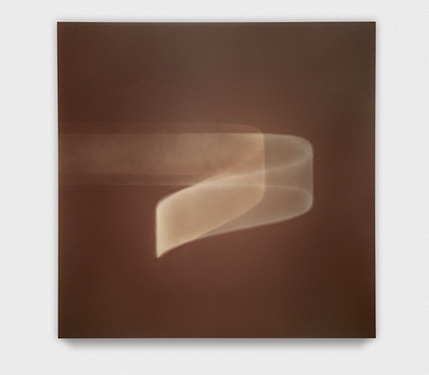
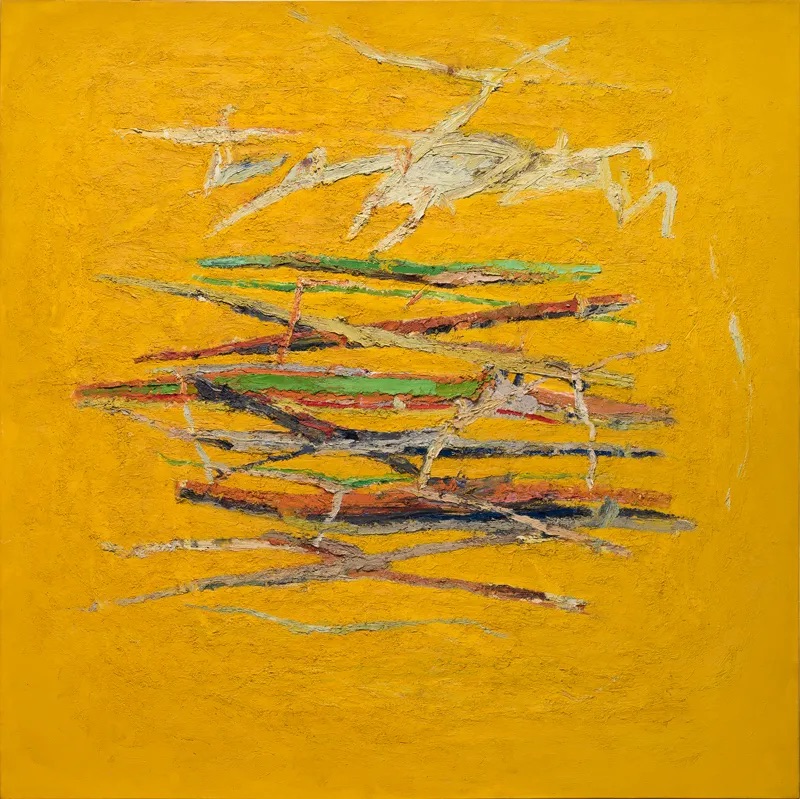
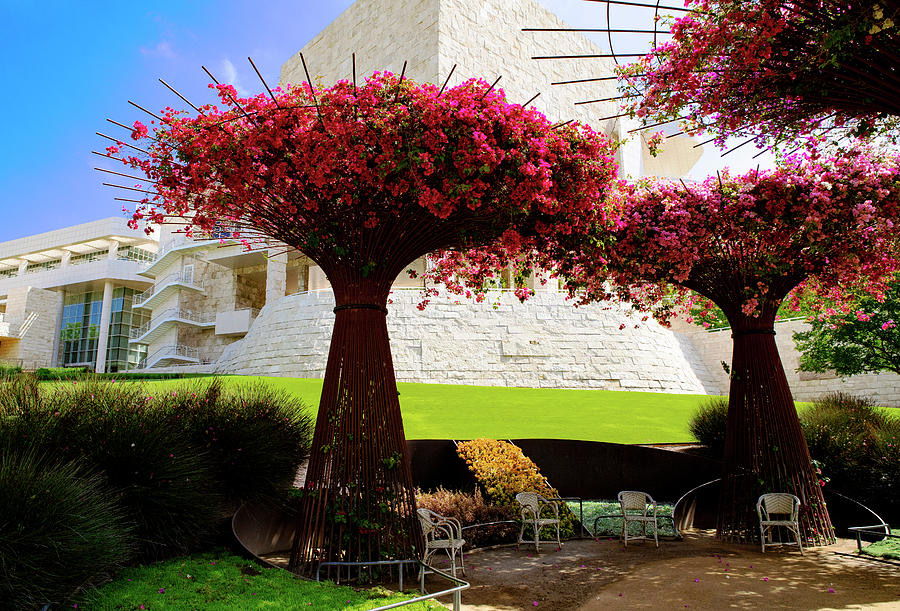
Featuring prominently in my mind these last couple of weeks has been the recent passing of Robert Irwin. There is. No. Artist that has had more influence on me than Robert. I am so privileged to have seen so much of his work, including his installation at the former DIA Beacon, the gardens at the Ghetty, his retrospective at the Hirshhorn, and the work that was included in the recent Light and Space retrospective at LACMA
“To be an artist is not a matter of making paintings or objects at all. What we are really dealing with is our state of consciousness and the shape of our perceptions.”
Robert Irwin
tldr #1; I am painting after art is dead (long live art).
tldr #2; despite having to use words to point at it (because thoughts don’t exist without language) I’m convinced that there is an experience to be had through Art that is unique to the same and exists- with immediacy- prior to our ability to describe it using language.
Now that I have your attention… so, the ever pithy Hilde Lynn Helphenstein aka Jerry Gagosian asked a question recently that I thought would be an interesting topic.
“it’s wild that art must be expensive and sold to the very elite to be considered important or good. Whenever people have attempted to make art affordable and accessible it tends to lose its allure. A print of an artwork for $30? Gross kitsch! A single work of art sold to an exclusive class of people for hundreds of thousands or millions? Meaningful, important, elegant. The scent and sheen of money on art history is so powerful that recently when speaking to a famous contemporary artist and I asked if they could sell their artwork to thousands of people but make the same amount of money, they told me that would degrade their allure as an artist. I appreciate their candor but I wondered if we can shake needing the approval of a few wealthy individuals to put a stamp on what is good or is this set in stone? Is it tacky to be understood by the masses or is this a condescending question?”
There’s so much to unpack here. Normally I would go with a “yes, and” answer, of course. I was in a workshop recently where there was a very candid discussion about making a career for oneself, and some of the particulars of working with galleries, and therefore a good deal of talk about relationships with “collectors.” That word is in quotes because it’s a stand-in that artists often use, I think, because the title of this article. My observation here is that literally no one raised any issues with the dependency of the speaker on this ecosystem, and in fact we all sat enraptured by his words hoping to find a nugget of truth we could take for ourselves so that we could carve out space for our own practices. Unpacking that is another essay though.
The “yes, and” would be “yes art is for rich fucky fucks, and, Art can still be amazing even with the primary lubricant of its existence being classism.” Probably worth mentioning that I’m not a “burn it all to the ground” guy, which shouldn’t surprise anyone who actually knows me *and* to be transparent I am a cis, het, white man living in America in 2023. All that to say, I’m enabled to sit in the position of holding this “and,” and not having an existential crisis about it (I think Jerry, I mean Hilde, probably is also). That is also another essay, and not the unpacking I wanted to do.
I’d like the reader to look at and think about many of the adjectives that are trotted out in this thought-provoking post on social media and pointed to/at as assumed goals for artists – “important,” “good,” “meaningful,” “elegant,” as well as “tacky,” and “condescending” (but as adjectives of traits to avoid). Also and, the word “allure” pops up twice in that paragraph.
I think the general question from Ms Helphenstein is about aspiration. She and her co-host on the often wonderful podcast Art Smack (Matt Capasso) have regularly dished on how to make it in the art world, aka NY City (no hate btw). Putting aside that “elegant” and “important” are pretty different aspirations, the direction I’d love to see a future episode take is a discussion of how these words resonate with and, further, motivate and drive the practice(s) of artists, in particular if the question is reworded as “to whom does the work in question seem… ?”
It’s hard to not think of Art as a meritocracy. I mean, jimminy Christmas, don’t we all want our creative output to, at *minimum*, achieve public consideration, which always, ALWAYS comes at the expense of someone else whose show proposal didn’t make the cut or whom the juror(s) ignored or just didn’t notice? And, we are told we live in a meritocracy, and therefore it shouldn’t be surprising that many, MANY people would see the “votes” of the affluent in the form of purchases of Art, and who have this status due to the merits of their labor (stick with me), as a sign of merit, as a qualification that said Art is likely elegant, or good and quite possibly important. As regular readers know I’m not opposed at all to evaluation of Art works. I’m not dogging out anyone’s position, or, again, saying “burn it all to the ground!”
That’s it. Sorry if you wanted answers. I’m just asking that we all be honest (once again) and pointing at the thing- every Artist makes stuff they want someone to see and consider (I certainly do) and I hope, whoever you are reading this, that you’ll take a few minutes to think about who “they” are and why they matter to you. Keep it real, lovelies!
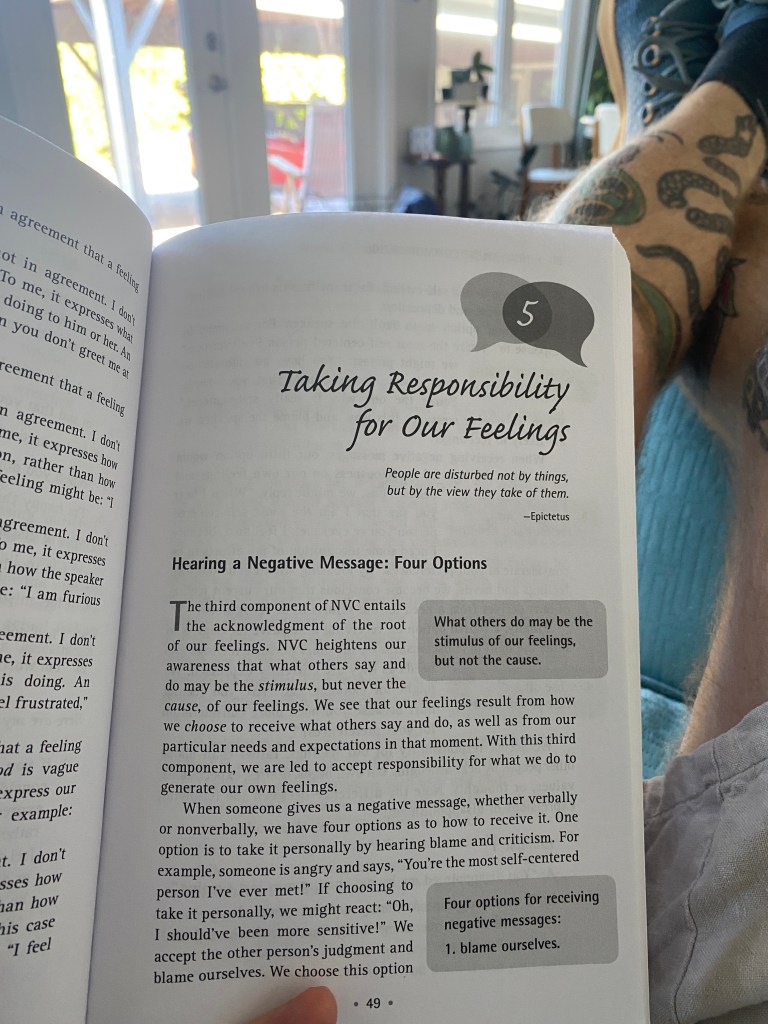
Had a rough week personally. Things didn’t go the way I wanted them to at work- specifically, the challenges I faced were not of a sharable nature, requiring me to literally lie in response to the question “how’s everything going” several times, and I really feel terrible about myself when I’m not truthful. My spouse was out of town, which meant a doubling of responsibility of course (sharing is caring), and then the universe also picked this moment for one of the pets and one of the kids to have health challenges. I didn’t get into a show (that apparently I was more emotionally invested in than I realized) and I found out another one I was certain was happening and had been making work for had been axed. And, I had set aside a (beautiful fall afternoon when I’d rather have been playing basketball and drinking beer with friends) to gallery sit, as a forcing mechanism to get some art admin done, and didn’t get everything (OK, *anything*) on my to-do list do’ed.
When we say we are disappointed what we are communicating is that we had expectations that weren’t met. That’s a totally normal feeling to have. There’s another step to take there, I think, which is examining why you feel this negative emotion. In addition to the help that Nonviolent Communication has given me in this area (below), I’ve been using Acceptance and Commitment Therapy of late. I’ve also been getting a lot of use and benefit from the mantra “I never lose, I only win or learn” (attributed to Nelson Mandela).
The show I didn’t get into? Yes it’s not a great feeling. When I chose to reflect on why I was disappointed I not only had some helpful clarity, I was able to share this with another artist who I had not yet had a 1-1 conversation with, and I learned more about them, too, as a result. Not winning, *and*, learning? Check!
Didn’t get everything on my to-do list done? When I chose to reflect on why I was beating myself up, I *learned* that I had underestimated what would be involved in a couple of the tasks, which will help me with setting goals in the future. And I did get several of the tasks started* which is moving towards the goals. Plus, a couple of the things that distracted me were items on my 3-month goals checklist. I also knocked one off this Friday, which was to hang work at the Carter Building in my friend Tom’s studio. It also helped that I went to an engaging workshop/discussion on the many paths to a rewarding practice which also centered my thoughts on my awesome arts community. And as regards my disappointment around the two shows that aren’t going to happen for me, one led to me experimenting with the work that got rejected for the first time in probably 8 months, and getting more time to work on the piece in the lower right- bladow!
No one word title or reflections on words/ideas this week. Object making is the core of my practice so I’m checking in with myself and you the reader on where that sits atm. Not that organizing and managing forward momentum towards goals isn’t important, and in fact, given the collection of projects that is my studio (and a reflection of my ADHD) it is as much an area for learning as the former. But I digress…
I’ve finished up a working on new shaped canvas and have a couple more small pieces in process. I also stretched two large canvases in order to begin larger versions of a couple of smallish pieces (last two images)- all are developments of sketches or work done during my sabbatical, for which I remain grateful.
The main project that has been drawing time and energy is new iteration of a project that I used to call remixes. Local folks have seen iterations of this project (first two images) at Golden Belt Arts and also at Hartwell in partnership with Charlotte Russell, and will also have the chance to see the newest piece in December at Lump in this year’s iteration of Strictly Voluntary. There is a hint at the upcoming development in the short video below.
Time lapse of me creating the modular pieces for this work (seen collected in a box above as well).
Voila!
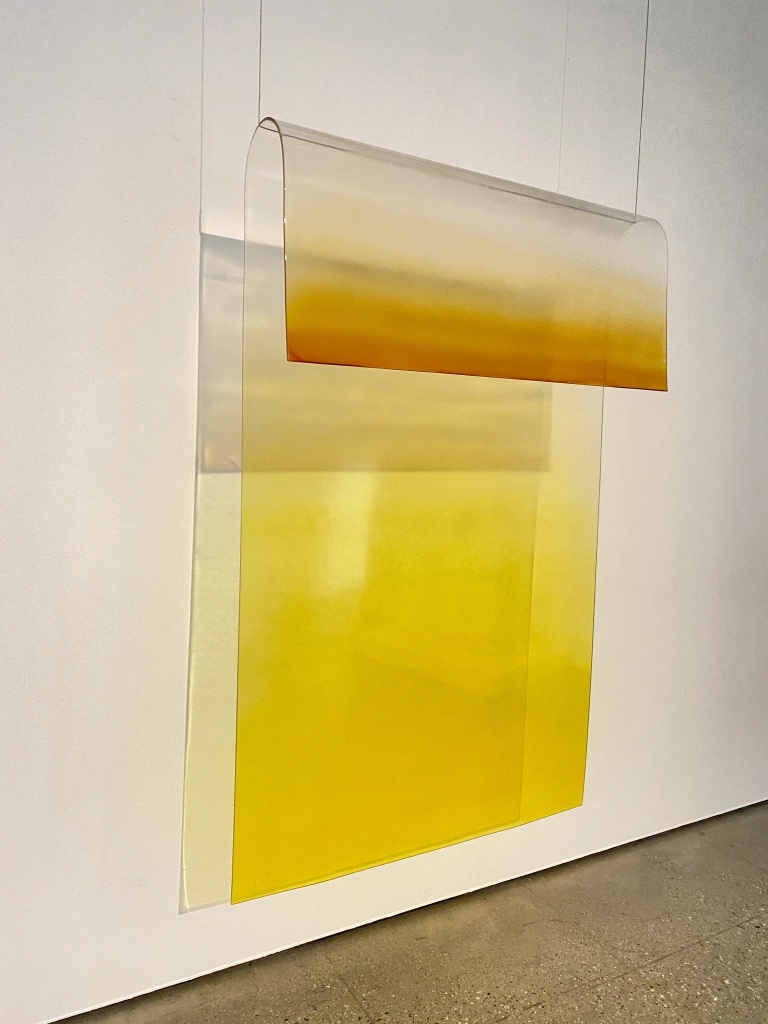
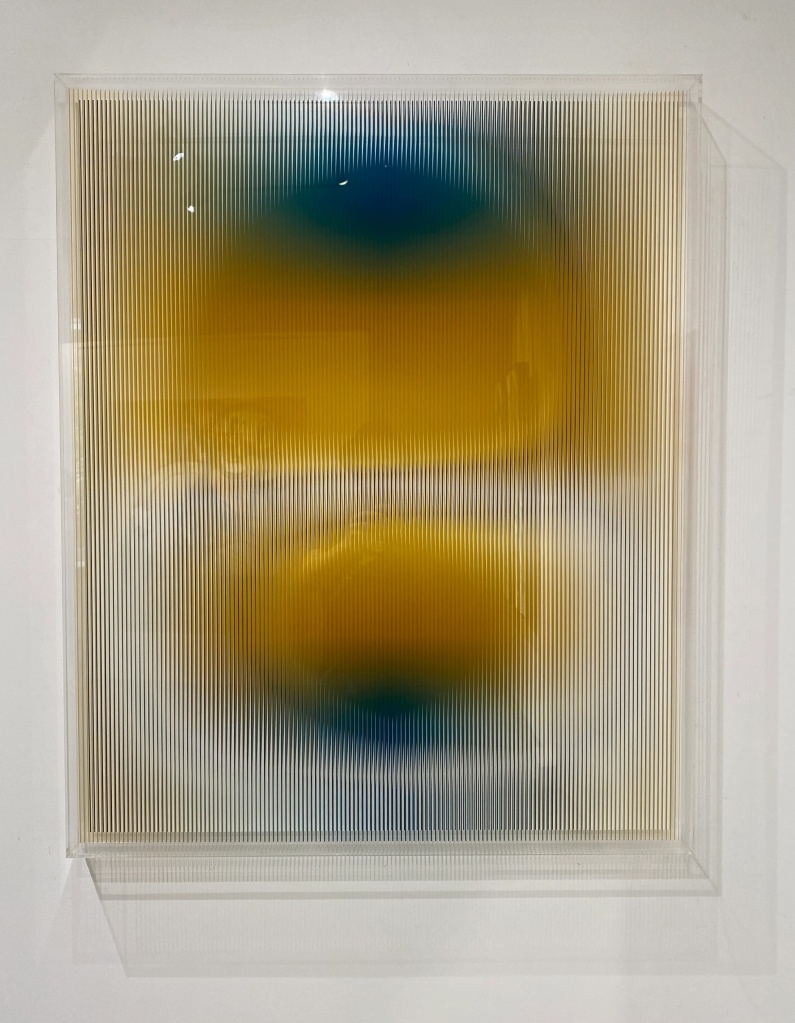
I’ve also collected some glass- a lot of it actually- and doing what can only be described at this point as experiments with different paint applications, mostly with a high level of transparency. In addition to developing ideas about material reuse (which relates to the project above) the substrate relates to my interest in the Light and Space movement. Part of the “work” (I hope) will “exist” on the wall as reflected light. I also really like the contradiction of making the paint both more physical- that’s all there is, right there on the glass- while simultaneously undermining the same via transparency. Lots of iterations to do and decisions to make, including how (technically) to photograph any finished work.
Two Coats of Paint recently posted an article on “negative criticism” that was a response to an article of similar name by Sean Tatol in The Point. There are several good takes in the Two Coats article (Laurie goes straight to the point by noting that Galleries aren’t going to advertise in art rags that criticize their stable of talent) and I encourage you all to read (or use the “listen” option) Tatol’s article in The Point. In particular, this bit stood out to me:
“Once we make any judgment at all we are aspiring to be objective, or at least correct, to the best of our knowledge. This objectivity may not be fully achievable, but if we are to think critically, or at all, the attempt is necessary. It is plainly impossible to approach the world without making judgments: anything from choosing friends you can trust to picking out a ripe orange requires a differentiation of qualities we learn to recognize through experience. Art and media are no different. “
Tatol
I prefer the word “evaluation” to judgement, although denotatively they are apparently completely synonymous. For me the latter (culturally) implies an additional step which can be a bit more fraught. Said differently, I’d personally rather be described as “evaluating” than “being judge-y” fwiw.
I’ve since been thinking about the ideas in Mr Tatol’s piece in the context of another, recent article by Adrienne LaFrance, executive editor at the Atlantic. In Defense of Humanity is a short essay (link is a pdf) on the moment in which we find ourselves. Specifically Ms LaFrance points at the thing- a precipice looking onto a future where AI can and will shape an increasing amount of our lives. She points towards the transcendentalist movement as a way of anchoring readers to the idea that there was (is?) a theory of culture that elevates and centers a life of evaluation.
A future in which overconfident machines seem to hold the answers to all of life’s cosmic questions is not only dangerously misguided, but takes away that which makes us human. In an age of anger, and snap reactions, and seemingly all-knowing AI, we should put more emphasis on contemplation as a way of being.
LaFrance
“More emphasis on contemplation” is clearly what caught this author’s eye. And while I sense that Ms LaFrance would probably agree that contemplation of a painting has similar value personally and culturally she’s clearly referring to thinking- the contemplation of a language-based idea.
To finish loosely tying the two articles together here*, I’m seeing two distinct authors pointing, in the same cultural moment, to the relevance and in fact value of contemplation and evaluation. I would go further and say that it sure seems like they would agree that looking at Art has a cultural importance today that perhaps it hasn’t had in some time and for which we should be grateful (*it is for you, the reader of this article, to chose- or chose not to- evaluate this idea on its merits though).























 Painting After Art is Dead