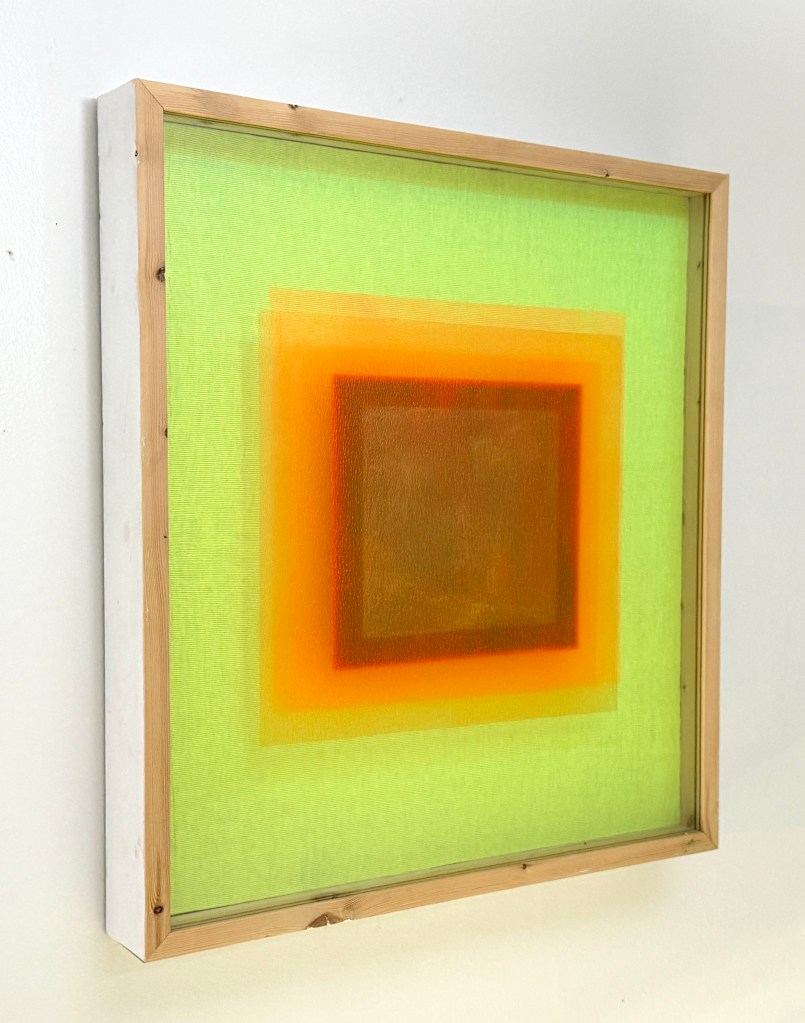
Chieko Murasugi is a painter and textile artist who was born in Tokyo, raised in Toronto, and lived in San Francisco for 20 years before moving to the Triangle in 2012. She has exhibited her work nationally in galleries and museums including the Weatherspoon, Mint, CAM Raleigh, and Ackland Museums. Murasugi works across painting, textile, and mixed media. Her choices of material and process carry history- both personal biography and American history- filtered through a transpacific lens. These histories enter her practice and work through charged references: cheesecloth, which was used to wrap napalm in WWII firebombs; nori (seaweed); childhood diary pages; and paper silhouettes of Samurai weapons and armor.
One element of Murasugi’s practice which those of us who follow her will note is how chance and intention are held in balance. I had the pleasure to sit down with Murasugi recently and talk about these concepts, as well as where she sees her practice today, in the context of her recent mid-career retrospective, Shaping Chance. The exhibit is hosted by Greenhill Center for NC Art in Greensboro, NC. The center is located downtown at 200 N Davie St and has open hours Tuesday through Saturday.
Please visit the exhibit if you have not already- it will remain up until June 27.
Sterling Bowen
Do you remember the moment you realized you were an artist?
Chieko Murasugi
I’ve been kind of skirting it all of my life. When I was moving my parents, I found a note from my kindergarten teacher who said my favorite tool was the paintbrush. I thought that was interesting because it wasn’t the crayon, it was painting, not drawing. Something about moving paint around… I like the juiciness, I think.
SB
It’s a very painterly way to describe the attraction of paint- juiciness.
CM
I remember Chuck Close saying that paint is just colored mud, and, since the beginning of time, people have been moving colored mud around.
SB
I would imagine grad school was an important experience. How did academia shape you?
CM
I had a studio at Golden Belt Studios and they would offer three months free residencies to recent graduates, and most of them were from UNC. It was a really exciting time, to go chat with them. Not only was their art interesting, but the way they talked about it… I wanted to be able to talk about my work like that, I really wanted to be in that program (UNC).
SB
When I came into the retrospective, I went straight to your (MFA) thesis work. After reading the wall text for that series, I couldn’t not see footprints in soot in some of the marks that you used. I was wondering if that was the first time you were working through your parents’ story of surviving the Tokyo Fire bombing?
CM
I think it was actually. That was partly art school, finding content that is unique to the artist- what about their history or interests is unique. Research is really interesting to me. I started using Nori, which you see in the Ikebana series, because I was reading through my adolescent diaries. There was one page where I wrote, “my friend came over after school, and my mother was eating nori; my friend was so shocked that my mother was eating black paper.” I told that story in one of my critiques, and one of the other students said, “well, why don’t you use it as black paper (which I did)?” Then I discovered that Nori was first cultivated at the mouth of the Sumita River, which is the river that runs through Tokyo, which saved my parents’ lives.

SB
Tying your work back to things that have a long history, the piece that struck me the most from Ikebana was #12. I see Cy Twombly– something about that shape reminded me of the way that he would approach flowers. I was thinking about (Twombly) dealing with “the Ancient,” as a way of talking or thinking about longing. You talk about… ancient might not be the right word, but you’re referencing traditions that are hundreds, if not thousands, of years old. That piece resonated for me with the same sense of casting back into time.
CM
I think that members of the diaspora probably all have this longing because they’re not quite at home, but they don’t know their home. In my case, it was just my parents who came here, no other relatives. So there was always this longing for my tribe. The Japanese who were there were the ones who came in the late part of the 19th century, and who were incarcerated during the war. These Japanese people had a real sense of community and a shared experience. My parents didn’t have a shared history with anyone- we were culturally isolated. I thought about that in the Rochambo series. The black was the void of time and memory, and I used shapes that were referencing Samurai artifacts explicitly. I wanted to know my ancestors, I wanted to grasp their history.
SB
The first time I saw one of your artworks was one of the Rochambo series, in the Art On Paper show (at the Weatherspoon Museum). You were reusing a lot of materials at that point. There is some work in the Greenhill show as well where you are using collage. A comment in the wall text about that period which caught my eye was “the elusive nature of reality.” That turn of phrase really stuck with me. You could have said “reality is elusive,” but then it would be about cognition. But when you say “the nature of reality is elusive,” it means that, by default, we can’t catch or understand reality. Was that what you were trying to get at?

CM
That’s why I have the illusions, the spatial illusions, because you think you understand something and then you realize, there’s another way of looking at it. I was talking about the elusiveness of reality, how it’s hard to understand the truth, in the sense that life seems complicated because we can’t control what happens to us. Our free will has nothing to do with chance, with random events. We’re bombarded with them all the time. I get very pessimistic sometimes, especially with the political situation (in the US). People cannot agree on even simple things…
SB
I feel like we’ve moved into a world where everything is a binary. Maybe what we need is more complexity?
CM
(The artist) Julie Mehretu just gave a commencement address, and that’s exactly what she said. Artists can hold different ideas and somehow make them work together, even if they’re opposites. And that’s what, as humans, we have to do. We have to take a world that is so complex, and has so many contradictions, and make some kind of coherence.
SB
Shifting back to the Greenhill show- the wall texts identify a stage in your practice as “Playing with Chance.” It implies that you were still making some intuitive choices. I think of your newer work that utilizes randomization as having very little, if any, opportunity for playing. It’s very… not passionless, but very serious.
CM
In terms of actual parameters, choices like orientation and placement, those were randomly determined. There were no “intuitive” elements; my newest works are just compositionally different, more grid-like.

SB
Abstraction is often viewed as very dry, so there’s a nice synergy there, between what you’re trying to accomplish and the media you’ve chosen. Making paintings about chance, which relates to this experience that random things can have huge impacts which none of us can understand… that’s very heavy, but making it by hand makes it human. I wonder if that actually softens it a little bit?
CM
Definitely. What seems like a sort of a sterile scientific exercise, when you see the irregularities in the brush strokes, you see the bumpy edges and so on, it brings it to the human domain from the abstract.
SB
I want to come back to the story about your kindergarten teacher saying that you loved paint. In your show at Craven Allen– the one with Renzo Ortega– there was a question during the artist talk you and Renzo did. Someone asked if the color choices are created via a randomization tool on a computer, why paint them?
CM
Rather than print them or something?
SB
Right. And your answer at the time was that you love painting. I’m just wondering about choosing your medium. Is it a distinct choice from choosing what your content is. You could have printed them. Is there a separation in your mind, to make the choice of your materials based on your affinity for them…
CM
It’s absolutely content driven. The kimonos are the most narrative, they’re the most political because I find that fabric and materials have their own voice, have their own history, their own stories. I think for me, for political viewpoints or for storytelling or narratives, textiles is where I do that. With paint, that’s when I can focus on abstract ideas, because paint itself is neutral. It doesn’t have a “voice.” I express different ideas and thoughts and feelings with different media.
SB
(Speaking of media choice), in the Shiro Kuro series, what stuck in my mind was the image (from the wall text) of glistening rabbit glue. I couldn’t get the image of the jelly-wrapped cheesecloth being put into those cylinders out of my head. It made me wonder how important the description of the rabbit glue is, of having that wall text there.
CM
It has to be there. Without the wall text, it’s really just a black and white abstract piece. And if it works formally, that’s fine. But for me as the artist, I want to say to the world that there is a reason I’m using these materials, and, this is the reason.
SB
I always wonder with abstraction that has a strong level of symbolism, like the In Loving Memory works- what is the relationship of words to the work. I think it would be a disservice to those paintings for someone to think that there was a codex to decipher them and understand your relationship with your mother. Is there room for mystery and feelings (in the abstract)?
CM
The three pieces I did for that CAM show have the most “representational” narrative of work that I’ve done. In those paintings, a lot of the forms just came, just emerged. Many times I didn’t know why. When I made the one on the icy ocean (Touches), I was looking at the horizon. There are two holes, and the horizon is flipped on one side, so the sky is on the bottom. When I made that, I didn’t want to make the obvious decision so I flipped it to be clever. But when I was looking at it the other day, I thought, this is how it must have felt for my mother to come to Canada. It’s like the world turned upside down.

SB
One of the works (in the Greenhill show) that jumped out to me was How’s Your Appetite? It’s a funny title. I assume it’s because there’s all these little “Pac Man” characters that are running around. Not that it isn’t a rigorous piece, but I’m wondering if you were feeling a draw to balance seriousness; I think your personality is often very serious.
CM
It’s very serious. So I try to lighten it up, with color. I think that Hippie Dreams is kind of a funny..
SB
Hippie dreams is kind of light, but I feel like it’s a sucker punch as well. “Hippie dreams” is an insult coming from some corners. It’s a very serious piece to start (the exhibit) with. It draws you in with the color, but then it’s deceptive, it’s like, oh, wow- it’s all unraveling!
CM
I like to draw people in with color or composition and (have them) say, “oh, this is so pleasing!” and then “what is this thing?” I really miss that in contemporary art; it’s so driven by social media, it’s high impact. You scroll through and you get the impact and you go on. I don’t like that. I really like to draw people in and have them come closer, look at it, think about it.
I really like to make people think.

Leave a Reply