Inspired by reading the unabridged story of how Jane Cheek became an installation artist and having the special privilege of hanging out in her studio for a couple hours one afternoon recently, I’ve decided to practice sincere flattery.

Like many of you reading this, I was one of those creative kids (I’ve hinted at what I see as the psychological benefits of my particular childhood before over on my IG feed). Although I grew up taking art lessons and enjoying drawing, the first time I fell in love with painting- I should clarify, “abstract painting”- was senior year of high school. Up in the attic of my parents house I found one of Pop’s old stretchers from his undergraduate days (art minor), around which I wrapped a bed sheet I think. I went at it with a bunch of old house paint and something about the challenge of making an image without relying on naturalism captured me almost instantly.

I continued to try my hand with no outside direction into my first year of undergrad at the University of Charlotte. Probably not surprisingly- given my affinity for implying space using isometric cubes- I started down my college path in architecture school. I soon tired because I felt I didn’t want clients telling me what to do (yeah, it sounds pretty childish to me now, too) and switched to fine art. I signed up for an intermediate level class on abstract painting second semester Sophomore year and quickly found out that our library had hundreds of monographs on artists who also worked in this vein (let’s be honest- many of us grew up knowing abstract painting was a “thing” but couldn’t name a single practitioner). I was drawn to the Abstract Expressionists first and sort of worked my way forward to what was happening while I was in undergrad (for me, it was mostly about the likes of Lydia Dona, Fabian Marcaccio, David Reed and Jonathan Lasker– the biggest survey of the era in which I was schooled was/is Conceptual Abstraction).
This was the time in my life when the young, idealistic me became an Artist- a love of making was cemented as well as my predisposition to making what at the time I would have called serious work. I quickly went from small scale studies in my dorm room to 4’x8′ and sometimes larger, much to the chagrin of my professors (undergrad studio space was limited).

The 90s weren’t a bad or great time to be making abstract painting- painters still got their fair share of Artforum covers– and I felt like being an outsider inside the little Art world which was outside the real world was just fine. Rebelling against the rebels and all that. I was still recovering from being raised MAGA so I’m sure that played into it. All the above is to say that a) I am and mostly have always been drawn to paintings that would be called non-objective, abstract, or formalist and b) I recognize, due to academic training, that the idiom I wield is part of a tradition that grew out of Western painting.
Like all serious undergrads, I elected to try grad school too, of course, and started at the University of Houston in the Fall of 1998. In the middle of second year (of a three year program) I began to notice my lack of concern for the academic art world, and at that moment, fighting thousands of other MFAs for a limited number of opportunities to hang around a caste of characters who I almost entirely found boorish. I immediately took time off from grad school and began working odd jobs and making small op-art pieces based on my love of color field/op art practitioners and a Hannah Barbara pallet. I had some success with a couple of new galleries in the Houston market.

Life happened quickly after that, in the form of a first child in 2001, followed by officially exiting the grad program prior to receiving an MFA. I had been staying home to raise our first kid, an experience that changed who I am as a human, and found when attempting to reenter the program that grad schools expect full time commitments, which doesn’t allow for working parents with kids- ooops for diversity… A reevaluation of our life goals lead to a move back home to North Carolina in 2003, which was a starting over for us in almost every way.
After the move, I painted some- at first. My energy and focus was centered on trying to find work in clean energy, thanks to the influence of the book Natural Capitalism, which did eventually become my profession. My desire to make art began to dim to the point that, sometime in 2009, after not painting any if at all for several years, I gave all my paint and brushes/knives to a colleague (insert a chunk of years where I spend zero time trying to be or even describing myself as an artist).
Fast forward to 2016 (I generally tell people at this point I had been not-an-artist for about a decade). A couple of things happened that created a situation and elicited a reaction from me that my parent’s generation would have called a mid life crisis (I was 41 at the time). Within about a six month period, our eldest’s depression reached a point where he needed a massive ramp-up in resources including a couple of stints in short-term, resident psychiatric care, and I was let go by my employer on the same day our general contractor started a six-figure renovation of our home that would require us moving out for six months. I do want the reader to know how grateful I am for the people I had around me at the time (and still do, especially Jessica Bowen, my amazing and talented spouse of 27 years, who also blogs) which enabled me to be there for our son, who survived depression because of music. And, this was a challenging time emotionally that made me rethink my priorities and objectives for life (like I said, midlife “crisis”).

Around this time I started taking photos of clouds- we were having a really wet June in North Carolina, and a side benefit of all the thunderstorms was that some of the cloud formations were pretty amazing. The primary reason was the brief but material calm it gave me to focus on a moment of wonder- to contemplate (and also the take advantage of the chance I had to make a choice- words/ideas/themes that are still within my practice today). This activity morphed into a regular (wait for it) practice. I thought of these snaps as sketches, compositions of shapes and lines, often with color as an important element. I fired up an Instagram account and began to share them with my social circle (which, again, didn’t include Artists since I wasn’t one). With my final #abstractionallaroundus post on my old IG feed, I wrote what can only be described as an artist statement that hinted at my interest in automatism (yes, we’re getting to installation art, I promise).

By 2017 my re-blossoming creativity had morphed into making drawings and paintings, too, first on scrap cardboard and eventually on canvas, and which were based on a system of automatic drawing utilizing interconnected cubes, which readers will recognize, and which had actually surfaced towards the end of my time at the University of Houston. Rebooting was the easiest place to start and in retrospect given how it has sustained me, a good decision. As I made more, I sought out the input of other creatives, and ended up joining an Artist affinity/crit group through an art venue cum artist incubator that at the time was Visual Art Exchange in Raleigh (now known at VAE and which has a different and improved mission). I still f&ck with the cats I met through VAE today; community is one of the best parts of being an artist. Also and, regular crits are important (to give and receive), try to fit it into your practice.
How does this relate to being an installation artist (and yes I still do and will always paint)? In one of these crits in very early 2020*, someone made an observation that the paintings I was making at the time didn’t have any clear source of light or relation to gravity. It’s sort of amazing what comments you hear- both as an artist and also in life in general- that will really hit home for you. This one did, and I spent the next couple of days thinking about light and gravity and wondering if it the best way to incorporate those concepts wouldn’t be to just make physical cubes. We all see what the answer was/is.
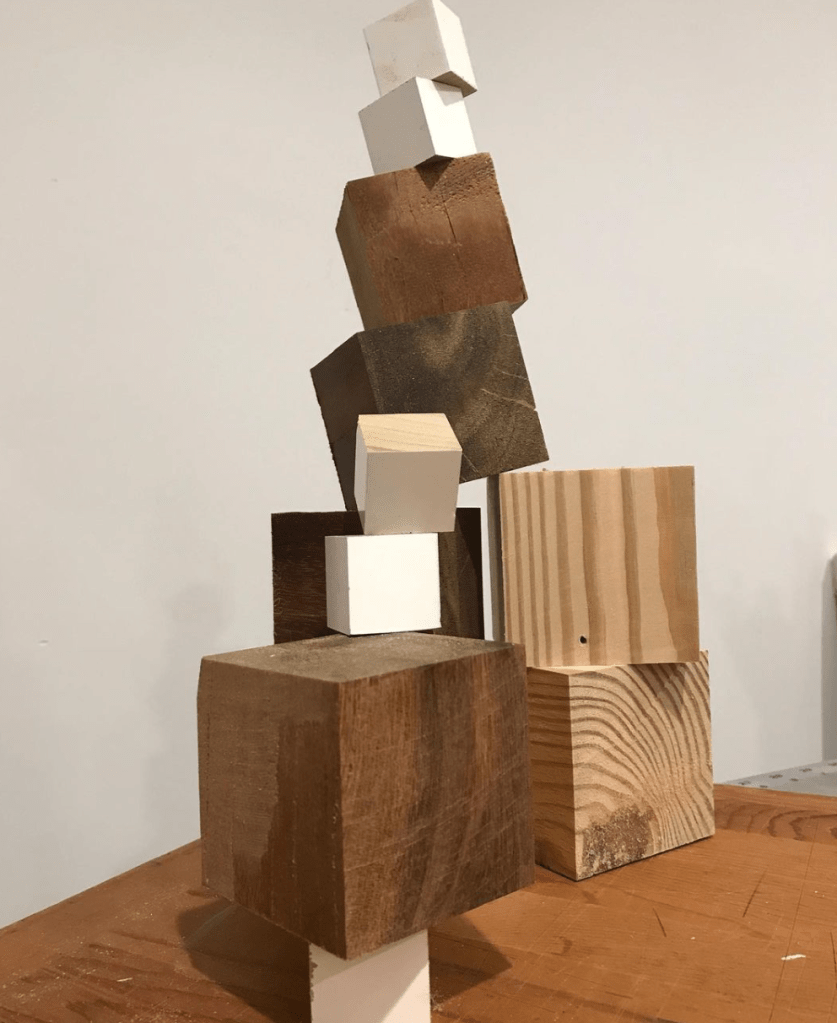
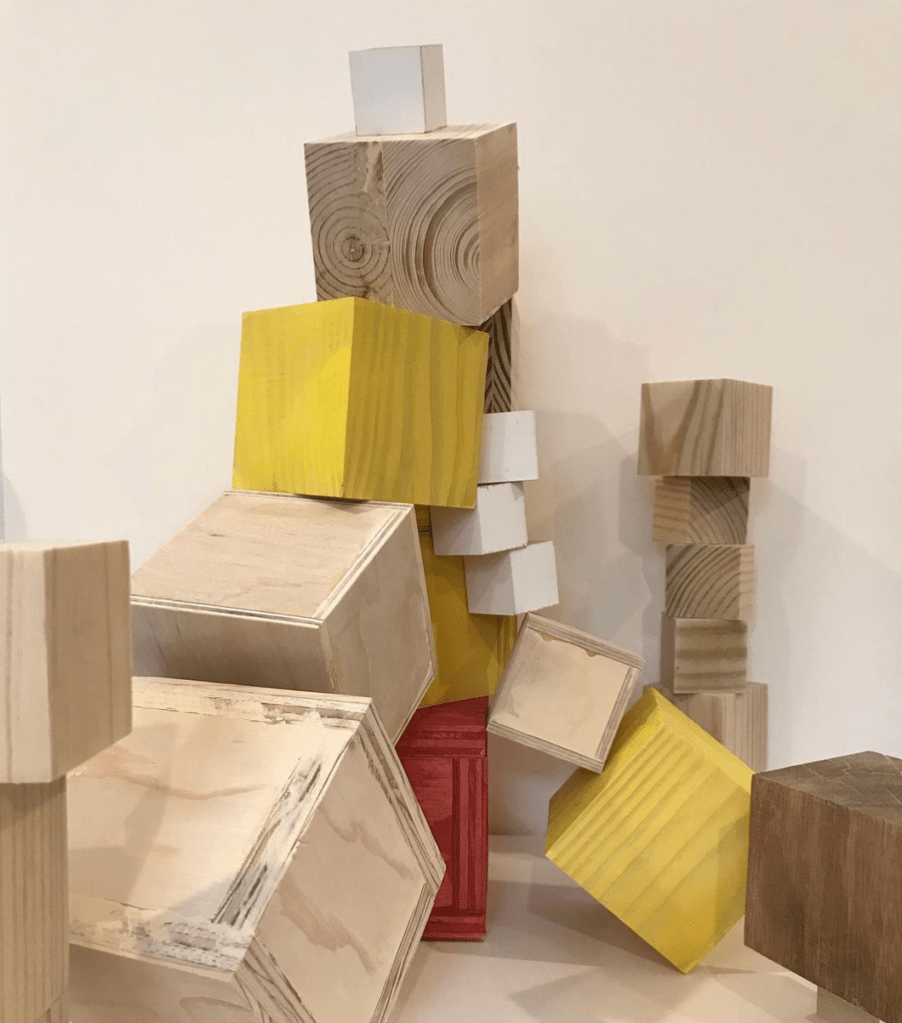


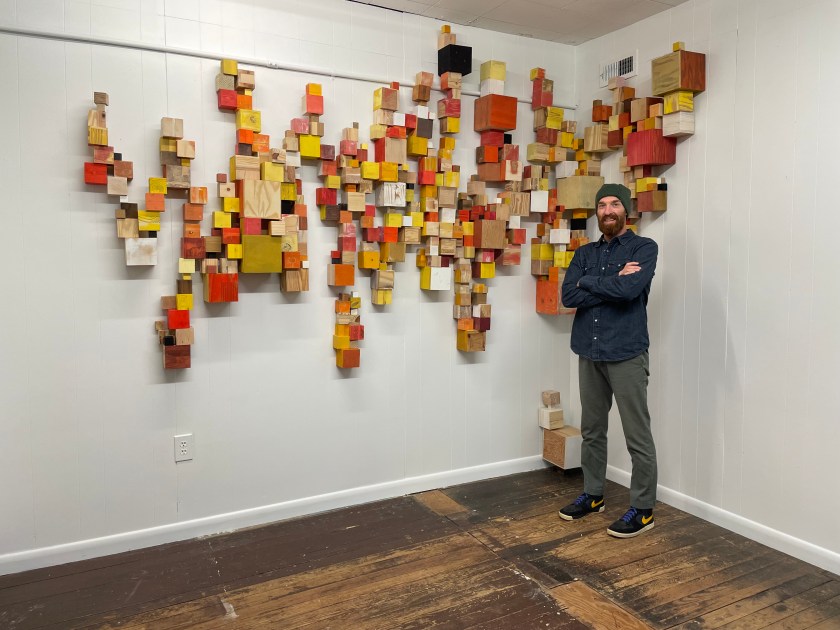
Early iterations are above. *I’m sure the reader will also note the context of the year in reference, so for me, the pandemic all of sudden became a time to make objects- eventually, a lot of them. This project has become a work in and of itself, that I’ve now shown in a number of iterations and look forward to installing this April at Art Fields art fair in South Carolina. I’ve written about the integration of this physical and always temporary manifestation of automatism into my practice often, and am grateful for the addition of this modality to my practice. It is a way for me to more clearly incorporate the theme of contemplation (for the audience) by centering a time element- no composition or presentation is ever repeated exactly the same, and their creation is very chance-dependent (they are never planned other than location). The nod to early Modernism via the cube is still present and perhaps even stronger since, even though the surfaces stand in for impasto and, given color, each cube can be thought of as a brush stroke, they are more clearly cubes than the painted compositions. I appreciate everyone in the local community who has supported this project!

 Painting After Art is Dead
2 thoughts on “My Backstory”